


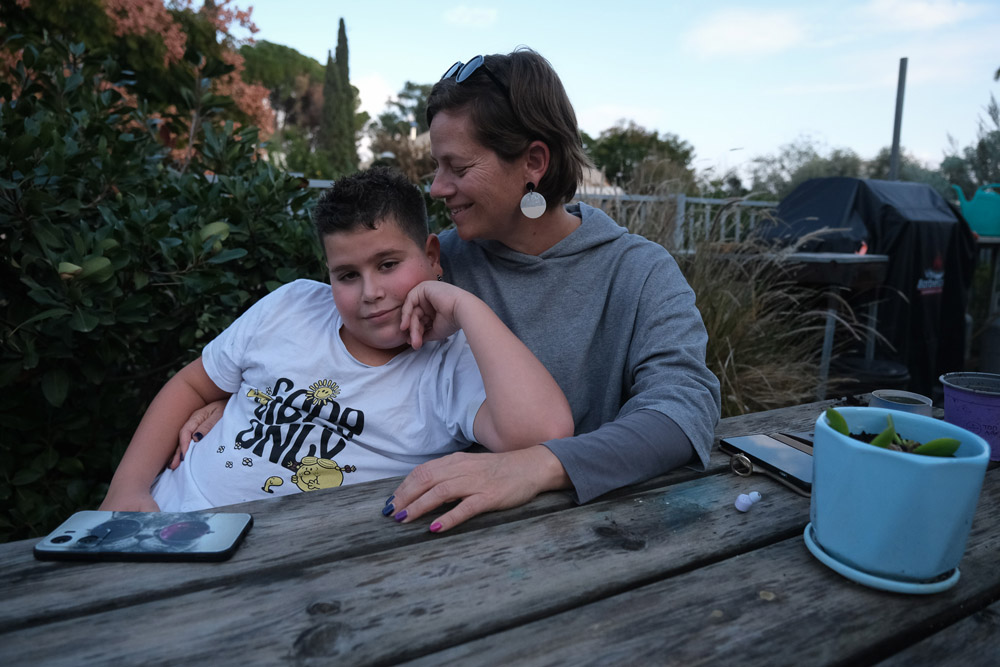
In the wake of the cease-fire between Israel and Hezbollah achieved late last month, Israelis from the north are heading back home and figuring out next steps, even as the state has yet to present a plan for the return of the evacuated communities. Those who have returned are both excited to be home and all too aware of the challenges that remain.
In Kibbutz HaGoshrim, less than two miles from the border with Lebanon, resident Ruthie Kalvari is excited for one of the small luxuries of cease-fire life: taking a long shower. “I can’t believe it. It’s not sinking in,” she told Davar. “I don’t have to be on constant high-alert. I’m not having to watch the sky for missiles and drones. I don’t have to be ready to run to the shelter at any moment.”
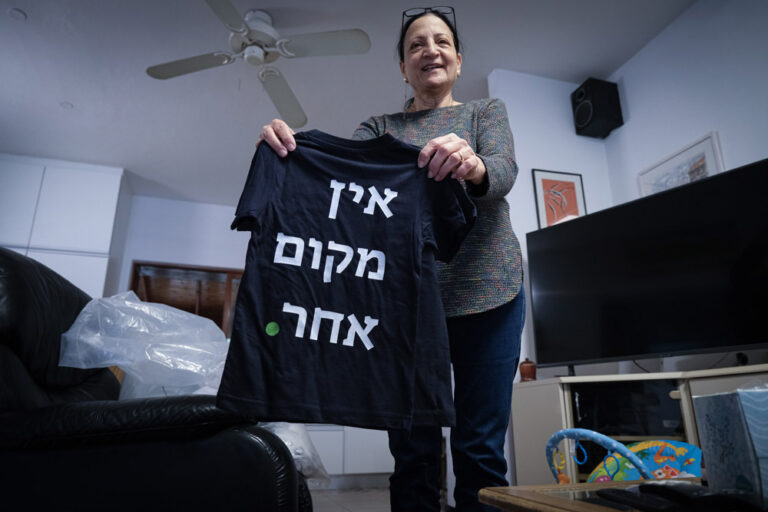
HaGoshrim was one of the kibbutzim evacuated as soon as the war began, but several hundred residents had already returned to the kibbutz when the cease-fire was achieved. On the second day of relative quiet, Kalvari and her friends went door to door in all 400 houses on the kibbutz, leaving a small note on each house that read, “It’s good to have you home, please let us know you’ve arrived.”
Kalvari described the cease-fire as a controversial issue in the community. “I can’t say whether the cease-fire is good or bad in the long run, but I’m giving it a chance,” she said. “For a year and two months, everything was frozen. They shoot, we shoot back. But I think the other side has an interest in ending it. They have also paid a heavy price.”

Eighth-graders Noa Gofer and Yael Hevlin recently returned to the kibbutz with their families, but they’re not sure whether the cease-fire will last.
“On WhatsApp I see that my friends are starting to plan to return here,” Gofer said. “If only their parents would relax a little.”
Both girls agree that the parents are the ones who are really stressed out in this whole war story, and if it were up to the children, most of them would have returned to the northern kibbutz a long time ago. “The children get used to it quickly,” agreed Kalvari. “For them, the war is over.”

Kalvari has lived and taught in northern Israel for years. She has one grandson who was born during the war and spent most of his time on the kibbutz and other grandchildren who were evacuated. As stressful as life on the kibbutz during wartime was, life as an evacuee brought its own challenges.
“At the evacuation center, one of my grandchildren told me that he’s not in a hurry to make new friends, because every time you go to a different place,” she said. “Look at what the kids’ last year was like. They swam in the Sea of Galilee for most of the year. That’s good and healthy—but it’s not studying. There will be long-term consequences for a year and a half of living away from home.”
In Kibbutz Dafna, just northwest of HaGoshrim, there’s a similar ambivalence about the cease-fire.
“I really don’t know if I’m happy about it all,” kibbutz member Orit Parag, who returned to Dafna in June despite the ongoing war, said. “I’m doubtful. Is this supposed to be enough? To bring peace?”
She said that the real motivation for the cease-fire was likely the self-interest of Prime Minister Benjamin Netanyahu. The 1,100 members of the kibbutz each have their own opinion on the matter. “This is not the ideological, lefty kibbutz of old. There are also those of us who think that we should return only after we have eradicated everyone on the other side,” Parag said.

“When I walk around here in the desolate, empty streets of Dafna, I understand that the government is not interested in bringing us back. We are negligible to them. And our response to this negligence should be to simply persist. This is our home,” Parag said.
Her three children all plan to return to the kibbutz from which they were evacuated. The house of one son was damaged by shelling, but that doesn’t deter them. “It’s already something that’s screwed up in our DNA. A kind of genetic fearlessness,” she said.
Parag had distanced herself from the kibbutz over the past years, but the war pushed her to become involved again. She spent recent months leading kibbutz gatherings both in evacuation centers and on the kibbutz and discussing how the return home should look.

“The difficult question is of the people: we have had a lot of conflicts that have erupted within the community due to the tensions of the past year,” she said. “And then there’s the question of safety and real stability. On the one hand, I fear that militant rage towards Israel will erupt even more violently when we return. On the other hand, I have a tremendous desire for community.”
To the southeast of Kibbutz HaGoshrim and Kibbutz Dafna sits Moshav Beit Hillel, home to the Kurlander dairy farm. Even among the Kurlander family, opinions about the cease-fire are varied.
“Of course I’m in favor of the cease-fire,” Yahel Kurlander said, explaining that the military couldn’t have expected to achieve anything more than what it accomplished.
Her cousin, Tzachi, disagrees. “We’re left without a border. Without a buffer,” he said.
“Without a buffer zone, you won’t be able to tell what's happening up on the mountain, and certainly not down in the tunnel,” Tzachi’s friend Ohad Shitrit added.
Danny Shahar, one of the veteran security personnel in Beit Hillel, decided to return to the moshav for good days after the cease-fire was achieved. “I’m happy about the cease-fire, but you know, I have no expectations from the government, and you know what, not from the army either,” he said. “All these years they knew about the tunnels and the quantities of weapons and didn’t say a word.”
Kurlander, a well-known activist in the area, said that the cease-fire changes everything and nothing at the same time. “The government is completely unreliable,” she said. “They reopen a bank, great. But for how long? They announce that the education system is closing again an hour before midnight. What do we have to build on?”
The moshav leadership is asking residents not to come back yet. “I have a neighbor with a child who still isn’t ready to come back to the moshav,” Kurlander said. “She doesn't understand why she would exactly, and she is absolutely right. We don’t have a date for returning. There is not even time to gather for the return.”
Alongside northern Route 99, deserted by civilians for more than a year, young people gather for breakfast and are in awe of all the cars passing by. “I even managed to be stuck in traffic here for a few seconds," Tali, who left her temporary home in Tel Aviv for a day in the north, said. “Look at all the cars—it’s like a vacation for evacuees.”
Up Highway 9972 toward Kibbutz Ma’ayan Baruch, almost the northernmost point in the area, one can see Mount Hermon, Nimrod Fortress, and the base of Mount Dov in the distance. That’s where intense fighting has been going on for the past year, and where it’s continued, despite the ceasefire.
“We need to understand that even during the cease-fire and afterwards, not all the people who were here will come home,” Ortal Bari, a third-generation resident of Kibbutz Maayan Baruch and director of the Upper Galilee Regional Council’s Growth and Community Department, said. “I think a third of the residents who were evacuated will not return. The cease-fire is the beginning of a fragile stay. By the end of September, trust had been completely shattered. We were sure that we would be caught in this cycle of exchanging fire forever. The ground entry left us with expectations, and now, perhaps, this is the beginning of rebuilding. This is another stage in the trust-building process.”
Kibbutz members have become skilled in making decisions while the reality remains uncertain, Bari said. She noted that the council is currently working on developing rehabilitation plans and attracting residents as well as building the platforms necessary for enabling renewed growth and prosperity.
Cars are entering the kibbutz again, a sign of dozens of personal and family choices to at least think about returning. At the systemic level, there are still two major issues that have not been resolved: the reconstruction budget of 15 billion shekels (about $4 billion) has not yet been approved, and the state has not set a timetable or goals for the return. Residents say maybe during Passover, or the end of June, or the beginning of the next school year, which will mark two years since the evacuation.
“I tell everyone that the cease-fire is a sign of return for ourselves. It doesn’t say anything about when the state will decide to return us,” Bari said. “Maybe they won’t. But we can try to return to ourselves. And that’s what’s important.”
This article was translated from Hebrew by Etz Greenfeld.