


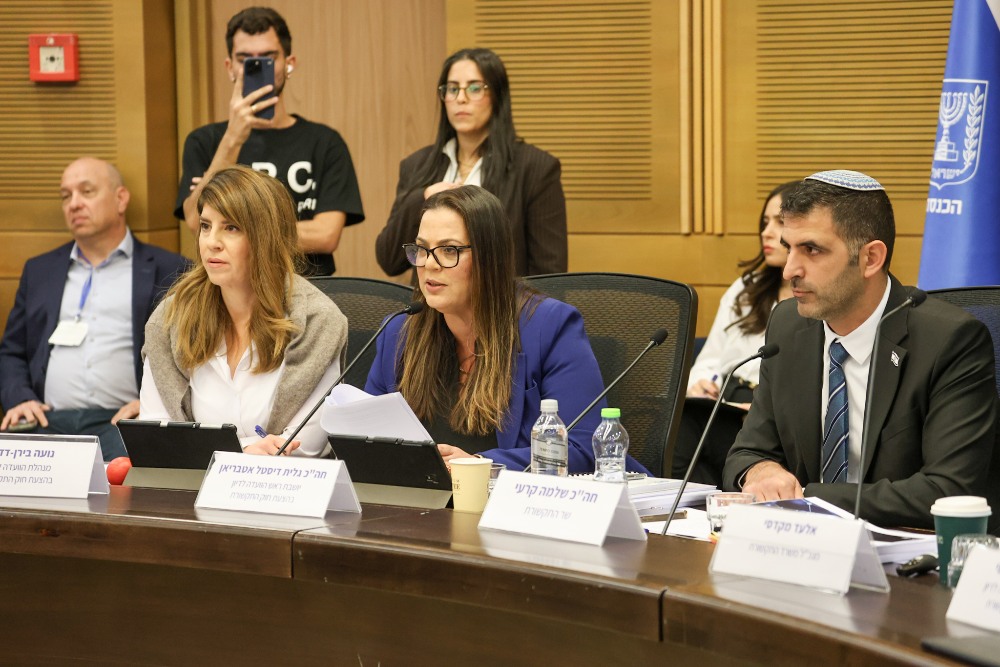
The Knesset's Special Committee for the Discussion of the Communications Bill proposed by Minister of Communications Shlomo Karhi (Likud) held its first meeting on Monday, during which it began preparing the bill for its second and third readings. In the heated discussion, opposition members sharply criticized the law, calling it part of the government's attack on the media, freedom of expression, and democracy. Minister Karhi presented the bill, answered Knesset members' questions about parts of it, and even said that he was open to amending certain sections, but stressed that "he will go through with the reform to the very end."
The bill, which passed its first reading in the Knesset plenum about two weeks ago, introduces a major reform of Israel’s broadcast communications sector — an area whose regulation has not been updated for many years. It eliminates the current regulatory separation between different broadcasting technologies and establishes uniform rules for all forms of broadcasting: over-the-air, cable, satellite, and internet-based streaming platforms, which until now have operated without any regulation. The reform also reduces the obligations placed on licensed media organizations, decreases content oversight, and creates a new supervisory body to replace the existing Second Authority for Television and Radio and the Cable and Satellite Broadcasting Council.
The committee chair, MK Galit Distel-Atbaryan (Likud), praised the bill at the opening of the discussion, contending that this is “a historic law intended to completely change the media landscape." She continues, "My critical opinion of the media is well-known and recognized, and I do not deny it. As someone who comes from the media world, I believe that today the media market is not diverse and does not allow adequate representation for large segments of the population. The media is centralized, monopolistic, and oppressive to the extreme. The media does not reflect reality, not even superficially. The media has created caricatures and removed complexity from the discourse in favor of one hollow and foolish agenda, which is ‘Rak Lo Bibi’ (just not Bibi).” According to her, “Anyone who knows this law is aware that there is no danger of dictatorship on the horizon; the real danger is that this law allows only competition and freedom.”
Communications Minister Karhi argued that the law is a "great breakthrough." He referred to the establishment of a special committee to discuss the law, and not to the discussion in the Finance Committee, whose chairman, David Bitan (Likud), opposed part of it, saying that "the special committee is not a bypass route and is not a legislative blitz. On the contrary, it is the proper parliamentary tool for an in-depth process that the State of Israel has been waiting many years for. The law brings Israel to an open and competitive market: less regulation and fewer barriers, less state intervention, and more freedom for the public."
Minister Karhi added regarding the legislative process of the law that “this is not the Ten Commandments. The Knesset is the place to probe, examine, and improve. The discussions will lead to a smart and precise reform in television, and later also in radio. A special committee is a necessary condition for a major initiative. We will work objectively together with the best professionals in the communications market and bring to Israel an open, competitive, diverse, and truly strong communications market. One thing everyone needs to understand: this reform will not be stopped. Not by guilds, not by monopolies, and not by those who are afraid of the freedom of expression of parts of the public.”
MK Shelly Tal Meron (Yesh Atid) spoke out against the proposed law, addressing Karhi directly: "The opening remarks of the committee chairman are an indictment against the media in Israel. The entire process of establishing the committee, including your selection as the committee chairman, is the pinnacle of the dictatorship whose sole purpose is to take control of the free media market. The entire process of establishing this committee was flawed, and this is only because you want to override the authorized committee chairman to discuss this law. This legislation is anti-democratic. And we will fight and will not allow it to pass."
MK Efrat Rayten (The Democrats) criticized Karhi’s conduct saying, "I listened to the words of the Minister of Communications. On one hand, he says ‘let's discuss here’, on the other hand, he says he won't be stopped and that he will go all the way. So why do this whole process? This entire Knesset has been paralyzed for a sacred purpose, which is the destruction of authorities and part of an attack on democracy and the suppression of the parliamentary opposition."
MK Karine Elharrar (Yesh Atid) commented on the matter saying, "The role of the media is to scrutinize those in power, and that's something you like less. The proposal did not receive the approval of the Government Legal Counsel, nor the approval of the Regulatory Authority, and that's something you also like less. You brought legal counsel to the committee whose area of expertise is not media. Who are you hurting, the opposition? No, you are hurting the public." Elharrar warned that even in Hungary and Poland, which went through a process of weakening democratic institutions, a single authority was established to oversee all media.
MK Gilad Kariv (the Democrats) warned of the longer-term effects of the bill: "There are also good things in this law. However, within this legislation, they have also hidden poison pills. This law politicizes the authority's council. There is a problem with the mechanisms for sanctions and penalties," Kariv said, noting that while the penalties are relative to the channels' revenues, there is no limit on the number of penalties. Kariv also said that “abolishing the obligation of separation in the news sector is unreasonable and it is clear where this will lead us. To speak highly of a law that opens the market but allows cross-ownership contradicts the law's rhetoric.”
Minister Shlomo Karhi responded to the claims raised during the discussion. Regarding the council that will be established, the minister argued that "it is the constitutional anchor of legal advice to the government for the entire reform. The council will be very detached from the minister, there will be no interference in the content, and this is the place to emphasize that." He noted that currently, according to existing law, the minister himself appoints all the members of the Second Authority for Television and Radio.
Regarding the issue of fines, Minister Karhi noted that they will focus only on competition issues and not on content, "for example, a certain channel that discriminates and sells to one provider at a certain price, and to others at a price four times higher. And this only after they were given the opportunity to correct it and they refused, only then will they receive the fine." The minister referred to the regulatory authority and said that it identified one flaw in the law, which is in issues of news supervision, and also that they refused to accompany the legislative process of the law in the Knesset.
Regarding the concern about interference with content, Minister Karhi said that the existing provisions in the law, which prohibit obscene content or content that harms the way of life of a certain public, are there due to the requirement of legal counsel, also exist in the current law, and from his perspective, could have been removed. According to him, he trusts the channels not to broadcast inappropriate content, in which he gave the example of i24news, which is not subject to regulation and has not broadcast inappropriate content, and if there is inappropriate content, there is also criminal law. On the clause prohibiting a channel from being a spokesperson of a party, he said that this is a refinement of the current language which forbids a channel from serving the interests of a party, in part due to claims against Channel 14 as serving right-wing parties.
Director of the Ministry of Communications Elad Makdasi presented the main points of the reform: “The need to adapt regulation in the broadcasting sector to the modern era was identified almost twenty years ago and has been discussed by a series of teams and public committees. All pointed to the need to update regulation in the broadcasting sector. The reform proposes the unification of one council to replace the Cable and Satellite Broadcasting Council and the Second Authority for Television and Radio. We held discussions with the Ministry of Justice, the Ministry of Finance, and the Competition Authority. With the Ministry of Justice, a number of professional disagreements remain, and I will also present the issues in dispute and the various alternatives that have been proposed."
He continues saying, “The existing regulation was established based on technology and applied only to cable and satellite broadcasts. As of 2024, 74% of platform subscribers in Israel receive broadcasts via OTT technology [media distributed via the internet, including streaming services], which is not subject to regulation. Established players are subject to a heavy regulatory burden, while new players are exempt from regulation.”
In addition, Makdasi presented the three principles on which the law was built: technological neutrality, so that the law would apply to everyone; competition and removal of barriers to allow new players to enter the market; and 'zero intervention in content' according to the minister's policy, so that the new authority would have no powers over content but only over the economic aspects of the broadcasting market.