
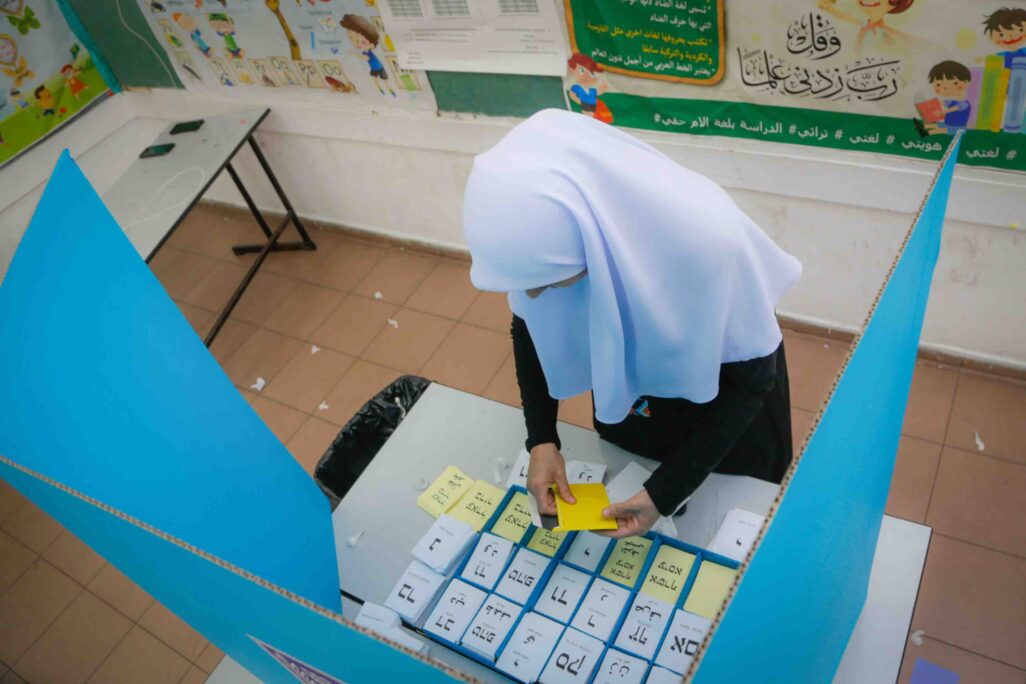
As the election approaches, social activists in Arab society are trying to encourage voter participation amid a bleak public atmosphere and feelings of disappointment and alienation from the political system. They say that political and social realities in recent years have driven some members of the public away from the polls, while for others, they have instead sparked a desire to influence the outcome.
“The current government has so openly abandoned Arab society, and Arab society has suffered greatly,” says Sundus Anabtawi, an activist with the Standing Together movement. According to her, the government’s policies have had a dual, and even contradictory, effect on people’s willingness to participate in elections. “There are many people who don’t want to go out and vote because of the repression they experience. During this period, that has changed — the repression is encouraging people’s desire to go out and vote.”
Anabtawi points to rampant crime, the public atmosphere, Sami Abu Shehadeh’s disqualification from running in the election, and statements by Jewish politicians as factors suppressing the desire to vote. Nevertheless, she believes the situation should not be accepted. “As Arab society, we should not accept this situation as an unavoidable fate. Arab society is deeply disappointed and suffering. It is time for us, as Arab society, to take responsibility for our future. The tool we have at our disposal is to vote and take part in shaping the future.”

However, Anabtawi’s determination often encounters alienation among young Arab citizens. “There are many young people who say, ‘Things aren’t good for us in this country, and we’re not interested in voting right now.’” After dozens of conversations and meetings, she believes that addressing this lack of trust requires deep, sustained work that goes beyond the election period.
“We need to invest in political education so that they understand how important it is for them to go out and vote. I think there are many young people who need this. Young people voting for the first time, if they don’t receive political education at home, probably won’t go out and vote.”
“Nobody Welcomes Us”
“Young people have lost faith in the state institutions,” says Suleiman al-Amour, co-CEO of the organization AJEEC-NISPED, an Arab-Jewish center that works towards peace and equality and economic development. According to him, around 250,000 young Arab citizens are expected to vote for the first or second time. He is frustrated that the political system is not offering them adequate responses to their needs and aspirations.
“No politician is developing a program aimed at them or sending them the message that they have a plan for them — programs for career guidance, academic guidance, and for eradicating crime and violence.”

According to him, this sense of being ignored is compounded by exclusion from the possibility of participating in government. “Young people say, ‘The politicians on the left and centre don’t want us in the government, whether we vote for the Democrats, the Joint List or Ra’am. No matter what we do, nobody accepts us.’”
The Road to the Polling Station Is Also an Obstacle
Alongside the lack of trust in the political system, al-Amour points to practical difficulties that prevent residents from exercising their right to vote, particularly in the unrecognized villages in the Negev. “There is no accessible polling station, no public transport. A large group of people who do not vote are women in the unrecognized villages, because there is no accessibility.”
For some residents, getting to the polling station means giving up hours of work or time devoted to caring for the home and family. These everyday difficulties push voting down the list of priorities, particularly when there is already little faith in its ability to bring about change. “There is an analysis of reality through the management of risks and complexities. The argument is that elections have not helped in the past, have not helped in the present, and probably will not help in the future either.”
")
Residents of the unrecognized villages are assigned to polling stations according to their tribal affiliation, even when the polling station is far from where they live. Al-Amour believes this is a problem that should have been addressed long before the election. “This needs to change,” he says. “This work should have been done two or three years ago. Now it is too late.”
But the sense of alienation he describes does not stem solely from a lack of accessibility or ongoing neglect. Al-Amour also takes issue with the argument that, following the events of 7 October, an Arab party cannot be included in the coalition. He says this argument is particularly infuriating given the price paid by Arab citizens during the war and the efforts made to preserve shared life.
“How is Arab society connected to 7 October? Did we carry out 7 October? Did we plan 7 October? We paid a price in people murdered, taken hostage and wounded. Bedouins risked their lives and went to save Jews. Those affected by Hamas and Iranian missiles were residents of the villages. The political leadership worked overtime to calm the situation, and succeeded. We all wanted to begin building a shared society from a place of responsibility and partnership. This drives young people crazy. How, after doing such a good job during the biggest crisis the country has faced, can we be treated this way?”
Despite his sharp criticism, al-Amour emphasizes that the way to confront the political reality still runs through the ballot box. “Their only way of dealing with it is through elections,” he says, but qualifies this: “It is not a choice between good and bad, it is not a choice between good and very good; it is a choice between bad and less bad.”
“This is the democratic tool in the country, through which a government can be replaced. It is the only thing we have left, where the Arab vote and the Jewish vote are equal. This is the only way to influence the situation. The demand now is mainly of ourselves: ‘Get up and take action, get up and take responsibility.’”