
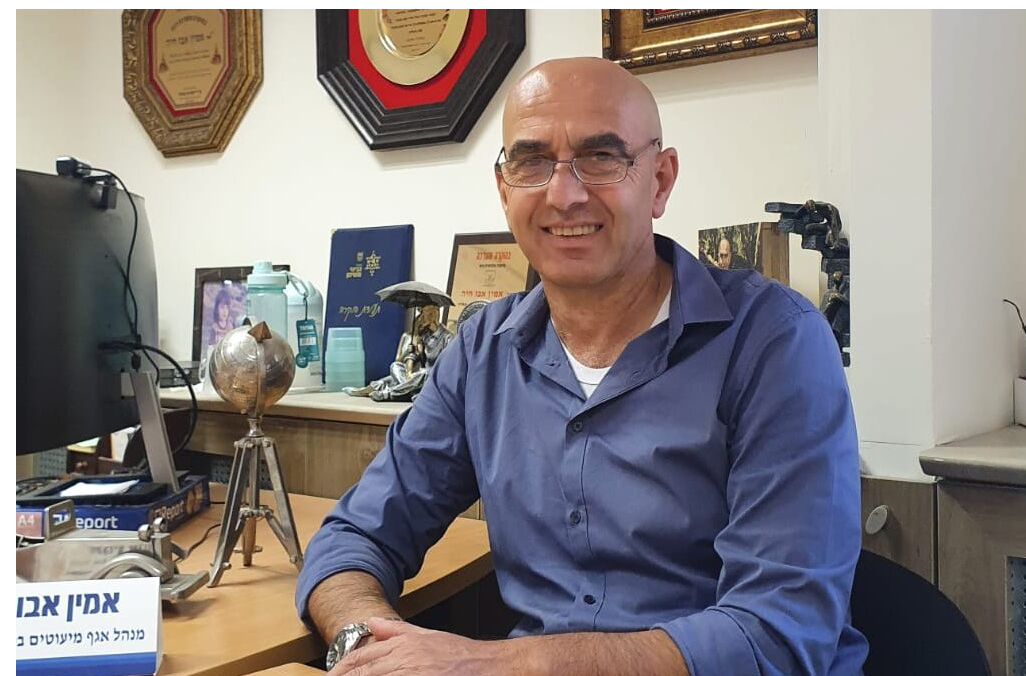
When it comes to the Arab-Israeli community, Amin Abu-Haya is cautiously optimistic.
“I think that we are in a much better place today than in the past,” he says. “There are difficulties in Arab society and the question is how we create opportunities out of them.”
Abu-Haya is the head of the Minorities Division in the Ministry of Construction and Housing. Housing is one of the biggest challenges facing Arab, or Palestinian-Israelis, due to widespread housing shortages, lack of funding and development, land shortages and low interest in public housing.
In an interview with Davar, he exposes the complexities baked into his position: from developing trust between local municipalities and the central government, to advancing joint projects on mostly privately-owned land.
The Minorities Division in the Ministry of Construction and Housing was established in 2017 following Government Resolution 922, the five year plan passed in 2017 allocating 12-15 billion shekels (around 4 billion dollars) for economic development in Israel’s Arab sector. The Division integrates all the professional areas in the Ministry and addresses the Arab, Druze and Circassian localities.
“This is a unique division among the government ministries,” Abu-Haya explained. “Part of the position entails maintaining direct contact with the local governments, mayors, professionals, but we also conduct a serious dialogue with the grassroots and with anyone promoting solutions for the housing shortage in the Arab sector.”
Abu-Haya, who has headed the Division since its establishment, is well aware of the deep distrust towards the Ministry of Housing in particular and the government in general within the Arab community.
“Initially the discourse was limited, there was antagonism,” he said. “People said, ‘who is this Amin guy anyhow? A Druze from the north working in a government ministry – someone must have sent him.’”
However, he is not deterred by the lack of trust, maintaining that it can be regained with hard work. Abu-Haya describes a drastic change in the Ministry, from mostly unplanned construction to constant planning, with much more funding coming in.
“Suddenly, we are saying that we don’t demolish buildings, but rather resolve illegal construction – a statement that isn’t obvious when it is issued by a government ministry,” he said.
“It is difficult to believe us, and that is why you have to convince people that you are coming from a good place and not because of an economic interest,” Abu-Haya continued. “I am well aware that the 50-year gaps cannot be closed in 5 years. Where we were specifically successful had a significant horizontal and general effect.”
The goal: 35 thousand housing units in five years
In hindsight, Abu-Haya thinks that Resolution 922 advanced many things, but also had quite a few problems.
The massive budget allocation allowed the Ministry to invest a great deal in planning and building public buildings. According to him, Ministry planned more than 120,000 housing unit on public and private government lands, which he calls “unparalleled.”
“Up until last year, the budgets were allocated equally based on population size in the locality, but now the allocation is differential,” meaning that the money is divided based on needs, and on responses to calls for proposals issued by the Ministry, Abu-Haya explained. “There are calls for proposals, there is competition, there are available projects. The strong will pull upwards and not the weak downwards. Everyone will compete to move up.”
Abu-Haya credits Housing Minister Ze’ev Elkin with forming new policies that more effectively addressing housing issues as part of Government Resolution 550, or “Takadum” (“Progress” in Arabic), a new five year economic plan for the Arab sector approved in 2021. This new plan provides nearly double the budget as the last plan, allocating 30 billion shekels (around 9.6 billion dollars).
“In Resolution 922, there was 1.2 billion shekels, and here we have 2.1 billion shekels, but it is not only a matter of bringing a larger budget, but also about how to direct the money in a manner which will be relevant,” Abu-Haya said.
“We learned more in-depth about the needs of the entire society, what works well in the Jewish sector that we can take and adapt,” he went on. “We set significant goals – planning an additional 100,000 housing units, and this had to be adapted to current needs. We have a goal of marketing 35,000 housing units on state land over the next five years. There is a current need for 50,000 housing units.”
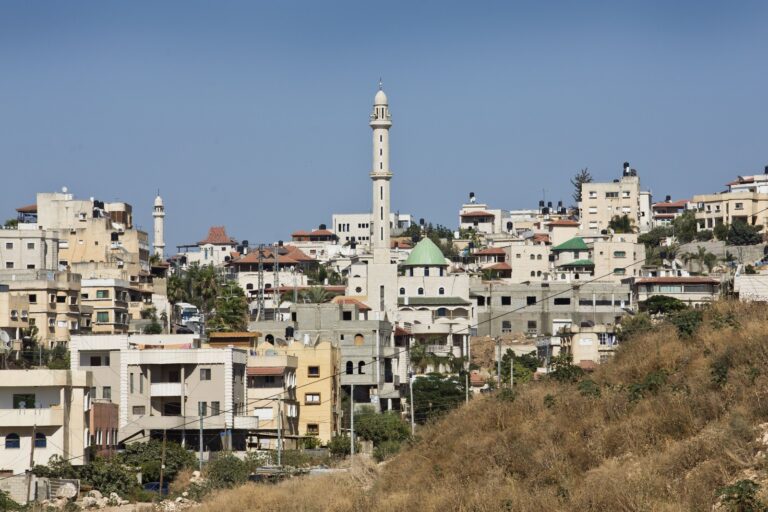
In the large Arab-Israeli towns of Kafr Qassem and Sakhnin, Abu-Haya took an 100-year old complex in the city center, and initiated significant urban renewal processes, a first in the Arab sector. The finished complex included a multi-story building and huge parking lots, as well as commercial spaces and public parks, similar to the neighboring Jewish city of Kfar Saba.
Abu-Haya laid out three major challenges when it comes to housing in the Arab sector: “Private land and its development, allocating land for the public use that is owned by the municipality, and a housing solution for people who evacuate their homes,” he said. “The need for a public space leads to a difficult discourse with the Israel Land Authority. We demand land allocation and they demand land expropriation”.
“Less than 30% [of the population] control more than 70% of the land”
Less than 10% of Arab citizens rent an apartment. The Ministry of Construction and Housing recently decided to introduce a long-term rental model into the Arab localities.
“I rent an apartment in Jerusalem because I have to live near my place of work. This the case for the majority of Jewish society, but it is different in Arab society,” Abu-Haya explained. “A resident of Sakhnin will not move to Kafr Qassem because of academia. It doesn’t interest him. He will move to Tel Aviv before he moves to Kafr Qassem. But the son in Kafr Qassem will want to live in Kafr Qassem, near his family.”
The potential renters are, on the one hand, people of a stronger socio-economic background who slowly build their homes and improve them, a very small market according to Abu-Haya. And on the other hand, there is the more disadvantaged population.
“In Jisr az-Zarka, one of the poorest localities in Israel, the people’s situation is so difficult that they cannot take out a mortgage, they do not have parents who can support them,” he said. “Everyone is in the same predicament, and in most cases will not be able to buy a house. I am trying to build two complexes there for long-term rental, particularly for these people.”
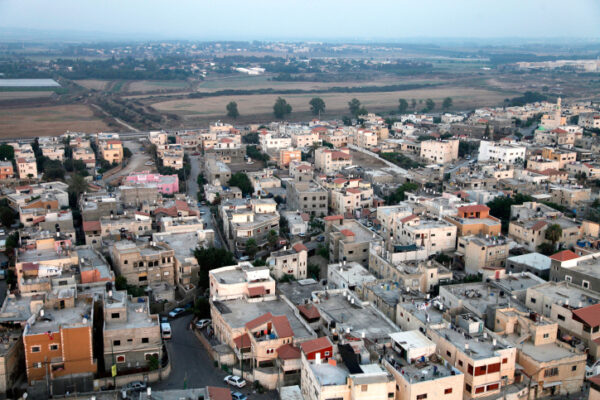
One of the problems this plan encounters is that contractors do not want to build in peripheral areas, a problem that does not only affect the Arab sector. Abu-Haya doesn’t believe in direct government investment in the issue. However, he notes that the set of tools which the Ministry provides him in order to incentivize developers can provide a solution, if only partial, to the problem.
“I will show a contractor surveys indicating a need for construction, I connect them to the locality and show them that there is a potential, I incentivize them with a grant, but also enable the lessees to opt out of the contract,” he explained. “If it is worth their while, the contractor will continue to rent – excellent. If they want to sell, then only according to the marketing terms, at least 75% of the apartments are for local residents.”
“Private land poses a big problem, mainly its division and consolidation,” Abu-Haya said, adding that at the moment, 90% of plan outlines are for private land.
He notes that most of the projects, and mainly the urban renewal processes, require some kind of intervention with respect to private land. The Arab-Israeli community struggles with this because it brings up hard memories of past land expropriation by the government.
“To take about 40% of a person’s land – in the past they would shoot me in the city square if I just dared to put forth such an idea,” Abu-Haya said. “Therefore, when you conduct consolidation and division, you must ensure that every public space or building that is supposed to be built, will really be built – otherwise the public will automatically vote against you.”
Abu-Haya explains that illegal building happens when people see the land, but can’t find a solution. When you plan legal development, it mostly solves this widespread issue.
“Of course there is the clear long-term economic advantage of land betterment,” he added. “In Kfar Manda, land that was worth no more than 300,000 shekels in recent years is now estimated to be worth more than 4 million shekel – but that creates a new problem”.
“If the value of the land increases in one locality, it increases everywhere,” Abu-Haya said. “In Arab society, less than 30% control more than 70% of the land. Therefore, this is a step that can easily make the rich richer, while not solving the problem of those who lack housing,.the average person, even if they work for this their entire life – they will not be able to buy 100 square meter of land”.
This is why, as he says that most future planning will be focused on state land.
Public housing is still negligible
Abu-Haya, born in Beit Jann, is aware of the land shortage problems in the villages.
“In Beit Jann, there are two challenges. One is that Beit Jann is surrounded by a nature reserve. The last available state land is currently being marketed, 258 units to soldiers who completed their mandatory military service,” he said. “The second challenge is the mountainous terrain. Development in such a terrain is very expensive, which is why a large share of Beit Jann’s young people live outside the locality.”
According to Abu-Haya, public housing has yet to become a high-demand commodity in Arab localities, and this despite its demand among the Arab public in mixed cities, Yafo for example. He notes that the initiative failed in two localities and a public project is currently being tried out in the Bedouin city of Rahat in order to solve the problem of housing in tin shacks, even though the Bedouin sector falls under the responsibility of the Bedouin Authority.
“Ultimately, the intent is not to build but to purchase apartments,” Abu-Haya said. He notes that despite great efforts by the Ministry on the issue, only 3% of the population takes advantage of rent assistance, and this is where he directs his criticism:
“There are unique problems,” he said. “Up until a year ago, you couldn’t receive assistance if you rented from a family member. They corrected it to a first-degree relative. There are also issues relating to politics, crime and family relations. A woman eligible to receive assistance that found an apartment rented out by a hostile family – she will not take the apartment, her family will not let her do so.”
Abu-Haya addresses the great need for public space in Arab villages and towns, committing to build playgrounds and parks in spaces formerly used to store garbage.
“It is inconceivable that families from Deir al-Asad come to play in Karmiel because they don’t have any other place,” he said. “At the same time, I am issuing a call for proposal to build public buildings. Through this you educate the new generation to attend afternoon activities, informal education activities, extracurricular classes. You build and people want to come and then demand grows – society flocks there.”
However, he notes that the focus cannot only be on the new.
“The old city centers continue to be the vibrant hub of all the localities, and the crowdedness brings its own problems,” he said. “There are houses that are flooded in winter. You pave a road and there is a telephone pole in the middle and a bus can’t get by. Nowadays every household has 2-3 cars and people park on the street and fight over parking, which sometimes ends in murder.”
Abu-Haya does not delude himself regarding the solutions which the Ministry of Construction and Housing offers and executes.
“No budget will be sufficient,” he said. “Whatever amount you put will be a drop in the ocean. We will invest in places that have the potential to succeed, will impact a large share of the population. On these issues there are no magical solutions.”
Abu-Haya views this availability and the connection to the field as the way to build trust with Arab society.
“There are things you won’t get like in Tel Aviv, but you have to be flexible and make adjustments,” he said. “With us, there is no chance that you won’t receive a response within two weeks, sometimes even within a day. The smart thing is that they feel a sense of belonging, that the state cares for them. When you provide proper solutions to needs, that is a winning formula.”