


It's a normal school day at the Amal Peres High School for Technology and Arts in Tel Aviv: students in their school t-shirts walk around the yard, sit near the large main building, or play on the sports fields. Most of the conversations at the school are conducted in Russian, some in Hebrew, since the majority of students come from families who immigrated from the former Soviet Union. Previously known as Shevach Mofet, the Tel Aviv high school has a history of offering new programs to absorb Russian speaking olim (immigrants to Israel) since the 1990s.
But beneath this seemingly regular surface lies an extraordinary story. Two hundred and fifty of the school’s students arrived in Israel within the last six months from Russia and Ukraine, fleeing the horror of the war and a life that had become a continuous vortex of uncertainty. Here, in this high school, they have found a home.
")
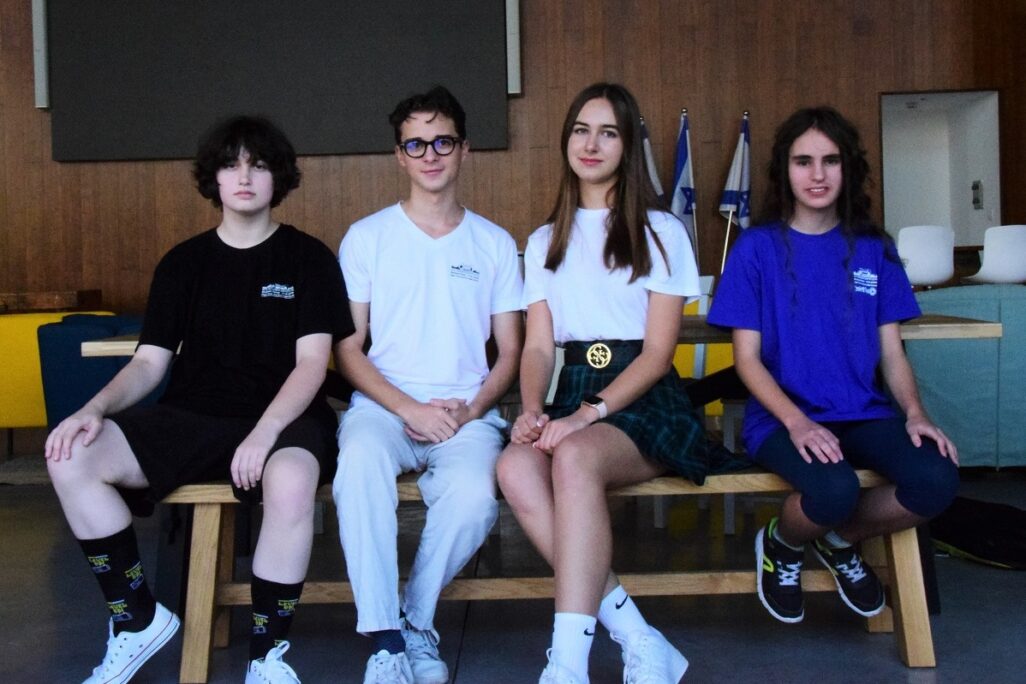
Margo Vodovnychko, Nastia Kulik and Alex Korshnov have each been in Israel for six months. Vodovnychko came from Kyiv, Nastya from western Ukraine and Alex from Moscow. Sasha Ginsburg, who made aliyah to Israel seven years ago, is their classmate, and like other 'veteran' olim at the school, serves as a kind of mentor to the new students.
They miss their scattered family and friends, and the places they had to say goodbye to on short notice. Their encounter with Israel and the Hebrew language is a challenge, but they all love the beach and are impressed by Israeli democracy. Some want to stay in Israel, some imagine a future elsewhere. But for the meantime, having a connection with other olim, support from teachers and a calm and open atmosphere make the crisis a little easier to handle.
Margo Vodovnychko: "For me, Israel is a stopover, and the most important thing for me is to finish school"
"I grew up in Kyiv, and I didn't think I would come here, maybe just to visit. My mother has been in a long-term relationship with a Jew, and they planned to get married and live in Israel after I finish high school. But the war disrupted all of our plans and my mother, my brother and I had to flee here. I always wanted to live in Europe, especially in Germany or Austria, mainly because I know German from my grandfather. I relate more to the politeness that exists in Europe, and the truth is that it's quite difficult for me that it doesn't exist here in Israel.
"Hebrew is not like any language I speak, and I'm very frustrated that I can't fully understand it. Besides the language, I miss my home in Kyiv. To be more specific, I miss the feeling of coming home and everything is yours, unlike now, when we’re in a rented apartment.
")
"When we arrived in Israel, I knew that I wanted to attend a Russian-speaking school, to make it easier for me and to do well on my graduation exams, which is very important to me. My mother found the high school on Facebook. The teaching team at the school helps and assists me in whatever way they can, and thanks to them I feel better in Israel.
"At first I was afraid of getting lost, because the school is very big. My friends at school are like me, they came to Israel in the last six months. Being friends with them eases the loneliness, because we’re all in the same boat. All the students treat me very well, but unfortunately there’s some distance from the students who only speak Hebrew.
"In Ukraine we were a family of 20 people who celebrated the holidays together and were close to each other, and now we’re scattered all over the place. This makes me sad, and I don’t like the constant heat here. But I like the fact that I can go to the beach, and I appreciate Israel for helping civilians in the last military operation.
"Because I'm not Jewish, I have 'rights like a bird' as they say in Russian, and I won't be able to stay in Israel too long. So, for me, Israel is a stopover, and the most important thing for me is to finish school here. Treating this period as temporary frees me in some way, and I can enjoy my stay here."
Alex Korshnov: "I like to connect with the ‘veteran’ olim at school, to learn from them"
"I made aliyah exactly six months ago with my parents and my five-year-old little sister from Moscow. I have another sister who’s studying abroad. When I arrived I knew I wanted to study in a Russian-speaking school, but I’m into the humanities and this school is focused on technology. My mother convinced me to take the entrance exams, and now I’m studying robotics and I enjoy it.
"One of my friends at school is a ‘veteran’ olah, and we both discovered that we grew up in the same neighborhood in Moscow. I feel that this friendship answers the strong lack I have in Israel of friends who have known me since childhood. Of course, the relationship with her is not a substitute for friends from Moscow who are not here with me.
"In general, I like connecting with older olim at school. I learn from them about integrating into Israeli society, because I don't yet feel like I belong and I want to feel that way. Perhaps unlike other olim, I like the weather in Israel, of course not when it's too hot.
")
"My city, Moscow, is a fun city to live in. I miss it, with its high accessibility and rich cultural life, perhaps because there are no buses in Tel Aviv on Shabbat. In general, I think that in the country there should be a separation between religion and state, a separation that does not exist in Israel. But still, the institutions here see the person before the bureaucracy, and I really appreciate that.
"I’ve always been interested in a career in diplomacy, because I speak several languages such as German, English and French, and in my free time I listen to podcasts dealing with British politics. In any case, it is important to me to be a law-abiding citizen, and to serve in the army if required."
Nastia Kulik: "I enjoy studying civics and Tanakh, because they deal with issues of democracy"
"My mother lives in Israel and has been working here for many years. Four years ago I visited her, so I happened to be here before the war. When the war broke out, I fled alone from western Ukraine to the Polish border, where my mother met me and we arrived in Israel. My grandmother, with whom I lived before moving to college, stayed in Ukraine and I miss her very much.
"In Ukraine, I already studied for a degree at a college in a city outside my hometown. Because girls are not conscripted there, you can study in a framework that is a kind of high school-plus-college. From the city where the college was, I mostly remember the efficient public transportation, and I miss the rolls I used to buy and eat every morning on the way to school from a cute little bakery.
")
"When I arrived in Israel I didn't want to go to high school, because for me it's a stage I've already passed. But I also knew that I couldn't go to college, because that requires a high level of Hebrew.
"My mother saw Amal Peres High School on Facebook, and convinced me to enroll in it. I'm glad she did, because I love the school. I especially enjoy studying civics and Tanakh [Bible studies], because they deal with issues of democracy, and my teachers speak Russian. I appreciate the freedom students in Israel have to choose what they want to study at school, because in Ukraine all subjects are compulsory.
"I was touched that other students approached me and tried to be my friends. I have friends here and I love the beach, but I miss my friends in Ukraine. My future is not clear, because on the one hand I want to finish school here, and on the other hand I want to finish my degree at a college in Ukraine."
Sasha Ginsburg: "I like that in Israel, you have the ability to criticize the status quo and stand up for your opinion"
"I made aliyah seven years ago from Moscow. It wasn’t a traumatic event for me because my parents explained to me the considerations that went into the decision. I don't miss many things from there, and I don't have a special need to be in touch with the friends I had. It may be because I was relatively young when I made aliyah, compared to my friends who did so at our age. If there are people I do miss, they are my grandparents, whom I won't see until Putin dies.
"My Hebrew wasn't good when I started studying here. It got to the point where I was getting 100 percent in practical subjects and 40 percent in language subjects. I was in ulpan [state-run Hebrew immersion lessons] in Netanya for two years, but it didn't help. When I reached the 9th grade, I started looking for a high school that deals with science, because I like it. I realized that this is a school that would be good for me. Following my studies, we moved from Netanya to Tel Aviv. Today I take classes with the new olim in subjects that require more verbal skills, such as civics, history, language and Tanakh.
")
"Here, unlike at my previous school, I have friends. They all speak Russian, whether they are new olim or older olim like me, because unfortunately it’s still hard for me to connect with students who only speak Hebrew.
"I love that in Israel, you have the ability to criticize the status quo and stand up for your opinion, whether it's in class in front of the teacher, or whether it's in front of the government. I am a person without a nationality, and I will live in any country that gives its citizens the ability to be free."
The High School for Olim from the Soviet Union
Since the 1990s, Amal Peres High School has been known as a school that caters to immigrants from the countries of the former Soviet Union. Many of the teachers speak Russian, enabling olim students to integrate into Israeli society without giving up their identity. Although there are no entrance exams, in recent years the graduation rate has stood at 100%.
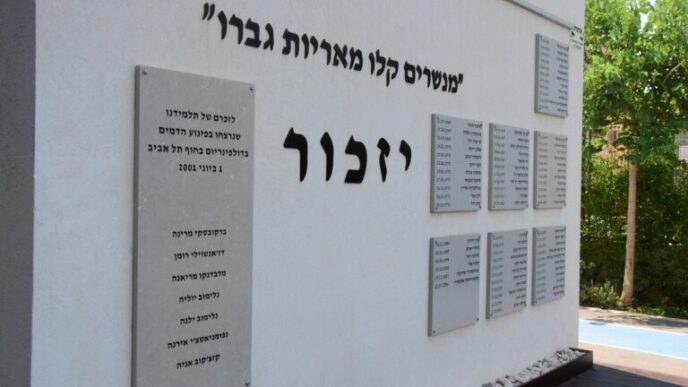
The school recently moved from its historic building on HaMasger Street in downtown Tel Aviv to a new building in the Tel Kabir neighborhood of Jaffa. The large lobby at the entrance, with spacious armchairs and tables, is reminiscent of high-tech company buildings.
The campus boasts a film and music room and diverse work and learning spaces. The new building also includes a memorial plaque for seven of the school’s students who were killed in the 2001 Hamas terror attack at the Dolphinarium, a popular Tel Aviv nightclub. Almost all of the 21 victims of the attack were young people who had made aliyah from the former Soviet Union.
Principal Max Sivan: “We have to provide students’ mental health support instead of the State”
"I knew there would be a wave of immigration two weeks after the outbreak of the war and I requested financial support from the Ministry of Education and the Tel Aviv Municipality, but I received nothing," says Max Sivan, who has served as principal of Amal Peres High School for 13 years. "I prepared my team and we recruited volunteers. This year we received a suitable budget, because the students are already established [within the school]."
But the budget is only one challenge that the school staff faces, along with attending to students' mental health and offering educational and financial assistance. "We come across depression and suicide attempts," says Sivan, "we have to remember that these youth were torn from everything they know under very difficult circumstances. Unfortunately, the support that the State of Israel provides in general in the field of mental health is thin, and we are required to provide support instead.
"A classic challenge that can be seen here among families of olim is the loss of parental authority. The children pick up the language faster than their parents, and that can lead to the erosion of the parent's authority over the child.
“In addition to all of that, our students suffer from financial shortages, and we take care of meals and clothes. All of these challenges are typical for olim students, but also for the other students at the school, such as children of foreign workers or Muslims from Jaffa.
")
"For the past three years, we have been in a building constructed according to our worldview. There are comfortable seating areas everywhere. The goal was that instead of the students being alone on their screens, they would sit down to have conversations with their friends. And truly, during breaks and in some classes you will see circles of students sitting and talking.
"In addition, the relationship between the teaching staff and the students is based on trust. We don’t have bells, but each classroom has a digital clock, and access to the music and film rooms is unlimited. You can also borrow books from the library for free without registration. When the librarian said she was worried that students would steal books, I replied 'I hope so.'”
Learning in Hebrew, with translation into Russian
The school’s absorption process for new olim includes Hebrew-learning classes [ulpanim] for the middle school grade levels, while 10th grade students remain in one class that functions as a homeroom, where all subjects are taught. In the 11th grade, where Vodovnychko, Kolik, Ginsburg and Korshnov study, students are divided into professional tracks, but language-based classes such as history, language, Tanakh and civics are taught together in homeroom.
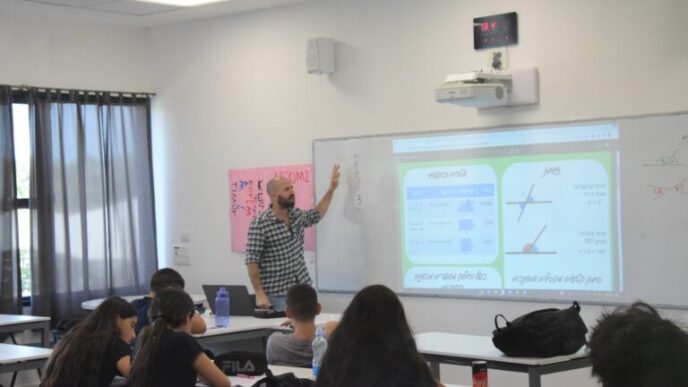
Pedagogical conversations between the teachers spill out into the school corridors, whether it is a discussion of technological aids that help with translation, or the question of whether to translate an article from Hebrew into Russian, or rather to leave it in Hebrew as a means of practice.
Olga Dor and Ludmilla Bricksman, who both teach at the high school and hold administrative positions in the middle school, tell about the unique methods that help students acquire Hebrew language skills.
"Our assumption is that through studying the subject you can learn Hebrew," says Dor, "so in the back of their notebooks, the students create a glossary of vocabulary terms for the subject being studied."
")
According to Bricksman, "The lessons themselves are conducted in Hebrew, with me or another student who speaks both languages translating. When working in groups, I make sure that there is one person who speaks both languages. This method of learning teaches all students to respect those who are different from them, and to help others when needed.
")
"I am happy that our school took in the influx of immigrants that came after the war, because we have a team with the skills to successfully integrate them", says Bricksman. “An example of this could be seen last summer, when a group of olim who had made aliyah a few months before were teaching a group of completely 'fresh' olim. Because they had to teach, it motivated them to learn."
Dor emphasizes that, for her, successful integration does not involve giving up one's identity. "[Integration is] when you feel at home. Contrary to what one might think, keeping the language and culture from the country of origin does not necessarily mean that you don't feel that this is your home, that this is your country."
This article was translated from Hebrew by Hannah Blount.