
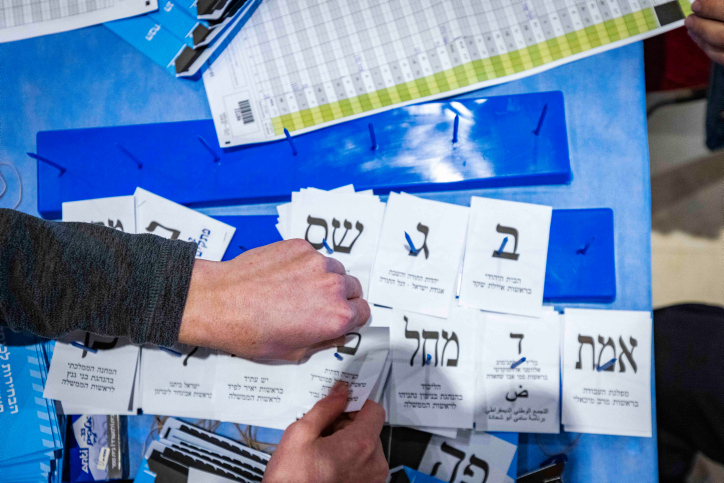
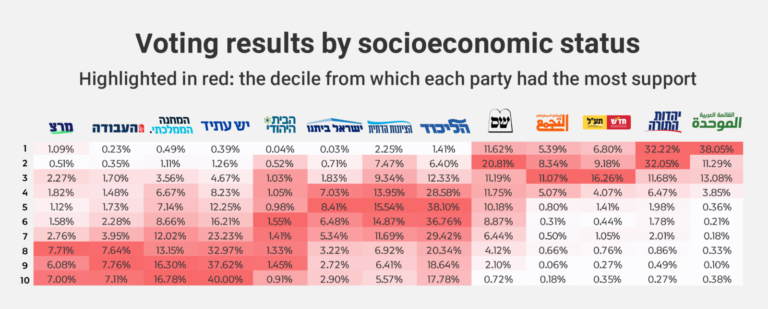
The Arab party Balad is the fifth largest party among the poorest localities, the left-wing parties Meretz and Labor are strong in the richest localities, and the center-right Likud party dominates the middle class, according to Davar's recent socioeconomic analysis of the 25th Knesset election results.
The analysis, which was done by cross-referencing each locality’s election results with its socioeconomic ranking, indicates clear voting patterns by class. The results use the decile system, with the lower deciles (1-3), corresponding to lower-income localities, the middle deciles (4-7) corresponding to middle-class localities, and the upper deciles (8-10) corresponding to wealthy localities.
Among the middle-class localities, those in the fourth through seventh deciles, Likud received about 32% of the votes, almost double that of the centrist Yesh Atid party, which received about 16.5% of the votes.
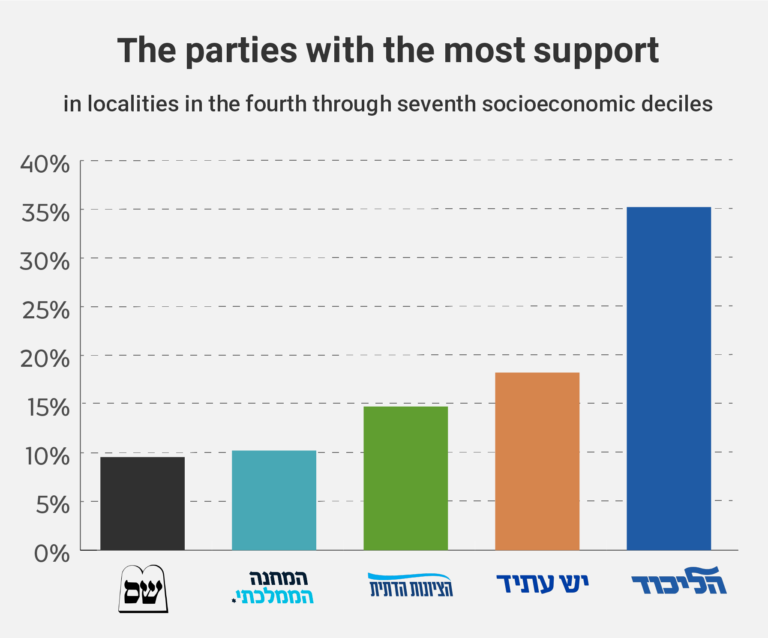
The middle class also constitutes the power base of the far-right Religious Zionism party and the secular right-wing Yisrael Beiteinu party, which have the best achievements relative to themselves in these clusters. After Likud and Yesh Atid, Religious Zionism is the third most supported party among the middle class, with about 13.5%, followed by the centrist National Unity party, which received about 9.5%.
In localities in the three lowest economic deciles, on the other hand, Likud received less than 10% of the votes, and Yesh Atid received only about 3%. Even with only 3%, Yesh Atid is still the party not aligned with Benjamin Netanyahu with the best support among lower social classes, setting aside Arab parties.
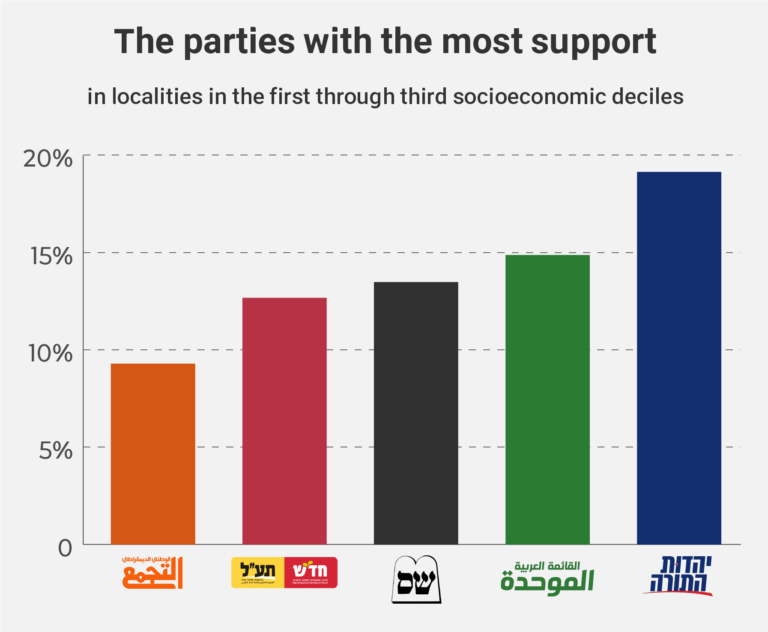
The two strongest parties among the lower class are the Haredi United Torah Judaism party, with about 20% of the vote, and the Islamist United Arab List, with about 15.5%. After these parties are the Haredi Shas party and the Arab Hadash-Ta’al party, followed by Balad, the Arab party which failed to receive more than 3.25% of the overall vote and therefore will not have representatives in the Knesset. Haredi and Arab parties together received about 72% of the votes in the three lowest economic deciles.
Outside of the lower class, support for United Torah Judaism and the Arab parties is nearly insignificant. Of the Haredi parties, only Shas managed to gain significant support even among middle-class localities, capturing about 8.5% of middle-class votes.
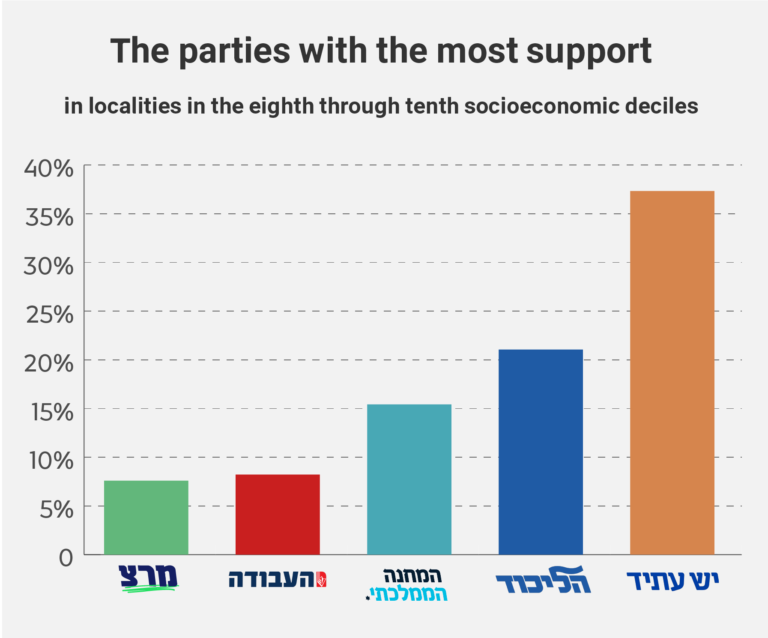
The three wealthiest deciles provide the bulk of the support for the parties in the Naftali Bennett and Yair Lapid’s centrist coalition, apart from Ra'am. Lapid’s Yesh Atid party received more than a third of the votes among the top three deciles. Likud was the next most popular party, with 19.5% support.
The National Unity Party, Labor, and Meretz, were the next most popular parties in upper-class localities, capturing about 14.5%, 7.5%, and 7% of the votes, respectively.
An analysis of voter turnout by socioeconomic makeup of localities shows that more residents of wealthier localities turn out to vote than residents of the average locality. A correlation is evident between the economic status of the locality and voter turnout, except for localities in the lowest decile, where voter turnout is 1% higher than the average.
Means of analysis
This analysis is based on 4.3 million votes, out of a total of 4.8 million eligible votes for parties that passed the election threshold, as well as for the Meretz, Balad, and Jewish Home parties that did not pass it. The votes that were not counted in this analysis are those that were cast at polling places in military camps, hospitals, prisons, and assisted living facilities, as well as those cast by Israeli diplomats abroad.
The results are based on cross-referencing the voting data for the 25th Knesset, with the Central Bureau of Statistics ranking of the socioeconomic deciles as of 2017, which is the most recent ranking.
The socioeconomic ranking is given uniformly to all residents of each locality, which negatively affects its accuracy in larger localities.There were 112,000 voters in localities in the lowest decile; 280,000 in the second decile; 587,000 voters in the third decile; 479,000 in the fourth decile; 454,000 in the fifth decile; 363,000 in the sixth decile; 943,000 in the seventh decile; 664,000 in the eighth decile; 404,000 voters in the ninth decile; and 25,000 voters in the highest decile.
This article was translated from Hebrew by Leah Schwartz.