
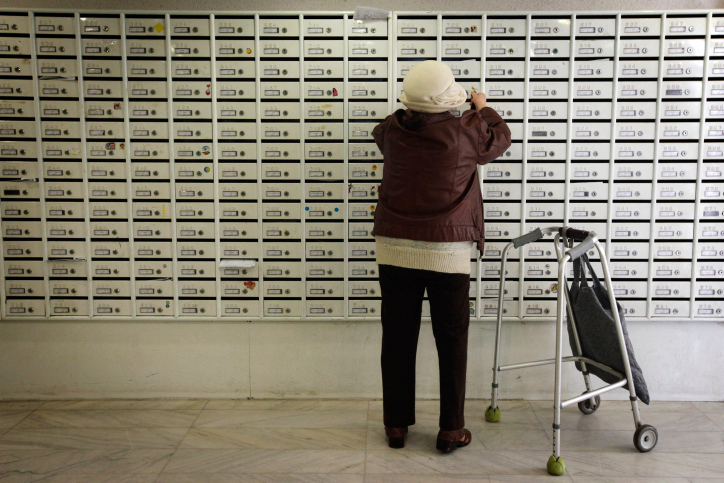
Because of the financial sanctions imposed on Russia following its invasion of Ukraine, tens of thousands of pensioners who immigrated from the former Soviet Union have not received their pension payments for more than a year, despite continued suggestions made to resolve the situation. According to evidence shown to Davar, some pensioners have had no choice but to turn to private companies that charge thousands of shekels in order to bypass sanctions.
Getting around the sanctions
These retired olim have worked for many years in the Soviet Union where they did not accumulate an organized pension fund. Many of them currently depend on these pension payments in order to survive.
The exclusion of the pension payments by the American Federal Reserve failed to solve the problem because of sanctions on Russian banks and other financial entities that could have helped the payments get to the recipients. Finance Minister Avigdor Lieberman himself intervened in the issue, but was unable to get the money to go through.
Into the vacuum created by the state’s failure to help, step private companies, such as IDEALFORM INTERNATIONAL, which assists former Russian citizens who need help with business and legal documents relating to inheritance, citizenship and pensions. The company, which is headquartered in Israel, but provides services all over the world, claims that it can circumvent the current situation and allow the pension payments to resume.
Davar investigated claims by a company employee that the transfer of funds is indeed possible. According to testimonies of people who have used the service, the cost is estimated at about 1,500 shekels ($440 USD).
Withdrawing money outside the borders of Russia, especially state money, is almost impossible, and the company does not specify the exact way in which it is done. Officials told Davar there are a set of very complicated steps to follow: the company needs to open a bank account in Russia and appoint a trustee, who will transfer the allowance to Israel through the money transfer services “Zolotaya Korona,” which will in turn then enable the transfer of funds between Russia and Israel. The amount of transfers is limited to a few thousand dollars a month, which should be enough for the modest allowances which average about $150 USD a month. Once the money is transferred to Israel, there are no restrictions on using it and it is able to be accessed from any bank accounts that have access to MasterCard.
"This is two-thirds of my annual allowance," Leonid Leshachansky, a 75-year-old pensioner from the center of Israel, told Davar. “The company advertised its services on several Russian-speaking websites and on television, and I know other people who contacted them, but it's crazy to pay such sums for such a meager allowance."
No response from the Treasury or the Bank of Israel
In Israel, there are about 57 thousand pensioners who receive quarterly pension payments from Russia. About 40 thousand of them receive it directly from Russia and another 17 thousand, who immigrated to Israel before 1993, receive it through the National Insurance. Former Minister of Finance, Avigdor Lieberman, announced last summer that the National Insurance system and the Treasury had reached an agreement on an interim solution, whereby the National Insurance would transfer the pension fund as an advance, in expectation of the funds being received from Russia and while being indemnified by the Treasury. At the same time, an effort would be made to open the necessary channels for the return of the payments.
And yet, nine months since the start of the war in Ukraine and the beginning of the sanctions, the transfers have not been renewed. The Ministry of Finance has not yet reached an agreement with the National Insurance on the method of compensation.
Despite several inquiries, the Ministry of Finance, the Bank of Israel and the Minister of Finance, Avigdor Lieberman, did not respond to the question of why the transfers were not renewed.
This article was translated from Hebrew by Rose Angela.