

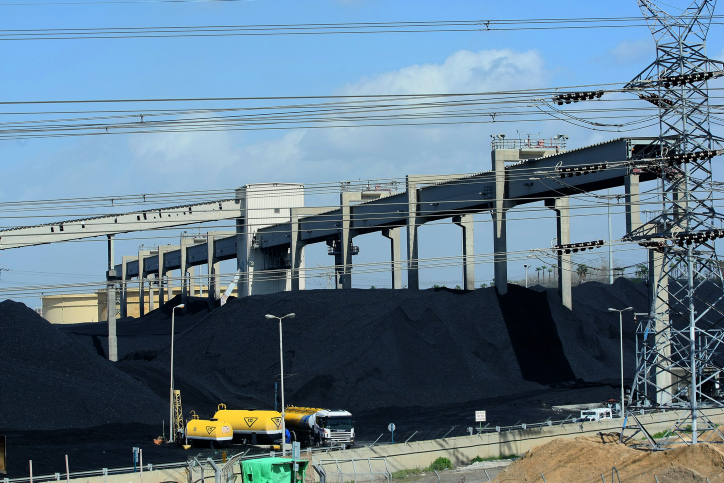
While the public discourse on green energy in Israel is moving forward, in reality it seems that the country is going backwards. At Israel’s largest power station, Orot Rabin in Hadera, use of coal-powered generator units 1-4, the oldest and most polluting units, was up 50% this September and October compared to the same period last year. The increase was the result of a variety of factors, including high temperatures and reduced output from the Tamar gas field due to prolonged maintenance activity there, but the policies of the Ministry of Environmental Protection were also among the culprits.
The ministry prevented the operation of four steam units at the Eshkol Power Station from August to December 2022 on the grounds that they are old and particularly polluting. In theory, this is a logical decision regarding 50 year old gas-converted units, but in reality the alternative, over-reliance on Orot Rabin’s units 1-4, was significantly worse.
In the coming month, the exact same problem is likely to play out again, with high electricity consumption on cold days leading to increased use of the 41 year old coal-fired units that have not been fitted with scrubbers (emission filtering devices designed to limit pollution).
There are a number of reasons for the ministry’s policy that, again, make sense in theory. The ministry claims that it is possible that by 2030, Israel will be able to produce 40% of its electricity from renewable sources. In reality, it is doubtful that Israel will even make it to 30% by then. According to predictions from Noga, the government owned company tasked with managing Israel’s electric grid, the share of Israel’s electricity that will come from renewable sources in 2030 will be somewhere between 18-30%. These estimates take into account the lag in the development of the renewable network and the number of facilities that exist so far, which supply only about 10% of the country’s electricity.
The Ministry of Environmental Protection has publicly contradicted the Ministry of Energy by opposing the construction of new power stations fueled by natural gas. Instead, the Ministry of Environmental Protection advocates building large electricity storage facilities, another move that, on paper, seems economically and environmentally responsible, but fails to account for its real-world implications.
In reality, there are both economic and environmental costs to curbing the construction of new natural gas powered stations, especially given that Israel currently relies on coal for more than 20% of its electricity. Contrary to what the Ministry of Environmental Protection implies, building new power plants does not increase the demand for electricity, and therefore does not dictate when or to what extent they will be used. What is certain is that a new, modern power station would replace Israel’s oldest and most inefficient stations. Natural gas technology is rapidly developing, making it possible to obtain more usable energy from the same amount of gas. Modern turbines have a built-in ability for multiple starts and shutdowns, offering increased flexibility in the amount of electricity production at any given moment. These are exactly the features required to complement an energy sector that relies on an increasing share of solar electricity, and can also serve as an essential backup supply as Israel develops more facilities for the storage of electricity.
Ostensibly, the Ministry of Environmental Protection opposes new natural gas plants for fear of increasing Israel’s reliance on natural gas in the long term. This is a noble goal for the future, but in the present Israel generates thousands of megawatts of electricity in facilities powered by fossil fuels. It would be far more beneficial to replace these facilities, which were not built to be part of an electrical grid with high solar penetration, with modern, flexible gas turbines, which will not replace solar electricity, but supplement it – and yes – for the next several decades.
The Eshkol station, with an installed capacity of 1681 megawatts, is the largest station that has been put up for sale by the Israel Electric Corporation (IEC), Israel’s electrical utility. It was valued at approximately six billion shekels ($1.8 billion) in a tender that will close next year. This appraisal is based on the assumption that the buyer will be able to replace the four old units on the site with modern units. But the tender does not include a guarantee that this upgrade will be possible, and the opposition to switching to natural gas could torpedo the upgrade. Thus the value of the station could drop to 3.5 billion shekels ($1 billion), or even less.
The 2018 governmental reform of the electricity sector states that any amount of money received from the sale of stations in excess of the value recorded in the records of the IEC will be directed towards reducing the cost of electricity. The extra billions of shekels at stake in the sale of the Eshkol plant could reduce the cost of electricity by about 5% per year for two years.
Today, the cost of electricity includes a significant subsidy for private producers of electricity from natural gas, as well as a larger subsidy for producers of renewable energy. But these subsidies are paid for by the general public, without any contribution from the state budget. Additional funding from the state to reduce the price of electricity would reduce the burden on economically weaker households. This is the only way to speed up the energy transition without making electricity more expensive for consumers. Until that happens, there is no practical justification for opposing natural gas, as this opposition only increases the use of expensive and even more polluting coal.
This article was translated from Hebrew by Nancye Kochen.