


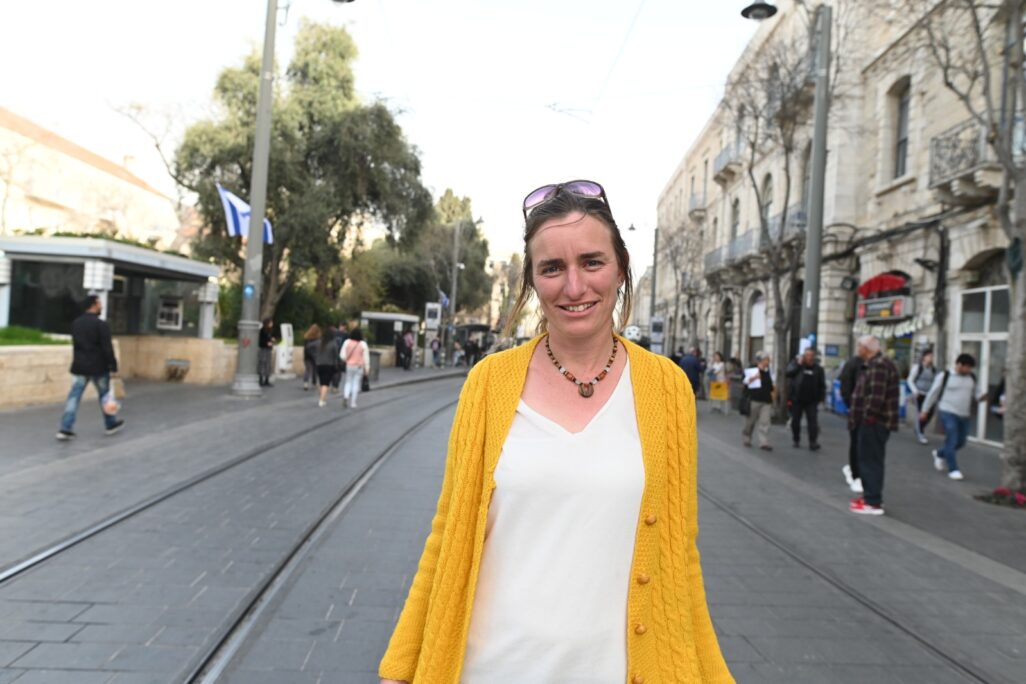
"The anniversary [of my father's death] came at a time when the nation of Israel is in a very difficult situation," says Liharaz Froman, daughter of the late Rabbi Menachem Froman. Rabbi Froman was well known as a peacemaker who negotiated with Palestinian leaders during his time as a founder and leader of Gush Emunim, a leading organization promoting Jewish settlement in the West Bank. Last month marked the tenth anniversary of his passing.
In an interview with Davar, Liharaz Froman spoke about the man who dedicated his life to building bridges between different parts of society, and about the attempts to continue on this path despite the realities of increasing polarization and social division.
Froman, 33, the ninth of the ten children of Rabbi Menachem Froman, has been leading a conversation tent with her mother Hadassah Froman and some of her siblings for the past few weeks. Two years after her father passed away, she published a novel called "Shemonah Dakot Ohr,” or “Eight Minutes of Light,” that tells the story of her family and its roots. She is no longer married, does not wear a head covering, and comes across as completely secular, until you sit down to talk to her.
.")
"How do you honor your mother? You go to a demonstration with her," Froman says. "I have many friends whose parents are public figures, but I don't know any family where this is just what everyone does. The idea of social change has always been present in our family home, because my father brought his work and ideals home with him. We would write his speeches, drive him around, whatever was necessary. My mother is like that too. She has students who help her sometimes, but we all take part because that’s how we were raised."
"As a Religious Person, You Understand Other Religions Better"
Froman is distracted when one of the cafe's employees, a resident of the Shuafat refugee camp, says that he was born in a room with 10 other siblings in 1967. "We are also 10 siblings, what a story," she laughs with him. They continue to have a joking conversation about life in a trailer, the Six Day War and families with many children, until he has to go back to work.
"I never had the chance to meet someone to whom I said, 'Wow, you grew up just like me,’ because it really was something very unique," she exclaims.
Did your father see himself as being on the left or on the right?
"It's hard to say, but what's certain is that we were never in the center politically, because the perception was that we needed something much broader than politics. We also didn't really bother with political definitions, because we understood that we need something more endemic, something related more to a sense of place and fundamental beliefs, and not just to one political side or another."
.")
Rabbi Froman actually saw Hamas as a possible partner for peace, and in the past even met for a joint prayer with Hamas leader Sheikh Ahmed Yassin. How did he bridge the gap between his own beliefs and the fundamentalism of Hamas?
"This is a perception and a belief that exists in people's minds, that where there are religious people, there is more conflict. As a religious woman, I think it is exactly the opposite. Of course, my father also thought that way.
"When you are a religious person, you understand the other side of another religion perhaps much more than a secular person would, your approach is pluralistic. A religious person knows what religion is and what faith is for a person of another religion. My father met for prayers with Muslims but also with other religions, including the Dalai Lama and other leaders, so in this way being religious can help build bridges."
He regularly participated in the Yitzhak Rabin memorial rallies. What was the significance of Rabin's murder for him?
"I was in the first grade, and I remember hearing my father crying and I asked him, 'Why are you crying? This is what we were waiting for.' In a young girl's mind [Rabin] was the bad guy, and now he's dead. It's like being told that Haman is dead. But my father really cried. It was a really difficult time for him."
You wrote in your book: "Much of my father's motivation to engage in peace and meet with Arabs was to bring Jews together. Even if we did not attain peace, something did in fact happen. The fact that both sides talk of this, even if what they say is not entirely the same, does still mean something in the current reality."
"So first of all, as we can see, the peace did not succeed. I think it’s like a tug-of-war, everyone is fighting for their own values, and it often hurts everyone that the values of the other side contradict their own – a rift has been created. I think what my father did was to find connections between seemingly contradictory points of view. If you are a settler, you are supposed to be in favor of Greater Israel. If you are from Tel Aviv, then you are in favor of peace. Why?
"He didn't do this as a way to trick people; he worked at it for 40 years, and his shiva, for example, taught me that he offered something that both sides could accept. There were both Arabs and Jews there. But right now that’s not the main issue. At the moment it's Jews and Jews. Let's solve this, because it's stupid. Straight away we're splitting into two camps.”
Froman mentions a conversation she had with a former Supreme Court judge. "I asked her to speak up if there’s something in the reform that she thinks is positive, because I’m sure there is. And I ask supporters of judicial reform as well, is this really what you want? You really think everything [in the proposed reforms] is good and reasonable?”
She wanted to bring Simcha Rothman, chairman of the Knesset’s Constitution, Law and Justice Committee, together with people who oppose the reform. "He said: 'I postponed it four times, but still no one came,' and I was heartbroken, because it showed that they really weren't ready.’ On the other hand, he has the power. It's like if I tell my kids: 'Either you go to sleep or there's no Playstation tomorrow.' They will go to sleep because they have no choice.
"There is a lot of inequality here, because people from [the West Bank settlement of] Tekoa tell me that the demonstrators say that they’ll leave the country, but during the disengagement from Gaza [in 2005], we never said that we would leave. But it's not us and them, it's just us, that's the fact and we have to take this into account, because there's nothing else, we are all there is.
“The cracks are getting deeper, a rift is being formed that we don't know how to get out of. I hear a lot of genuine pain all around about this rupture, and I think that everyone who is in pain should ask themselves what price they are willing to pay to keep themselves together. I don't think there is one right answer for everyone, each according to their own opinion. And maybe something old is being renewed and we should not be afraid at all."
Your father forged a new path for us. Where does it take us today? What is left of his legacy?
"There are many more settlers who look for peace. Even those who are not on this path are willing to listen. The racism that exists today, or the fact that ‘leftist’ is used as a swear word, is actually not coming from the settlers. At the time, we suffered a lot for our views as a family, graffiti and boycotts and such, but today there is more tolerance for positions like ours.
"I feel that my mission from my father is simply to do this, to build bridges between the people who live in this country. I'm not that involved with the issue of Arabs, but I did grow up on the fact that Arabs are not muktzeh [objects forbidden to use on Shabbat]. This is something new that happened in the settlements, and it's great."
.")
She says that in her house they didn't talk much about rabbis, but more about intellectuals. "Amos Oz, David Grossman, A.B. Yehoshua, who was a good friend of my father. Most of the people he came to negotiate with were left-wing, but we grew up with right-wingers, and building bridges is personally what I feel most passionate about, especially now."
What led you to engage in the reforms and negotiations?
"I swore that I would never get involved in politics, and here I am hosting Knesset members Yoaz Hendel, Chili Tropper, and Yuli Edelstein in a tent, because I now find the situation is so painful. At first, I really tried to call and connect people, but the controversy has long since gone beyond the boundaries of just the reform, and it is an opportunity that has passed us by. I believe there is a god and that He will help us. My father always said that you only remember God when someone is about to die and you have to pray to Him. But there really is a lot of pain here that has to come to the surface."
How has your experience at the demonstrations been?
"I came to one of the first demonstrations in Jerusalem with my brother Yossi and some friends from Tekoa. We shouted through the megaphone, 'Let's talk! We come in good faith!' Someone stood in front of me with an ‘End the Occupation' sign and told me that she had nothing to talk to me about, because as long as I define the state as Jewish and democratic, it hurts the Arabs. I told her that if from the first sentence there is nothing to talk about, then what are we doing here?
“It's difficult and complicated for me to go to the demonstrations, because on the one hand it’s clear to me that this is not the way to reform the judicial system, but on the other hand, I don’t identify with the demonstrations, because there are so many progressive things in them that I do not agree with."
So why do you still go to them?
"Because this is a mission, because you have to look them in their eyes, and understand the magnitude of the pain of the people who demonstrate. People who don't come to these demonstrations simply don't understand the pain, they say, 'Okay, they don't agree, they will get over it, we got over it too.’ But they don't really understand it, because they live in a completely different reality."
A Poet, a Kabbalist, a Vegetarian from Age Five
Rabbi Menachem Froman did not leave a will when he died. "Just before he died, he began summoning people to him," Froman says. "What he had to say to us, and what he taught us, simply permeated throughout our lives, and it crystallized for all of us in a very clear way. He never told us 'we should do this and that,' because it was simply clear, this is what we do."
.")
Rabbi Froman was also a poet, and even wrote a poem in which he says that he named his daughter Liharaz after his mother Leah Reizel.
"Not long ago there was an evening at the khan [roadside inns where travellers can rest and exchange ideas], where his poems were read, and when this poem started there was an actress acting it out, and I started crying right then and there," she laughs.
"During the time of the Oslo Accords, he published a book of love songs for Israel, and from his point of view, this was his way of fighting for the Golan,” she continued. “Someone told me not long ago that the mistake of the settlement enterprise was that we did not write songs, there was no real culture. We went on trips and sang songs about the Kinneret and Ein Gedi. Why isn't there a song about Tekoa? It's an amazing place."
He studied at the Mercaz HaRav Yeshiva, which is considered mainstream, but his public image and part of his occupation were more associated with Rabbi Nachman, who was known for his spirituality. How did this process happen?
"He started studying Rabbi Nachman about 40 years ago, and he was one of the first to make Rabbi Nachman known outside of the Haredi and Hasidic realms, not many had heard of him before. This is a movement that had a ripple effect, so that one rabbi teaches him and another rabbi teaches him and suddenly the Torah takes on new directions. In his later years he taught more of the Zohar, [a foundational text of Jewish mysticism]. I personally don't connect to the Zohar, I teach Gemara, [a central text of Rabbinic Judaism]. That’s my little rebellion."
.")
Where did your father get his ideas on the Torah from?
"He came from Kfar Hasidim [a moshav in northern Israel]. It was not a religious place, and the whole time he studied at the Mercaz HaRav [a religious-Zionist yeshiva in Jerusalem], he lived with Rabbi Zvi Yehuda Kook. He wasn’t allowed to go to boarding schools because he didn’t wear a kippah or leather shoes. He was a vegetarian from the age of five. Even then he really stood out, but he was part of the group of Gush Emunim that came out of the Mercaz HaRav. He was a free spirit and would pray with shouts and cries, a non-conformist whose soul was influenced by Rabbi Nachman. In my opinion, Rabbi Zvi Yehuda Kook was also a very torn soul, with many contradictions and surprises. In the stories of the second aliyah, his father, Rabbi Abraham Isaac Kook, had to pay the price of being different. My father used to say that he was one of his only successors.
"Today people can say that religious Zionism is a logical thing. Where could people say that then? After all, what Rav Kook did back then was considered crazy, revolutionary, and he didn't just do it to be pluralistic and polite, but he really wanted to learn from people who were different from him."
"You Don't Do That to Other Jews, Even if They Did the Same Thing to Us"
The school that Liharaz Froman attended in Tekoa was the first mixed school for both religious and secular people. "The religious were very religious and the secular were very secular, and we understood that we benefited from that," she says. "People today need to understand what they are hearing from the other side, beyond the fact that on the other side you say that they are violent and fascists and anarchists; that is not okay. You come to the demonstrations and you see people up close and in the flesh, you see the pain in their eyes. What can you take from it? How does it affect you? It may be that everything you think is true and it’s the other side that’s wrong, but what else is there beyond that?"
How does your father's legacy connect to the challenges that Israeli society is facing today?
"These are scary times that we are living in, and we need to come together. All my childhood I was at demonstrations, and it does something to you. The right-wing has been in power now for 20 years, and there was no need to demonstrate, so it causes you to become complacent. But as soon as you have power, it's as if you feel you can stop trying, and then you fall asleep at the wheel. The left has really woken up because it feels that something is being taken from it, but this is an important awakening. If you walk with the Israeli flag in the street, suddenly you are a leftist. I arrived with my brothers for the first time at the conversation tent, and there was security there. I was with a flag and they let me in, but those without were not. As if suddenly the flag is a marker that differentiates. It's madness.
"Something in the reform is becoming vindictive, and I hope we have uncovered this. Such voices are really starting to be heard. There are those who wanted to bring the left down to show them who's the boss. I hope things will really change and it will become more balanced, because every day one of the parties is crushed, it just keeps it going and aggravates the situation. You don't do that to other Jews, even if they did the same thing to us. So what? What does it matter? Precisely because we are people who went through the same thing, we need to understand that it shouldn't be done this way.
.")
"The disengagement [from Gaza] was a very real and painful crisis for me, and not everybody experienced it that way, but the effects of it keep reverberating. We know it by heart, and we don't know the experiences of those who did not agree with the disengagement. Those who are not connected to this community simply do not understand the pain."
What was your father like as a parent?
"His job was to wake the children up in the morning, because he got up very early, and we would leave him notes with the times we wanted him to wake us up. He didn't always wake us up. Once when I asked him why he didn't wake me up, he said: 'You were so cute, and you were sleeping so sweetly, that I didn't want to wake you up. What would you be doing at school?' Both of my parents had a saying that it didn't matter if we went to school or not, but we would of course go, so he would write me a note for the teacher: 'It was her own fault Liharaz was late, she didn't want to get up in the morning, but she's so cute and she has a dimple, so maybe you can forgive her?', and the teachers would burst out laughing.
"There’s something in this that very much represents my father, the breaking of the norms and laws. Many people ask me what he would do today, and I tell myself that we really don't know. It could be that he would have done something with Arabs, it would be something unexpected for sure."
On the 16th of March, an event was held to mark the tenth anniversary of Froman's passing, under the title "Clap Your Hands – Bridging Contradictions in Israeli Society." In addition to Hadassah Froman, Israeli author Tamar Appelbaum and Israeli rockstars Ehud Banai and Berry Sakharof took part, along with many others.
"Ehud Banai and Berry Sakharof were my father’s partners, because he initiated the idea of 'singing Torah’ with them. He was very much the jazzist of the Torah, because he never prepared lessons in advance. He let the Torah take flight. He sat improvising and it created something exciting with many musicians – Shai Tsabari, Micha Shitrit, Eviatar Banai. They were there too, and it seems to me very appropriate for my father that at his memorial, both religious and secular people came and sang songs together about the Torah and God."
This article was translated from Hebrew by Rose Angela.