


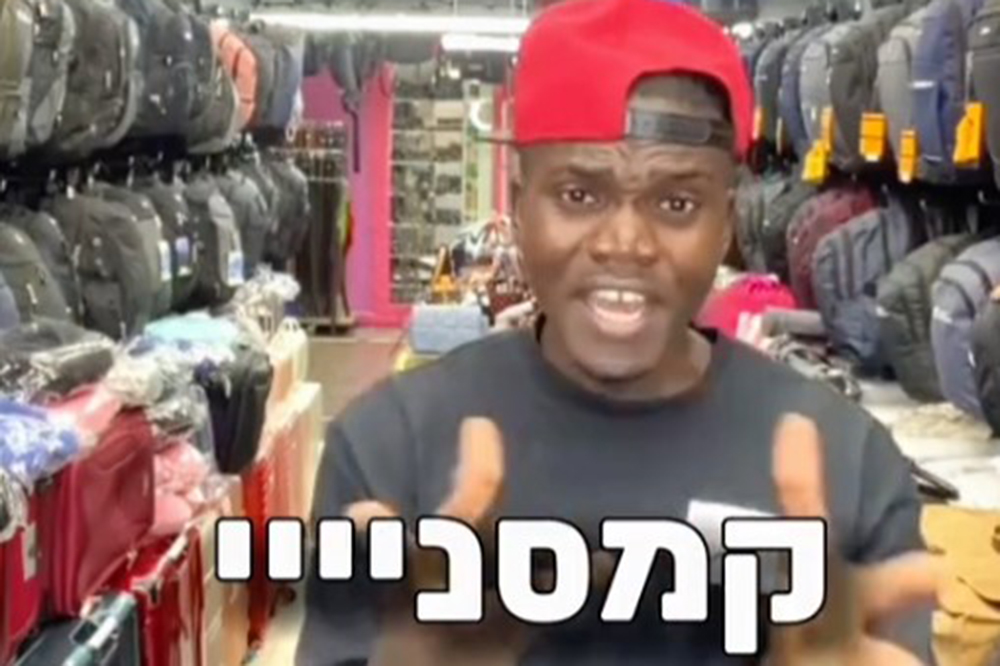
Sheikh Abdul Hakim Muhammad is exhausted. Just since this morning, dozens of children have approached him wanting to make a video with him. "I haven't eaten all day," he says while walking between his two shops on the third floor of the central bus station in Tel Aviv. He is nice to everyone, even to those who have come for the fifth time and asked for a selfie. Lipat, who came from Kiryat Haim, says that her son introduced her to Tiktok and there she encountered Muhammad. "I love the African community, sometimes they are better than us whites,” she says. “Did you see how he brought me water because I came from afar?"
For the past month and a half, there has been a persistent and unrestrained war between three shop owners in the central bus station in Tel Aviv. All three are refugees from Sudan who fled the genocide in Darfur, all three arrived in Israel and were granted asylum here, and all three have an account on the popular TikTok app with hundreds of thousands of followers and millions of likes. At Sheikh Abdul Hakim Muhammad's store you can find mainly bags; at Yosef Adam Hasan's, beauty products and clothes; and at Omran Adam's, who calls his store “The Beauty Garage,” both.
@omranadam6
Hassan claims he was the first to use TikTok and that he got Muhammad into the TikTok business, but Adam disputes this. In any case, and with all due respect to Adam (18,600 followers) who chose not to be interviewed and Hassan (49,100 followers), Muhammad is the hit of the central bus station. With 32,500 followers and 1.4 million viewers for his song “Kamsani” (a mispronunciation of the Hebrew word “kamtzani,” meaning stingy,) he is the breakout star. He attributes his big break to the actor Moshe Ashkenazi, who did a duet with him on TikTok.
")
"In the beginning, I filmed people talking about my service in the store,” Muhammad says. “Children would do dances. Slowly I started talking and selling, I said, 'do you want to fly to Ethiopia? Come take a suitcase with four wheels,’ and slowly it caught on. After a while I said to myself, 'listen, you have to do something.’ I was looking for something new, something that wasn't already done.”
@shaikh_bags #ethiopian_tik_tok #israel #ישראל #אתיופיה #viral #foryou
♬ original sound – ???????????????????????? ????????????????
His inspiration for the popular song “Kamsani” came when customers would accuse him of being stingy. “The Israelis always argue about the price,” he says. “I tell him, it’s 50 [shekels], he says 40 [shekels], and I would always say, 'why are you stingy?' One night I recorded myself singing 'because you're stingy.’ I heard it and burst out laughing.”
The rest was history. Muhammad came back to the store and made the video. An hour after posting it, his pronunciation of the word “kamtzani” had been corrected, but the video caught on regardless.
Around 2,500 TikTok users—soldiers, business owners, gym trainers, girls selling makeup—made their own videos using the song. Altogether, the videos have millions of likes. “Business has boomed by 15% since the video became a hit," says Salomon, a barber at a nearby barbershop and a regular participant in Muhammad's videos.
“Quickly, everything became difficult”
Muhammad fled Sudan carrying only a bag with money, a passport, a shirt, and underwear. After arriving in Egypt, Bedouins smuggled him into Israel in an empty concrete mixer. “We drove all night from Egypt to the border, everything quickly, quietly,” he says. “At the border they shot at us. A few were injured, but you only worry about yourself. You tell yourself that if you're alive, you're fine.”
Since arriving in Israel in 2012 at the age of 18, Muhammad has worked to earn money to send back to his family in hopes of moving them to a safer area. He was able to move his family, but that area was bombed too. His brother was injured and his father died of an illness a month ago.
Muhammad had high hopes for his new life in Israel. "I knew I would be safe in Israel, that it has a big heart, that it respects people, that it accepts refugees,” he said.
")
After arriving in Israel, Muhammad was taken to the Holot detention center on the border with Egypt. There, he was given clothes, food, and vaccinations. A few days later, he was taken by bus to Tel Aviv.
“I thought I was a king, but quickly everything became difficult,” he recounts. “It was raining, you have no home, you have no family, you have nothing. If I go back there I die, so what does it matter?”
Little by little, he made a life for himself in Israel. He rented an apartment with friends on Levinsky Street not far from the central bus station. He got a job in a restaurant washing dishes and helping in the kitchen.
From there, he found all sorts of jobs, in construction, a laundromat, a supermarket, and eventually in a luggage store in the central bus station. After some time, Muhammad bought the luggage store from its previous owner.
All the while, he studied Hebrew. He was the first one to show up to his classes. When he speaks about his teacher, Sara, his eyes light up. “I thank her a lot,” he says.
“If there is peace, I want to return”
Hassan, who owns the beauty supply store, has excellent Hebrew. He is 33 years old, and arrived alone from Darfur 2010. Tears well in his eyes as his shows the scars from his torture at the hands of the Janjaweed, a Sudanese Arab militia. “Sorry,” he says. “Everything is fine.”
After being caught and tortured twice by the Janjaweed, he decided to flee for Israel. A few years ago, he got married in Ethiopia to a woman from the area he grew up in. After she got pregnant, she returned to Sudan and he returned to Israel. “If there is peace, I want to return,” he says. “The most important thing for me is to be with my wife and daughter.”
He fled his village, as did the rest of his neighbors, in 2003 when the village was bombed. “We arrived at the place of the United Nations, and there we received protection,” he says. At the age of 20, he decided to seek asylum in Israel. He walked for four days from the Darfur region to Khartoum, the capital of Sudan. From there he traveled to Wadi Halfa, on the border with Egypt, and then to Cairo. It took him three more days to reach the border with Israel.
When he arrived at the Israeli border, soldiers welcomed him and gave him waffles. “First time in my life that I ate one,” he says.
He stayed in Ramon prison for nearly four months, until a family from Kfar Vitkin, a moshav in central Israel, became his guarantor. While living with the Eyal family, he worked, studied Hebrew, got a driving license, and took construction classes. In 2017, he moved to Tel Aviv.
“I decided I wanted to be independent,” he says. “I walked around the central station and saw that there was a lack of children's clothes. At first I worked on the fourth floor. I had partners, but I didn't get along with them, and I continued like that." He moved his floor to various floors, until returning to the third floor six months ago, when his business took off.
Help from God, and from TikTok
Hassan says that his number two source of support (“after God”) has been TikTok. “I joined TikTok at the end of 2021,” he says. “After the coronavirus, people didn't have money to spend on anything. But people don't skimp on something for the face and hair. I told myself that TikTok has advertising, and I started advertising face and hair cream while instructing people how to use it. My first video went straight to the For You Page [the main feed seen by Israeli TikTok users] because I realized that in this application they like original content, and I learned everything by myself.”
")
"Since the success of TikTok, sales have increased, but the prices have not," boasts Hassan, who always has to take 40% off the price printed on the product packaging in his store, a sort of marketing method. "I like to earn what I deserve. It's important to me that the customers leave with a smile." He brings products from all over the world. "Everything is special,” he says. “What I have is not in the supermarket." His most unique product is a yellow stone that helps with skin problems, which he imports from Sudan.
“You must come and see for yourself”
Muhammad and Hassan both hope to leverage their TikTok fame into larger dreams for their futures.
"In 10 years I want to be a star on stage, singing, making jokes,” Muhammad says. “This has been my dream since childhood. I would see 50 Cent, who sings well, dresses well, is strong, and want to be like him. When the man comes to you to shop he wants a suitcase, but when a man comes to your concert he comes for you.”
"In every country there is a place that no one sees,” Hassan says. “Every bad thing is thrown away in south Tel Aviv. Drug addicts are brought here, mentally ill people. Why not take care of them? You see these people falling in the street, it doesn't interest anyone. I look at the person, and my heart is open to every person, no matter who you are. I would like to be a doctor, but I am not allowed to study here. I would like to return to Sudan."
")
Muhammad admits he has forgotten some of life in Sudan. “But if there is peace, I want to return, even though I love Israel,” he says. “There is still racism, they tell me, 'You are an infiltrator, go back to Rwanda.' ‘He is problematic, stay away from him.’ The Israelis think that everyone wants to come here, but most people in Sudan do not want to come here. My uncle, a strong Muslim, did not want to accept money from me because I am from Israel."
As the evening arrives, the shops on the floor slowly begin to close. The sellers take down the corrugated metal gates, lock them, and hope that the boom will continue. Those who come to take selfies with the hottest TikTok stars do not always buy luggage, but the increased customer traffic is encouraging. More and more shop owners in the station have started using TikTok in the last few weeks, even the elderly Georgian shoe seller.
@yousifdam8 #رهد #israel #ethiopian_tik_tok???????????????????????????????? #african
Among the customers who frequent the stores are also quite a few LGBT people, many of whom feel comfortable in the strange, diverse space that is the central bus station. “Meeting the trans people was very exciting," says Hassan. "I have never met such people. There are Israelis who are afraid to come to the center, but I tell them: you must come and see for yourself, there is nothing to fear."