
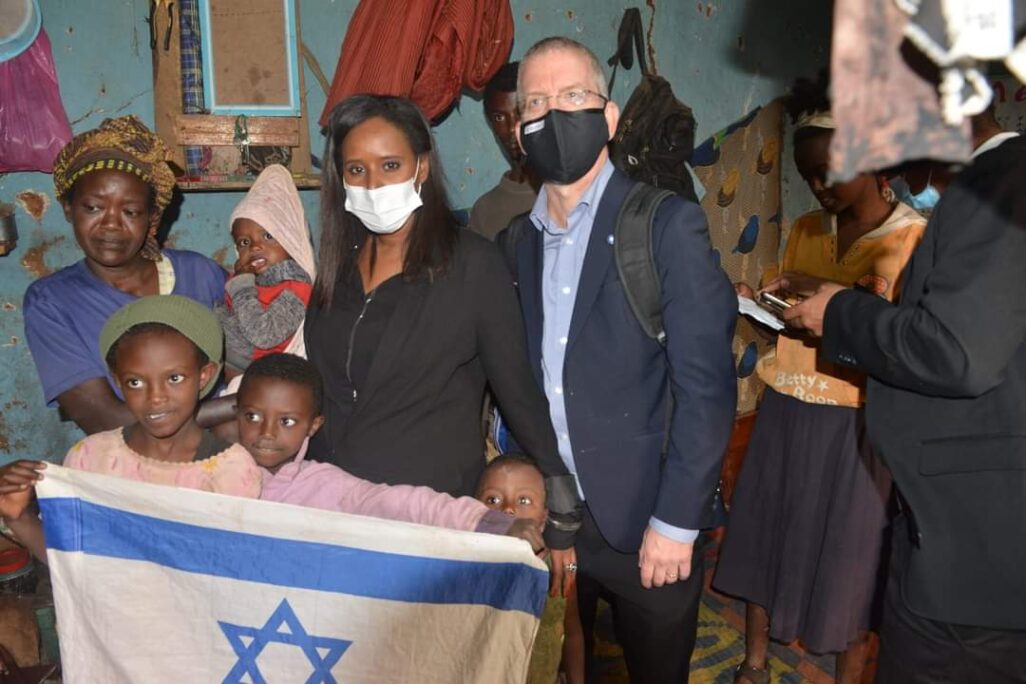
When the last of the immigrants stepped off the plane from Ethiopia on July 12, former Minister of Immigrant Absorption Pnina Tamano-Shata knew she had sealed a chapter in Israel's immigration history.
"I wouldn't have stayed in the government if they didn't provide a real response to the members of my community," Tamano-Shata, the first Ethiopian-born woman to serve in the Knesset, tells Davar, "Why did I go all the way to the government, for honor? Not at all. To be a loyal emissary."
Operation “Tzur Israel” began in December 2020 and has brought 5,000 Ethiopian immigrants to Israel to be reunited with their relatives. Throughout this time, Tamano-Shata served as the Minister of Immigrant Absorption under both the Netanyahu-Gantz (2020-2021) and Bennett-Lapid (2021-2022) governments. The future of some 2,000 additional eligible immigrants waiting in camps in Gondar and Addis Ababa is uncertain, given the lack of a dedicated budget for aliyah in the current government.
"It feels like I’ve missed an opportunity,” Tamano-Shata says. “If I had two more years, I would have found a budget for those 2,000 people waiting who have first-degree relatives [already in Israel]. But this government, they put zero shekels toward aliyah. It's a shame and a disgrace. We must remember that those who abuse the weak pay a price.”
Tamano-Shata asserts that it is a national responsibility to find a real solution for those waiting to make aliyah, and claims that “the fact that the government is dealing with the judicial reform and not really with anything else is very acute and painful for the public.”
Alongside the plane of immigrants that landed earlier this month, a delegation of various government ministries officials who flew to see the situation in Ethiopia up close also returned to Israel, together with representatives of the Jewish Agency and Jewish organizations from the United States. According to the current Minister of Aliyah and Immigrant Absorption, Ofir Sofer of the Religious Zionist Party, the officials’ trip is meant to set a path forward for continued aliyah in the near future.
As it stands now, those eligible to make aliyah from Ethiopia have to continue to wait for the foreseeable future. The delay is apparently based on ideological concerns of members of the current government. Tamano-Shata recounted the objections to Tzur Israel that she experienced within the government.
")
"[Former] Interior Minister [Ayelet] Shaked had [Population and Immigration Authority Director] Tomer Moskowitz, who refused to advance the issue,” she says. “The man told me, 'If it were up to me, no one would make aliyah.' There was a direct conflict, and people paid a price, even at the cost of their lives. The major claim is that it will never end, that the camps are filling up. It's a great insult to the Jewish people."
Tamano-Shata describes the agonizing wait of those eligible to make aliyah, and the disregard with which the government has related to their situation. “Over the years, I have seen how children and adults die waiting,” she says. “This is a matter of life and death, and the Israeli government is taking its time. Those who are not entitled to aliyah should not immigrate, and those who are eligible—they should immigrate immediately. It shows the neglect of a population that has no voice."
The path to approval for "Tzur Israel" was not simple. Nevertheless, it has a considerable budget of close to a billion shekels—390 million shekels (about $100 million) for "Tzur Israel 1," in which 2,000 immigrated, and 570 million shekels (about $153 million) for “Tzur Israel 2,” through which 3,000 immigrated.
Operation “Tzur Israel” was part of a specific budget allocation for aliyah from Ethiopia. In order to accomplish this, Tamano-Shata was involved in long negotiations with the Ministry of Finance. Following the setting of the agreed upon budget, a senior official in the budget department tried to re-enter negotiations with Tamano-Shata in order to reduce costs. "He sat with me, and said, '1,800 immigrants and this is what there is,' I told him, 'You don't talk to me about immigrant numbers,'” she says. “I negotiated a budget, and from there the number of immigrants was derived. This is also something that doesn't happen in any other aliyah. It shouldn't be like that, but I did everything I could in order to move things forward."
It wasn’t only finances that posed a challenge for the approval of “Tzur Israel.” “I had a clash … with the National Security Council,” Tamano-Shata explains. “They issued a report that [the prospective immigrants] were not Jewish, and that someone had influenced them.” However, after meeting with her, the body changed their perspective. Following their discussion they said to her, “We are with you through thick and thin,” she says. “They understood the human, social and Jewish perspectives.”
Even Tamano-Shata did not previously support this sort of aliyah—immigration of those who a few years ago were referred to by the derogatory phrase "Falash Mura,” the name given to descendants of the Ethiopian Jewish community who voluntarily or forcibly converted to Christianity. While non-practicing, they are Jewish by ancestry. Opinion and policy on their immigration to Israel on the grounds of the Law of Return and on humanitarian grounds has varied widely over the years, including claims that Tamano-Shata herself even opposed the continuation of Ethiopian aliyah in her first year as a Knesset member.
"I'm the granddaughter of a Kahane [an Ethiopian-Jewish priest],” she says. “I immigrated at the age of 3. I didn't understand the subject as well [when] I entered the Knesset in 2013. I was 31 years old. I haven't changed my position since then, but I formulated it. In the first year, I studied the subject. I never said I objected, I said I needed to check, and I went and researched."
During her research, Tamano-Shata found approval given by her grandfather for the immigration of Jewish Ethiopians who were not recognized as Jews according to halacha at the time.
"There are those who looked at that year and said I was against it, but you have to understand that with authority there is increased responsibility,” she says. “When I took on the role of minister I knew it was an important issue, and I worked on leading to meaningful solutions."
When Tamano-Shata begins to tell the stories that she heard, those she was able to help and those that she didn't, she is moved. The reason why she fought for "Tzur Israel" solidifies into stories, with faces, names, pasts, and futures. She recalls how moving it was for the Chabad members guarding the Jewish cemetery in Addis, and the responsibility of updating Ethiopian Israelis who have been waiting years for the immigration of their relatives.
She also shared a story of a shocking encounter from her visit before the start of “Tzur Israel” in late 2020. "When I left the camp in Addis Ababa, after meeting several hundred of those waiting, a non-Jewish woman who lives in the village came up to me and said to me in English, 'I have to talk to you, are you from Israel?'” she recounts.
The woman led Tamano-Shata to a mud house, explaining that the family who lives there are Beta Israel, Ethiopian Jews. “I arrived with the security guards to a poor and miserable house, with no food, nothing, and gaunt children,” Tamano-Shata recalls. The mother explained that while her brothers made aliyah nearly 30 years ago, she was 15 years old and had children, so her aliyah was denied. “I was horrified that that's the only reason she's the only sister that remains there with her elderly mother," Tamano-Shata says of the experience.
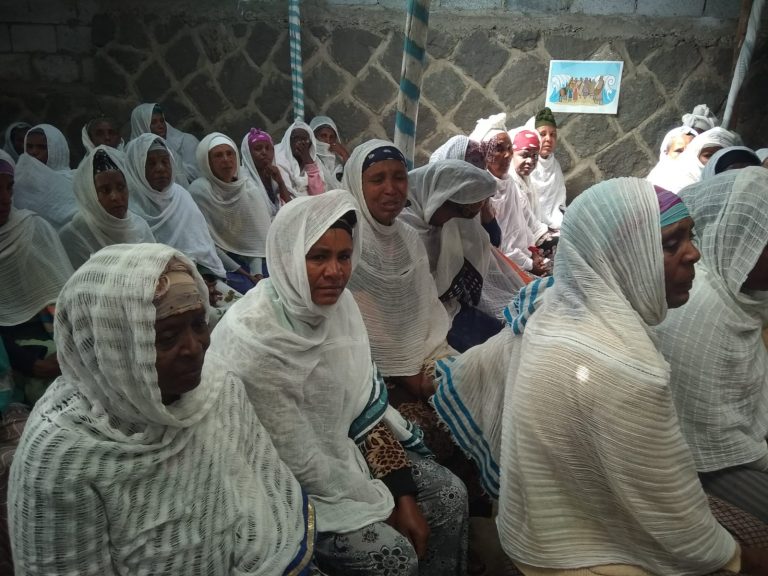
"I returned to Israel, contacted the family, checked and realized that she did not meet the criteria that existed at the time. Even after her brothers immigrated under the Law of Return,” Tamano-Shata says. However, a year later, Tamano-Shata received news that the woman had landed at Ben Gurion Airport. “I cried, I was so moved, it was for me the understanding that a life-saving government decision can correct an injustice,” says Tamano-Shata.
Alongside the success of Tzur Israel, there are quite a few failures as relates to the bureaucracy of the Ministry of the Interior—for example, a child of a Christian mother who converted after marrying a Jew who was left behind in Ethiopia when only the shared children of the mother and her Jewish husband were allowed to enter. Or a Jewish father who married a Christian, immigrated to Israel and left behind his wife and daughter. When the mother died, he was forced to pay for foster care for his daughter for years.
"The Interior Ministry's answers are disgraceful,” Tamano-Shata responds to these stories. “Everyone will pay for this injustice. It's karma. How can such a thing be done? I will fight for these cases."
"It can't be that only ministers from the [Ethiopian] community will serve the members of the community," Tamano-Shata says. She is proud of the fact that as minister she took on responsibility for everyone, especially Bnei Menashe, Jews from India, about 1,000 of whom immigrated during her tenure. "If aliyah is not renewed, it will be a collective struggle. It's a shame that everything has to be achieved here through protests,” she says.
This article was translated from Hebrew by Marina Levy.