
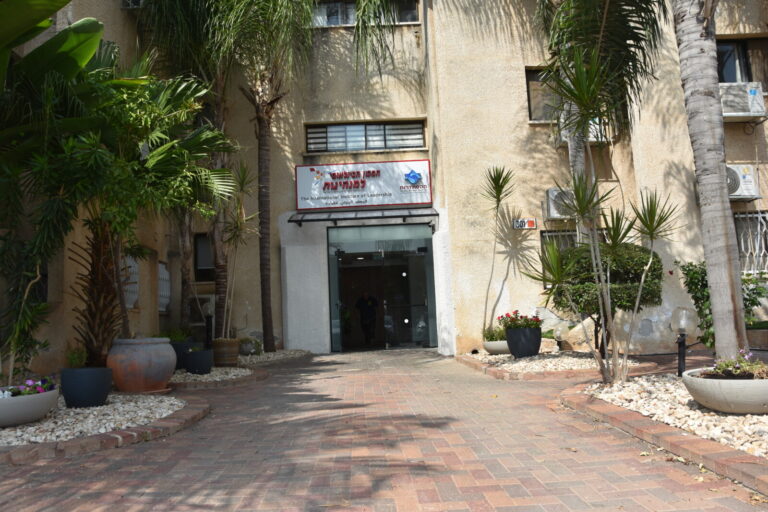
It is quiet in the lobby of the Histadrut's International Institute of Leadership, located at Beit Berl College in Israel’s Sharon region. Everyone in the lobby is anxiously watching the news as the IDF spokesperson gives a speech, trying to glean a shred of information about the situation back home. Suddenly, dozens of children arrive from an activity that has ended. "Shhh," the adults whisper, and the children quietly walk to each of their families.
A few minutes later, a young couple with a tiny baby arrives at the reception. With confused looks, they say their names, and suddenly an elderly woman runs up and picks up the sleeping baby from the stroller. "Now everything is fine, Grandma is with you," she whispers to her, and the mother of the baby melts into her own mother's hands and begins to cry. "I didn't know where you were," she says, "How lucky we are that everything’s okay."
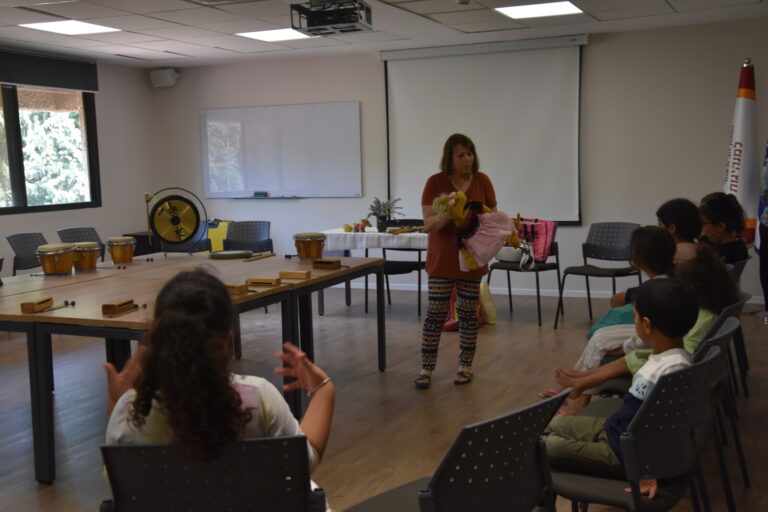
In normal times, the International Institute of Leadership serves as a professional training center for unions and as a base for delegations from abroad invited by the Ministry of Foreign Affairs. A delegation of journalists from Brazil was supposed to stay in the institute starting next week, but now all 45 rooms are being used to host families who fled the Sderot and Ashkelon regions, which have seen heavy rocket fire. The families staying are a diverse group: from babies to the elderly, secular, religious, and ultra-Orthodox, and from all ethnicities.
״I didn't think something like this would happen to us in our country״
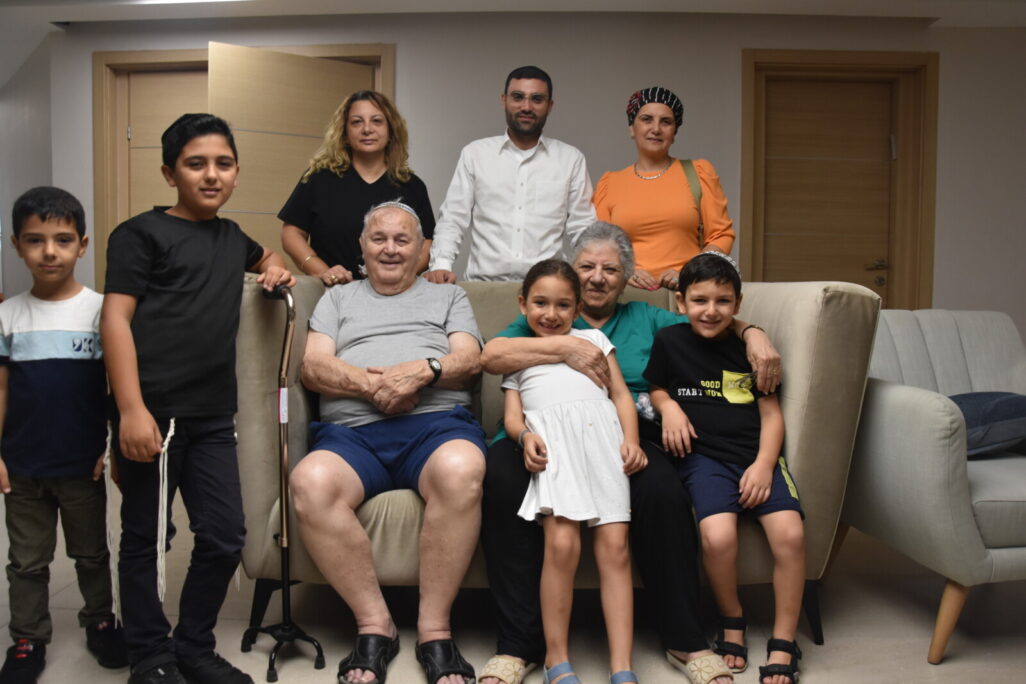
Vivianne (81) and Raymond (86) Barchechath, residents of Ashkelon, sit and watch the IDF spokesperson's messages with concern. They arrived here on Monday afternoon, a family of 17 people, all from Ashkelon. Vivianne and Raymond, their two daughters (out of their four children) Tali Gal and Ariella Elbaz, their grandson Elia Elbaz, their spouses, sons-in-law and daughters-in-law, grandchildren and great-grandchildren.
"On Friday, my parents and I went to my sister in Sderot for a vacation," says daughter Tali Gal, "where we got stuck. From Saturday at 6:00 in the morning, the sirens began, with power outages in between. We started hearing about terrorist infiltrations, a lot of hysteria, and chaos. We received orders to close the shutters, so we just sat in darkness."
"We were in the safe room for many hours, I don't remember how many," Vivianne describes. Gal adds: "Our parents are older, and it was very hard to run to the safe room all the time, so they just sat there in the room all the time, in the dark."
Their daughter Ariella Elbaz was with her family at home in Ashkelon. "From Saturday, there were just barrages of rockets and incessant sirens. Missiles exploding all around us, smoke everywhere,” she says.
Her son, Elia, says he was busy planning his wedding, which is scheduled to take place in about a month. "I literally collected shrapnel from our balcony," he says. Ariella adds: "Mentally, it was unbearable. As soon as we realized that Tali's son-in-law had found a place, we inquired for us as well, and were immediately told that we had room for the whole family."
"My son-in-law is a civilian IDF worker, so he heard about the place, they came here first and invited us,” Gal says. “They just accepted us all. We came with a small bag, the one we were with at my sister's house on Saturday. Here I heard that my two sons had received an emergency reserves call up. Yesterday we went looking for some clothes, we only found the Super-Pharm open, and we were able to buy some hygiene products and underwear. We have no clothes, we are with what we came with."
Vivianne adds: "I'm still wearing my slippers, but it's a small thing. They welcomed us with open arms. We didn't expect this. We wanted some quiet, and we really got so much more."
"I made aliyah to Israel from Morocco in 1955, after King Mohammed V was exiled, and there was a pogrom against the Jews in the city," says Raymond. "At this stage, although things were good for us in Morocco beforehand, we decided to come to the land of Israel. Now it's very painful, I didn't think something like this would happen to us in our country."
Ariella says that the emotional damage, especially to the children, is very severe. "I don't know how we're going to get back to normal. We don't have security," she says. "It's truly unimaginable. So many people you know, friends, family. It's something I've never experienced in my life."
Elia says his perception has completely changed. "I don't know how to get back to where we came from. I feel like I still can't even grasp what happened. Now I mostly want them to do what needs to be done. We back the army, whatever is necessary. Just let them give us back our security, our home."
Institute Director-General: "Until they take responsibility for the residents, we are here"
Inbal Giorini Perez, the director-general of the Histadrut's International Institute of Leadership, tells Davar that the institute was closed last week and was only supposed to reopen on Tuesday. “On Saturday, after a quick consultation, we realized that we had to do something," she says. "Since Saturday we have been open 24/7, and we never stop taking in families. From the moment we got the okay to open until the moment they could get out [of the south] and arrive took quite a while. The families from Sderot had to be escorted out, it took a few hours, but now we are fully booked. People are asking to squeeze into rooms to allow more families to arrive."
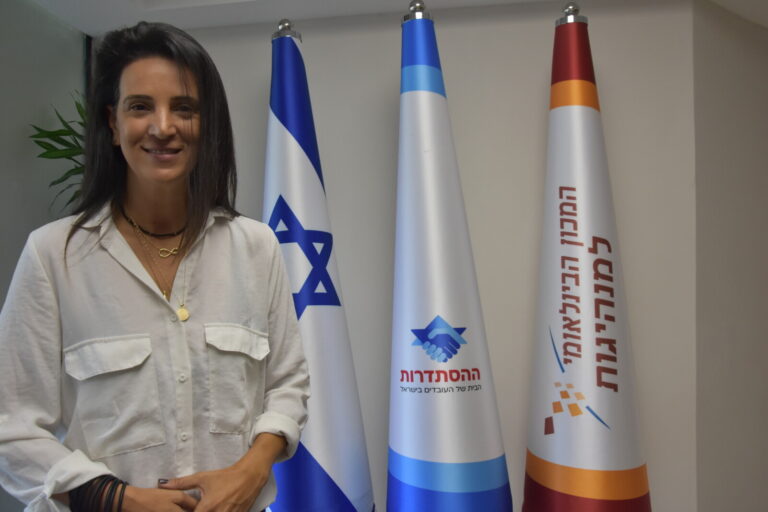
"We're not alone in this. That's the whole Histadrut," she says. "We are also hosting people in Beitar, in Alumim, Mishan, in all the facilities of the Histadrut. There isn't a branch that isn't doing something, from the workers, the unions, the regions, to the chairman of the Histadrut. Everyone is mobilizing, everything is opening up, everything is receiving support."
From Giorini Perez's perspective, the citizens have stepped up to the situation, while the state has not yet fully engaged. "There is an incredible effort happening here from all directions,” she says. “I'm very proud that we have the right to join the war effort. I'm particularly proud. I'm new to the Histadrut, and this is the first time I've seen an organization mobilize like this. The moment we opened our doors, we were ready to receive people. My staff immediately mobilized without even asking questions. Within hours, we started receiving boxes upon boxes of hygiene supplies, food, baby equipment, clothing, everything, from unions all over the country. Even my suppliers immediately said to me, 'Just tell us what's needed.'"
She says that HaNoar HaOved VeHaLomed, the youth movement associated with the Histadrut, has been providing activities for children based in the institute, and that Hapoel, the Histadrut’s sports association, has been running sports lessons.
“Activists are providing activities for children and toddlers, people are offering to cook, lots of equipment and assistance. In contrast to what is happening in our government, this is leadership in my eyes,” Giorini Perez says.
In contrast to civil society, state authorities are responding slowly. "The chair of the Histadrut ordered, with the push of a button, to open all the houses and all the buildings to the residents, all the unions were mobilized, and in less than four hours everyone was on standby to absorb the families. And like us, dozens of other small and large organizations mobilized within seconds to be prepared to help in any way. At this time, we see the government authorities in the country starting to argue with the residents who is eligible, how they are eligible, for whom is there funding, for whom there is no funding. This is absurd. In the end, these are people, these are babies, adults and children with difficult stories,” she says.
"Everyone is missing someone,” she continues. “Everyone knows someone. We all have family and everyone cares, there are children and partners who have been called up. Just as we will need to understand what happened and who failed after all this, we will also need to appreciate all this civilian activity in which everyone in the country is mobilizing towards. There is not one person in this country who has not enlisted in this effort."
She’s excited to host, she recounts, but it's also very hard to see the families when they arrive. "People come exhausted, hungry, with vacant looks. It feels to me like an immense privilege to give them a shower, a bed, a clean towel, the chirping of birds we have here. Until the government ends its quarreling and until it takes responsibility for the residents, we are here."
Chair of the Histadrut Arnon Bar-David, arrived today to visit the Institute and other Histadrut sites hosting residents from the south. "We have harnessed the Histadrut institutions for the benefit of hosting those who fled from the settlements in the south. Today I visited the dear residents of Sderot who evacuated their homes to the International Institute of Leadership in Beit Berl and to the Alumim boarding school of the Mishan network. I met wonderful people there with their children who demonstrated resilience and strength like no other. I thank Director-General of the International Institute of Leadership Inbal Giorini Perez and Mishan Director-General Omri Cohen for their amazing dedication to and contribution on behalf of the residents of the south,” Bar-David said in a statement.