


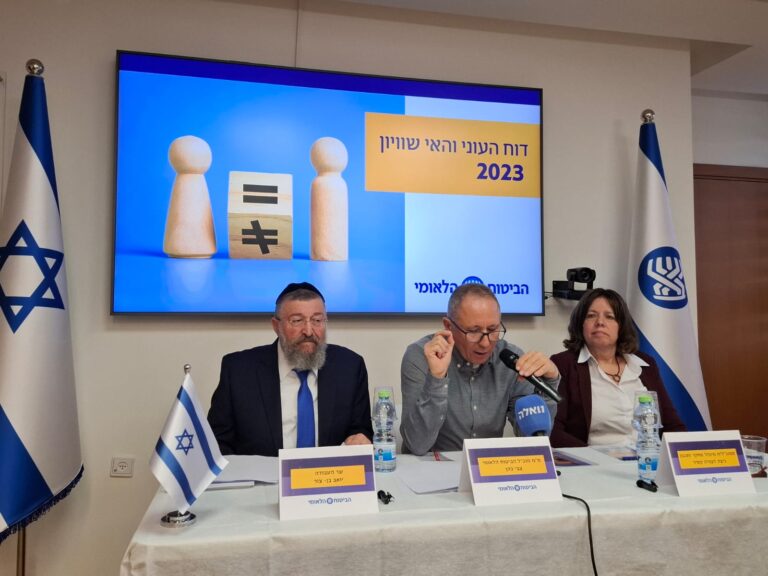
Nearly 2 million Israelis, or 20% of the population were living in poverty in 2023, including 872,400 children and 158,500 senior citizens. That’s according to the poverty and income inequality report published last week by Israel’s National Insurance Institute, known in Hebrew as Bituah Leumi. Israel’s poverty rate is nearly twice the average OECD poverty rate of 11.6%, and Costa Rica is the only developed country with a higher percentage of poor citizens.
Poverty rates have remained almost unchanged compared to last year. Israel’s 2023 Gini coefficient, a measure which calculates socioeconomic equality based on individual or household income and consumption, stood at 0.369, a 1.5% increase compared to 2022. (A Gini coefficient of 0 represents total equality; the OCED average Gini coefficient in 2022 was 0.324.)
Child poverty in Israel is similarly severe: Israel ranked second in child poverty among OECD countries, with only Costa Rica below it.
An individual is considered poor if their income is below the poverty line, which in 2023 was 3,324 shekels ($907) per month. The poverty line is defined as 50% of the median income.
According to this calculation, a single person needs 4,155 shekels ($1,135) per month to be above the poverty line, a couple with one child or a single parent with two children needs 8,808 ($2,405) shekels per month, and a couple with two children needs 10,637 shekels ($2,903) per month to stay above the poverty line.
Eran Weintrob, head of the major anti-poverty organization Latet, pointed out that defining poverty according to median income doesn’t take into account the rising cost of living in Israel. “This means there will be a significant negative impact on families living in poverty in the coming year and in the years that follow,” he said. “Without a significant increase in government assistance and its adjustment to the levels seen in developed countries, especially in light of the planned economic measures and the consequences of the war, we anticipate a dramatic worsening of the socioeconomic situation of vulnerable populations in Israel.”
Israel’s National Insurance scheme has been heavily affected by the wartime economic situation, and the 2025 budget includes an increase in individual payments to national insurance, typically taken out of a worker’s paycheck. Instead of paying 0.4% of one’s income to the program, a worker will now pay 1.2%.
“The alternative was to cut benefits,” Zvika Cohen, acting director general of the National Insurance Institute, told Davar. “When compared, I think the decision was correct.”
Cohen said that the 2023 report highlights the role of National Insurance as Israel’s safety net.
Minister of Labor Yoav Ben-Tzur told Davar that his ministry fought to keep national insurance benefits in the 2025 budget. “The increase will be temporary and will eventually end. I hope that by the end of 2025, when the situation stabilizes, the payments to the National Insurance will decrease.”
Alongside the National Insurance Institute, many nonprofit organizations have moved in to address widespread poverty and advocate for a solution. Eli Cohen, chair of the Pitchon Lev humanitarian organization, said that his organization has experienced a 25% increase in Israelis seeking assistance. “The current budget is fueling the next poverty report,” Cohen said.
He pointed to new austerity measures like increased value-added tax (VAT), electricity prices, water prices, and national insurance rates as policies that will lead more Israelis to poverty.
“The only way to reduce the monstrous poverty levels we have reached in Israel is for the government and the Finance Ministry to cancel all the measures that directly harm the most vulnerable populations,” he said.
Similarly, Becky Cohen-Keshet of the Forum Against Poverty said that Israel has to change its strategy in order to solve its poverty problem. “The solutions are right in front of us and have already proven themselves worldwide: differential VAT on basic goods that will significantly reduce the cost of the basic shopping basket, expanding the list of regulated products to prevent arbitrary price hikes, expanding eligibility for exemptions or caps on contributions for medications and medical treatment to ensure access to health care, and establishing an authority to fight poverty alongside a National Food Security Council that will systematically link all government ministries in the fight against poverty,” she said.
“When the government manages to lift only a third of the poor while other countries have much higher success rates, this is not fate—it’s policy decisions that can and must be changed,” she continued. “A national emergency plan is needed to integrate all these tools together. The knowledge exists, the solutions are known. What’s missing is the political will to act.”
The National Insurance report found that 39% of Arab families and 33% of ultra-Orthodox families lived below the poverty line, a slight decrease from 2022. These rates are double that of the general population.
Poverty rates among large families (five or more children), which are common among Arabs and ultra-Orthodox Jews, are more than twice the rate for smaller families. They represent 3% of the population but 8% of the poor.
There was good news in the report. The gap between the poverty line and the incomes of the poor decreased slightly in 2023. In 2022, the average poor family made 40.3% less than the poverty line, and in 2023, the average poor family made 39.5% less.
The average poor family also reported feeling less poor, with 74% of poor families reporting being able to cover all their expenses in 2023, up from 70% in 2022. Fewer poor families also reported forgoing medical treatment and skipping meals.
The report demonstrated that government intervention is critical in preventing the worst cases of poverty. Welfare benefits reduced the poverty rate of individuals in 2023 by 34% and of families by 41%, a more significant reduction compared to the previous two years. But Israel’s overall poverty-alleviating welfare system is weak compared to other developed countries, about 60% of the OECD average.
This article was translated from Hebrew by Ronen Cohen.