
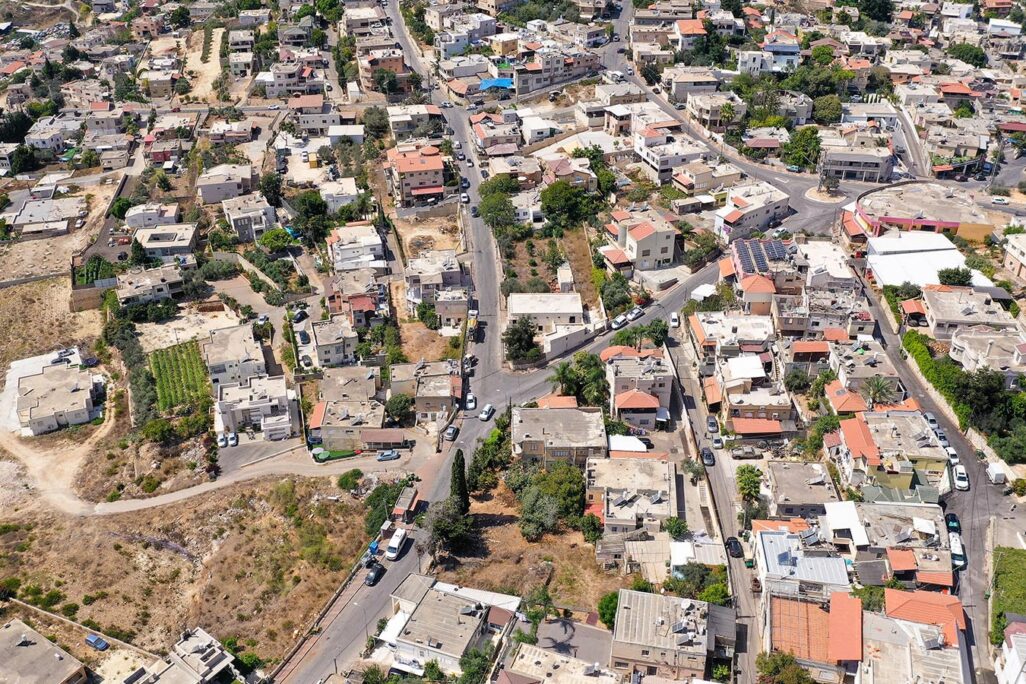
Earlier this month, the government approved a five-year plan for economic development of the Druze and Circassian towns and villages in northern Israel’s Carmel and Galil regions. About 4.35 billion shekels, or $1.2 billion, has been budgeted for the plan, which also includes the establishment of a new Druze settlement. A parallel program with a 520 million shekel ($143 million) budget will provide similar support for Druze villages in northern Israel’s Ramat HaGolan.
About 150,000 members of the Druze minority live in Israel, as do around 5,000 Circassians. Both groups are concentrated mostly in northern Israel, with nearly all Circassians living in the two villages of Kfar Kama and Rehaniya.
Both groups have faced significant state discrimination over the years. A particular point of contention for the minority groups is the 2018 Nation-State Law, a basic law that defines Israel as the state of the Jewish people, effectively relegating non-Jewish minorities to second-class status.
Unlike other non-Jewish minority groups in Israel, Druze and Circassian men are conscripted into the military, with 1 in 16 Druze men disabled by his service in the Israeli military.
“This reflects the strength of the bond between us and the Druze community. They fight alongside us, shoulder to shoulder; we have a unique alliance, called a ‘blood pact.’ I say, it is a blood pact, but it is also a pact of life,” Prime Minister Benjamin Netanyahu said of the new plan.
Finance Minister Bezalel Smotrich added, “This is a direct investment in strengthening the towns, ensuring residents’ economic security, and securing a better future for the next generation. We will continue to act with deep appreciation for the immense contribution of the Druze to Israel’s security and social resilience.”
The program was approved in early March after a five-month delay, despite Netanyahu’s promise to approve it last October. Druze local leaders had planned to protest last week over the delay but canceled the demonstration following Netanyahu’s announcement.
“I hope this is not just a statement and that it won’t remain on paper like previous plans that raised our hopes but were never implemented, leaving our municipalities in a budgetary crisis and reliant on crowdfunding from the public,” Amir Hanifas, chair of the Druze Movement for Democracy and Equality, said.
Hanifas went on to call for the repeal of both the Nation-State Law and the Kaminitz Law, a 2017 law that gives the government increased power to demolish illegally constructed homes. Non-Jewish minority groups in Israel say that they have been placed in a double bind where they are not granted permits to build homes and then treated punitively with home demolitions and fines when they build illegally.
During a discussion in the Knesset in December, heads of multiple Druze localities noted that government refusal to issue building permits meant that hundreds of residents were left without adequate housing.
What’s in the Plan?
Much like Government Resolution 550, the equivalent plan for economic development of broader Arab-Israeli society, these programs will influence a variety of areas.
Building and planning committees specific to the Druze and Circassian committees will be established and will function in cooperation with the regional committees. Subsidies will also be provided for connecting houses to electricity and for the establishment of residential infrastructure for those who serve in the security forces.
The Ministry of the Interior will provide an additional 616 million shekels ($169 million) to the localities’ general budgets, as well as 139 million shekels ($38 million) specifically for the localities’ development budgets.
The plan also includes investments in education and culture in Druze and Circassian localities. Under the plan, the government will invest 100 million shekels ($27 million) in the Druze religious authority, 23 million shekels ($6.3 million) in the Druze heritage center, 21 million shekels ($5.8 million) in the Druze fighters heritages center, and 2 million shekels ($550,000) in the Circassian heritage center.
Special attention is directed to Druze and Circassian youth under the plan, which directs 59 million shekels ($16 million) to youth centers. An additional 10 million shekels ($2.7 million) each will be directed to youth directorates, professional training, and the establishment of a regional center for the study of physics.
The plan also allocates 75 million shekels ($21 million) to the establishment of regional industrial areas, 20 million shekels ($5.5 million) to support small businesses, and 60 million shekels ($16 million) to regional agriculture.
Attention is also given to transportation and accessibility, given that many of the localities are located far away from major cities. The plan provides 537 million shekels ($147 million) toward transportation infrastructure and 25 million shekels ($6.9 million) toward public transportation in the localities.
Following Resolution 549, the government decision to combat crime and violence in Arab society, 48 million shekels ($13 million) will be invested to enhance personal safety and fight crime.
Monitoring and oversight mechanisms have also been established to ensure the program’s implementation. The Economic and Social Development Authority for Druze and Circassian Communities will coordinate the execution, and a steering committee, led by the director-general of the Prime Minister’s Office, will oversee the program.