


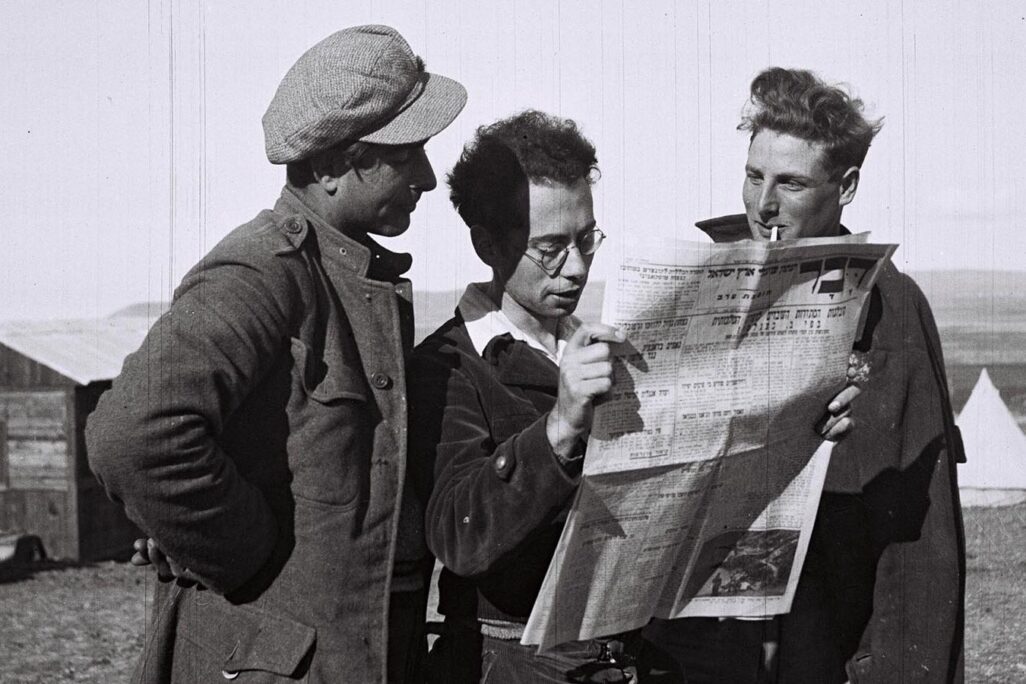
Today, Davar marks 100 years since the publication of the first Davar newspaper on June 1, 1925. More than 20 years before the establishment of the state of Israel, Davar was established by the Histadrut as the first daily newspaper for the workers of the land of Israel, edited by Berl Katznelson and supported by the then-Histadrut chairman and future Prime Minister David Ben-Gurion.
Davar was the most important and influential newspaper in the Jewish community of pre-state Israel, and even after the establishment of the state, its pages formed a central foundation in writing the Israeli narrative. Among its editors and writers were leaders of the pre-state and future state, such as Moshe Sharett and Zalman Shazar; poets and intellectuals like Rachel Bluwstein, Nathan Alterman, and Haim Gouri; and leading journalists such as Doron Rosenblum, Nahum Barnea, Hannah Semer, and Avirama Golan. The newspaper was shut down in 1996 following a financial crisis in the Histadrut.
In 2016, the Histadrut revived Davar as an online news site, and since then it has served as a media home for millions of workers, retirees, social activists, and policymakers, committed to the values of Zionism, democracy, and social justice.
President Isaac Herzog congratulated Davar on its 100 year anniversary. “Davar’s contribution to the Zionist enterprise is one of those well-known facts that need no proof, and the list of writers and editors over the years is enough to understand its strength and its influence on our building as a society and a state,” he wrote.
In a special editorial, Davar’s board reflected on the anniversary. “In an environment of polarized and toxic public discourse, economic gaps, and social rifts, in a country facing an existential threat, Davar seeks to fulfill the role it has always taken upon itself: to be a place that connects current affairs—the news, updates, and alerts—with grand ideas and values of Zionism, justice, and equality,” the editorial board wrote. “To be the protector of the working public, regardless of religion, race, or gender. To allow every reader to lift their gaze from the current state of affairs to a better, more beautiful and just reality. To point to flaws—and also to the possibility of a corrected society. … This comes from the belief that the value-based world from which Davar grew is more relevant to our time than ever before. That even now, Israel must be better, and must be renewed in the light of lofty ideals.”