
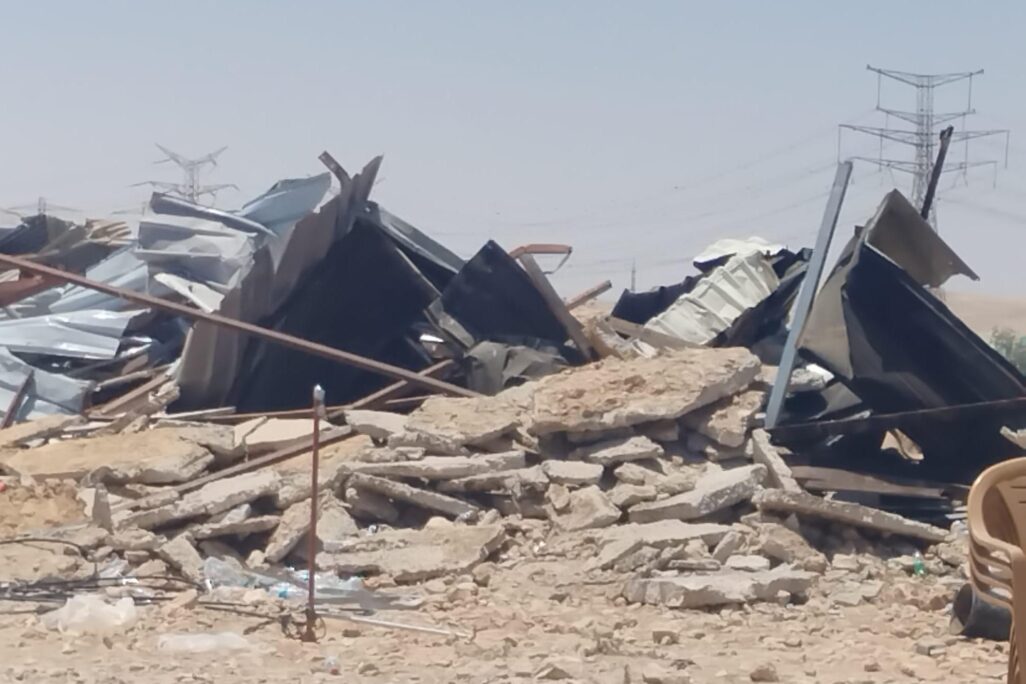
In the Bedouin town of Segev Shalom, Al-Mustaqbal elementary school has transformed from a place of learning into a shelter for families displaced by a wave of home demolitions. Mattresses and blankets are scattered across the yard, and a tent normally reserved for field trips now stands in the center, housing families forced out of their homes.
“This boy is nine years old,” said Ibrahim al-Gharibi, a father of four and a member of the committee of the unrecognized village of al-Sir, pointing to a child playing with a cell phone in the schoolyard. “He was like this yesterday too, and the day before. He didn’t participate in the school celebration because he didn’t get up in the morning. He doesn’t have his backpack, his books. Everything went with the demolition. Instead of getting ready for the holiday, buying clothes and being happy and joyful, the children are lying around in the schoolyard.”
On regular days, about 1,200 students study at the school, including children from al-Sir. But for two weeks now, the classrooms have been taken over by families seeking refuge. “The classrooms are occupied by families,” said Al-Gharibi. “Here the youth sleep, and inside, the women and young children. It’s unacceptable that elderly women, connected to medical devices, are sleeping in a school,” he said, his voice heavy with frustration.
Al-Gharibi, who owns a transportation company, has not been able to work for two weeks. “There are no showers here. You can eat, drink, and sleep. But to shower, to have a place for personal things there isn’t.” He described the youth wandering the schoolyard, aimless and without structure. “The youth are just wandering. They go in and out, sleep. No structure whatsoever.”
The ongoing demolitions have left at least 100 children like the boy in the schoolyard without homes or schooling. “Will this boy support the state? We want him to be with the state. To study, to contribute, to do everything. To start a life. He deserves to live, but without a home how will he live?” Al-Gharibi asked, his frustration turning into a plea.
The demolitions are part of a government plan to regulate Bedouin settlement in the Negev by relocating residents to recognized towns such as Rahat, Hura, Mar’it, and Bir Hadaj. Since May, 264 residential structures have been demolished in Bedouin villages across the region. “They demolished the Al-Walidi family's homes last week and the Al-Kharoumi family's this week. We’re talking about 50 homes that were destroyed, an unprecedented scale,” said Marwan Gaddafi, director of the community center in Segev Shalom.
In response, hundreds of Bedouins protested in front of the Authority for the Regulation of Bedouin Settlement offices in Be’er Sheva, carrying black flags and signs reading “We want to live with dignity.” Talal Al-Krinawi, mayor of Rahat and head of the Council of Bedouin Authority Heads, called for a peaceful protest. “We will speak out clearly against the home demolitions. Yes to dignity, yes to life. No to house demolitions,” he said.
Two years ago, the people of al-Sir signed an agreement with the Authority for Bedouin Settlement Regulation to move to a new neighborhood in Segev Shalom within 22 months. “That agreement is a joke,” said Al-Gharibi. “Two years ago they signed a deal that within 22 months the residents would move to permanent housing. But what did the Authority do? Nothing. They demolished their homes and told them to go manage in the community center or at a school.”
At a recent meeting in Jerusalem, representatives of the village and the Bedouin community met with officials from the Prime Minister’s Office to propose solutions. “Everyone’s there. All the organizations, including the head of the Segev Shalom council. They’re all sitting at the table. But on the other side, no one is sitting with them to resolve this,” said Al-Gharibi.
The frustration is compounded by the tactics used during demolitions. “The Yoav Unit breaks in at 6:00 a.m. to people whose homes are marked for demolition and arrests them, humiliates them. Why do they need to be humiliated?” Al-Gharibi asked.
The leadership of the Arab-Bedouin public in the Negev has vowed to continue the struggle against home demolitions until a just solution is found. At a recent gathering in al-Sir, the High Steering Committee for the Arabs of the Negev and the Council for Unrecognized Villages called for unity and escalation of protests if the government’s “Focused Plan” is not canceled. The plan for regulating Bedouin settlement in the Negev and approved by the government in June 2023 includes the demolition of unrecognized villages and the relocation of residents.
Atiya Al-Asam, head of the Council of Unrecognized Villages, stressed the importance of creating plans internally. “It is our role to create our own plans, including the heads of the local authorities, and not the role of the Bedouin Authority,” she said. At a Bedouin Society Conference titled “Between Tradition and Modernity,” experts and community leaders discussed the complex challenges facing the Bedouin population. “The conflict is originally a legal one. There are differing perceptions between the state and the Bedouins regarding land ownership,” said Dr. Tzvika Aviv.
Others emphasized the need for greater political power and community development. “There was leadership that wanted to promote Bedouin integration into the state,” said Mohammad Kaabiya, Chairman of the Bedouin branch of Yad Labanim. “But political power is necessary. Without it, nothing can move forward.”
“The Bedouins are not going anywhere. Our dream is to live in a diverse and tolerant country. We want equality and to integrate,” said Ahed Rahal, Head of the Al-Batuf Regional Council. Despite the challenges, residents stress their desire to be part of the state. “We’ve never been against the state, and we never will be. We’re an inseparable part of it,” said Al-Gharibi.
But without homes, infrastructure, or a clear path forward, the future remains uncertain. “This isn’t life. We’re just waiting for the day to end and the night to pass,” Al-Gharibi said. “Better to die. If you don’t have a home, you don’t have anything. They destroy the house, what’s left to live for?”
This article was translated from Hebrew by Marina Levy.