
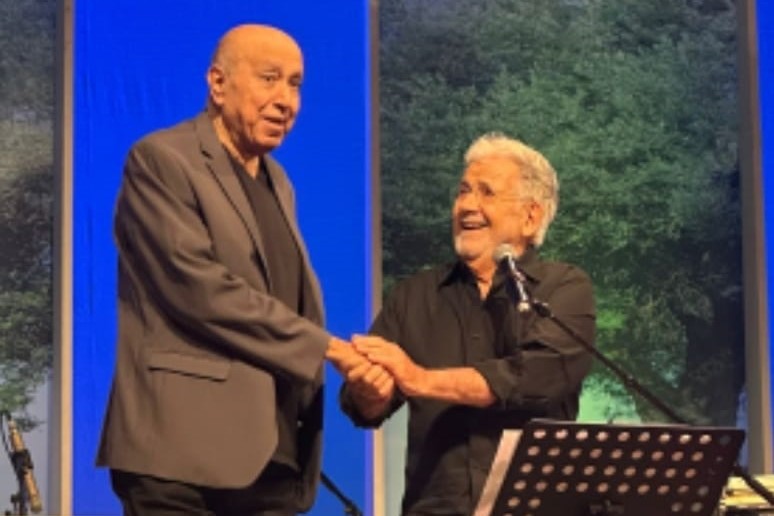
The Jewish-Arab Institute of the Histadrut created a special panel in collaboration with the Storytellers Festival, featuring storytellers who focus on shared life, coexistence, and union between the religions in Israel. "Just like in the past two challenging years, we will continue to believe, to hope, and above all to strive to build bridges between the religions in Israel," said Shadi Kablan, CEO of the Jewish-Arab Institute.
Yossi Alfi, who founded the Storytellers Festival in 1993, moderated the panel, which took place last Sunday at the Givatayim Theater. Participants in the panel included Haifa Mayor Yona Yahav, the Mayor of Daliyat al-Karmel, Rafik Halabi, journalist Zouheir Bahloul, Professor Uzi Rabi from the Moshe Dayan Center for Middle Eastern and African Studies at Tel Aviv University, CEO of the Jewish-Arab institute Shadi Kablan, and Moshe Ben-Atter, a member of the institute’s board of directors.
The festival focused on childhood stories about life in mixed neighborhoods. Ben-Atter, who grew up in Katamon, shared about his childhood: “My father had an Arab partner, the mukhtar (head of local government) of Beit Safafa, Omar Alian. They were partners for almost 40 years. I told the stories of fraternity, shared loyalty, and friendship, which did not fade even in the hard times, when I was a child during the Six-Day War.”
Ben-Atter, one of the festival organizers, told Davar about the difficulty, but also the importance of the event: “It is very difficult to operate in an atmosphere of a war that has not yet ended, and there is still tension. And the relations between Jews and Arabs in the State of Israel have regressed because of this war.”
The institute’s activities have also been affected over the past two years. “Now we need to rebuild these ruins, to create a new atmosphere,” said Ben-Atter. “I know that many people were hesitant to attend this event because the atmosphere wasn’t right. But this is precisely the role of the Histadrut’s Jewish-Arab Institute: to fight against this trend and to look forward.”
“Especially now, at a time when tension seems to be rising, and there is reluctance and stereotypes breaking out, it is precisely at this time that we need to sit and talk together,” emphasized Ben-Atter. “We live together; no one is going anywhere. The relations between Jewish and Arab citizens are very important. I am very glad that the Histadrut created this platform through the Jewish-Arab Institute to lead activities both in workplaces and in civil society in various places. This is what we do at the institute throughout the year: nurture this activity (of Jewish-Arab dialogue and co-existence), discuss it among many parts of the public, and contribute our part as a social organization to a fruitful dialogue, good relations, and shared existence.”
According to Ben-Atter, despite some reservations, the event received positive responses. “Even people who seem to have rigid views and a lack of trust, which deepened during this war, we suddenly saw that here, after all, people can get along. We were all created in the image of God, and we make every effort to improve dialogue and the atmosphere, and it gives a good feeling. I think that ultimately, the dynamics of the relationships that develop between Jews and Arabs, in all meeting places, in hospitals, pharmacies, markets, workplaces, are life itself, and this is what we need to nurture.”
Ben-Atter is acutely aware of the existing tension between Jews and Arabs in the country, saying “I think these relations can be good if we learn to address this issue from a young age, so that Jews meet Arabs, discuss the various problems that exist, it’s not on the political side, but on the social, community side, on the side of shared life, to educate for a culture of peace. That’s what we want, because a culture of peace comes before peace itself. When we educate people to live side by side, we create an atmosphere that ultimately allows for a more respectful and considerate approach to one another.”