
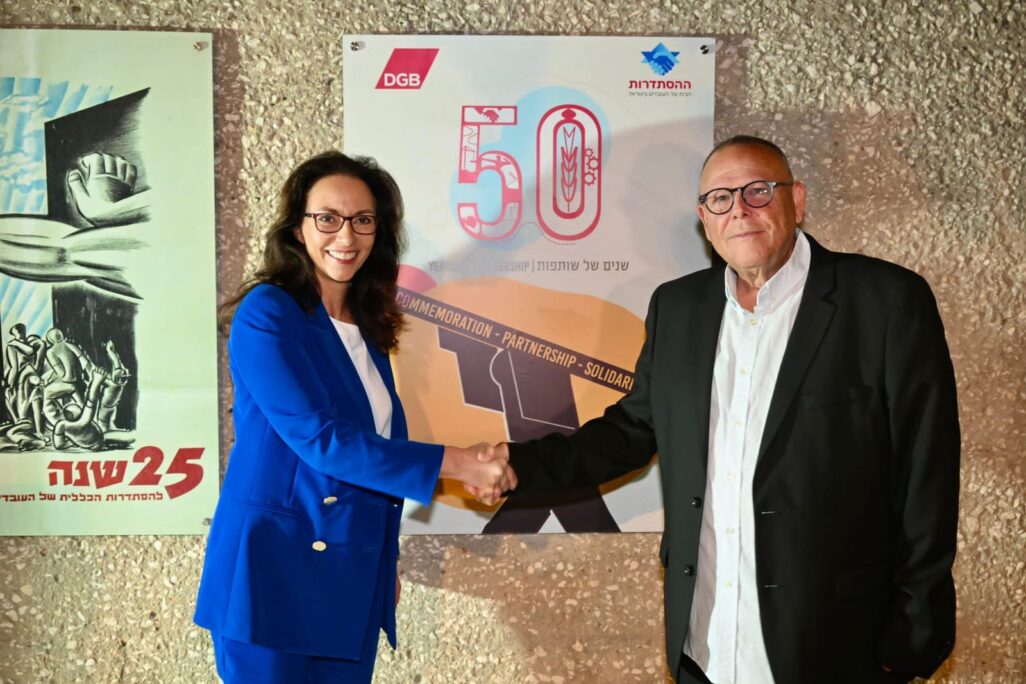
“You, the Histadrut, are our brothers. You always work for all workers and their rights, and for all people. You are not the government and not the state. That is why it has always been clear to us at the DGB that we extend our hand to you, and so it will be for the next 50 years as well.”
These are the remarks of Yasmin Fahimi, President of the German Trade Union Confederation(DGB), at an event marking 50 years of relations and solidarity between DBG and the Histadrut.
She continues: “The partnership between us is a genuine and meaningful one, seeking to build connections that strengthen democracy, workers, and the idea of peace. You have gone through two difficult years of cruel suffering. We deeply felt the unimaginable horrors that Israeli society has endured. We long for the day when people will stop hating and killing one another.”
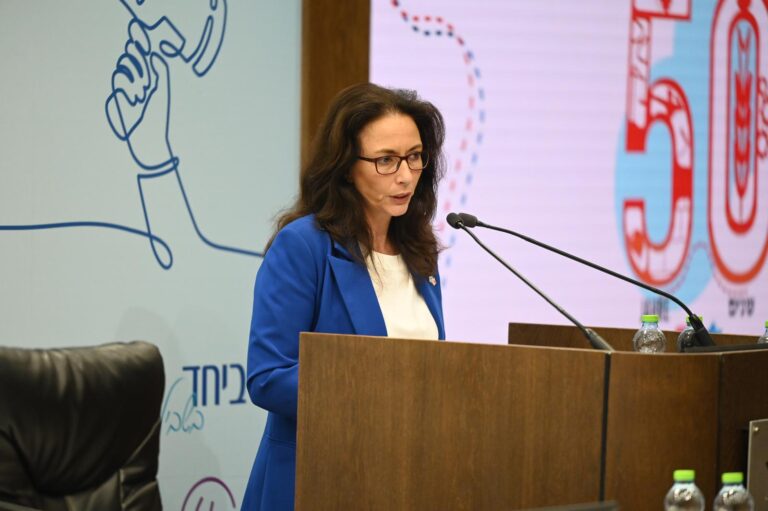
The first cooperation agreement and memorandum of understanding between the organizations was signed exactly 50 years ago by then–Histadrut Secretary-General Yeruham Meshel and DGB President Heinz Oskar Peter, Fahimi noted.
“Even before that, even before 1957, when diplomatic relations between Israel and Germany began, talks and connections between our unions had already started. That took courage, and such courage is still needed today. I believe that trade unions can play a role in promoting peace and educating for peace.”
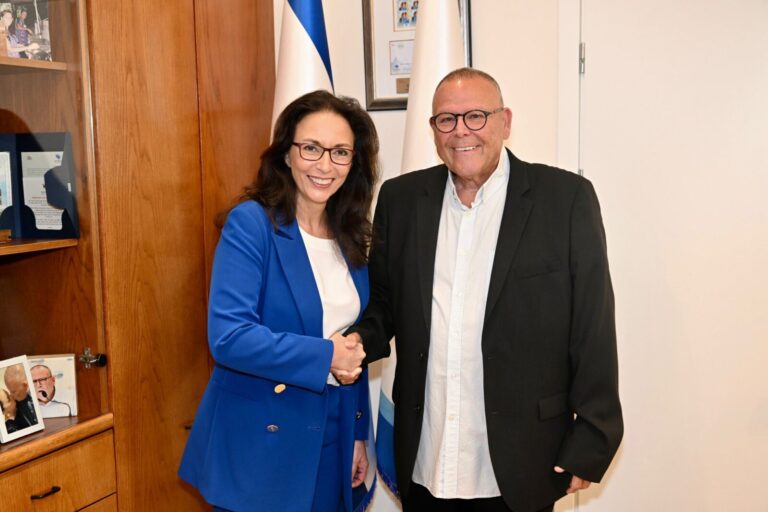
This past April, Fahimi, together with Histadrut Chairman Arnon Bar-David, signed the renewal of the partnership agreement between the organizations. The document states that both organizations are committed to promoting peaceful solutions to conflicts in the Middle East.
“The solidarity of trade unions can help connect organizations across political boundaries,” she said. “I believe it is right to strengthen this aspect of our relationship and to bring it to life, to commit together to advancing peace between peoples.” she says.
Fahimi emphasized the importance of promoting exchanges between young members of the two unions, which would help deepen understanding of the complex reality in Israel and bring the voices of Israeli workers to decision-makers in Germany.
“Fifty years of partnership between the Histadrut and the DGB is much more than an organizational milestone. It is a human, moral, and social story, about the courage to reach out, the ability to heal wounds, and the belief in the power of solidarity to cross borders,” said Histadrut Chairman Arnon Bar-David.
“When this partnership was born in the early 1970s, it was an act of tremendous trust. Just one generation after the Holocaust, it took courage for Jews and Germans to meet and create a foundation for dialogue and cooperation. Since then, we have come a long way and built a true network of bridges between unions and communities, with delegations bringing together dozens of young people every year, joint projects and professional training, shared struggles against worker exploitation, exchanges of knowledge, and collaborative efforts to advance workers’ rights.” he continues.
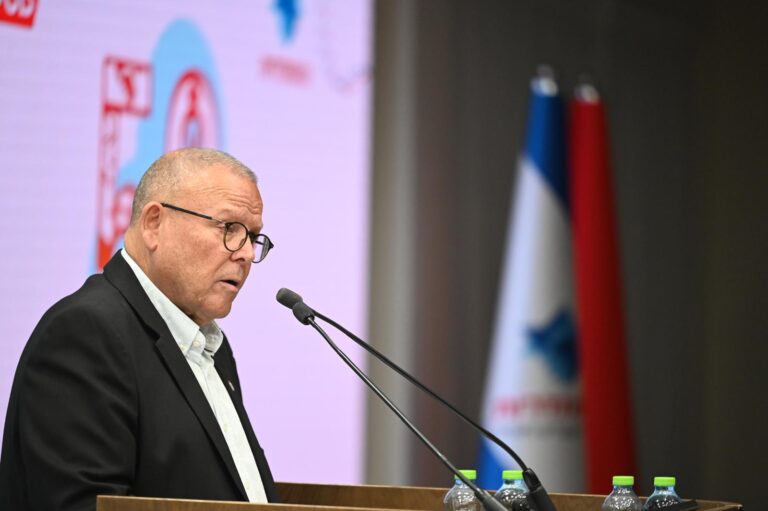
Bar-David thanked Fahimi for the German confederation’s unwavering support following the October 7 massacre and throughout the two years of war. He said that the past two years had posed a difficult test for the partnership between the organizations, but the DGB met it with understanding, sensitivity, and continuous dialogue.
“The world was turbulent, public discourse was charged, and reality was unbearable; and it was precisely then that the depth of our connection became clear, because instead of drifting apart, we chose to come closer. We chose to deepen the dialogue. Amid painful moments, we found together moments of genuine partnership, in Hostages Square and during visits to the southern communities. The joint ceremony we held this year at Platform 17 during our visit to Berlin, where representatives of the Histadrut and the DGB stood together at the very place from which Germany’s Jews were sent to the extermination camps, was a choice to remember, to commemorate, and to pledge that both movements will stand as a solid wall against racism, antisemitism, and any attempt to strip people of their humanity.” he says.
“Today, with the fighting subsided, the return of the living hostages, and the ceasefire, fragile as it may be, we have reason for a little optimism,” Bar-David added.
“One can hope that we are at a crossroads on the way to regional peace, which I long for and hope for. We still have 13 fallen hostages we are waiting to bring back home before we can turn the page. The world we live in is not easy. Political polarization, populism, racism, and attacks on democracy threaten the values on which workers’ movements were built in different countries. Amid all this, our connection is a source of hope and pride.”
The 50th anniversary event took place as the opening of the joint “Naftali Forum” of the two organizations, which is expected to address trends in the world of work and how organized labor responds to them, as well as strengthening the voice of workers in the workplace. Prof. Bettina Kolrausch, Director of the Research and Science Department at the Hans Böckler Foundation of the DGB, explained that the forum is named after the German-Jewish economist Peretz Naftali, who headed the research institute where she works.
“Our goal is to analyze the economic reality, its impact on society, and how it can be strengthened,” Kolrausch said. “This is precisely the role of trade unions — to analyze the social situation and develop a vision for a better future. To develop tools, including scientific ones, to improve collective bargaining, workplace democracy, and the status of workers.
The idea of industrial democracy means that true democracy is created only when workers are active and influential in the workplace. Capitalism may offer formal equality, but it perpetuates structural inequality between employers and capital owners on one hand, and workers on the other. Trade unions, collective bargaining, and parity-based mechanisms seek to balance this reality.
These matters are also significant for developing democratic consciousness more broadly. As we have shown in recent research, workers involved in decision-making processes in their workplaces tend to develop fewer anti-democratic attitudes. Workers whose employment future is secure are less likely to turn toward extreme or populist solutions.”
Gershon Gelman, Chairman of the Peretz Naftali Foundation and Head of the Foreign Relations Department at the Histadrut, emphasized that the joint forum represents another milestone in the relationship between the two unions, in both dialogue and joint action.
Jennifer Otto, a member of the German Federal Youth Committee and the German Police Union, highlighted the great importance of collaboration and the exchange of youth delegations between Israel and Germany, as well as between young members of the German union and the Young Workers’ Movement in Israel.
Martin Schulz, President of the Friedrich Ebert Foundation of the German Social Democratic Party, said that in his youth he looked to the Histadrut in Israel as a model for promoting social justice and the labor movement. He expressed hope that in the future meetings could be renewed between young members of the Israeli Histadrut and young members of the Palestinian Workers’ Union.
“Today this does not take place, and it is hard to imagine, but it is a dialogue that must be renewed. I believe that the Histadrut and the trade unions can make a difference.”
Translated by Nancye Kochen