
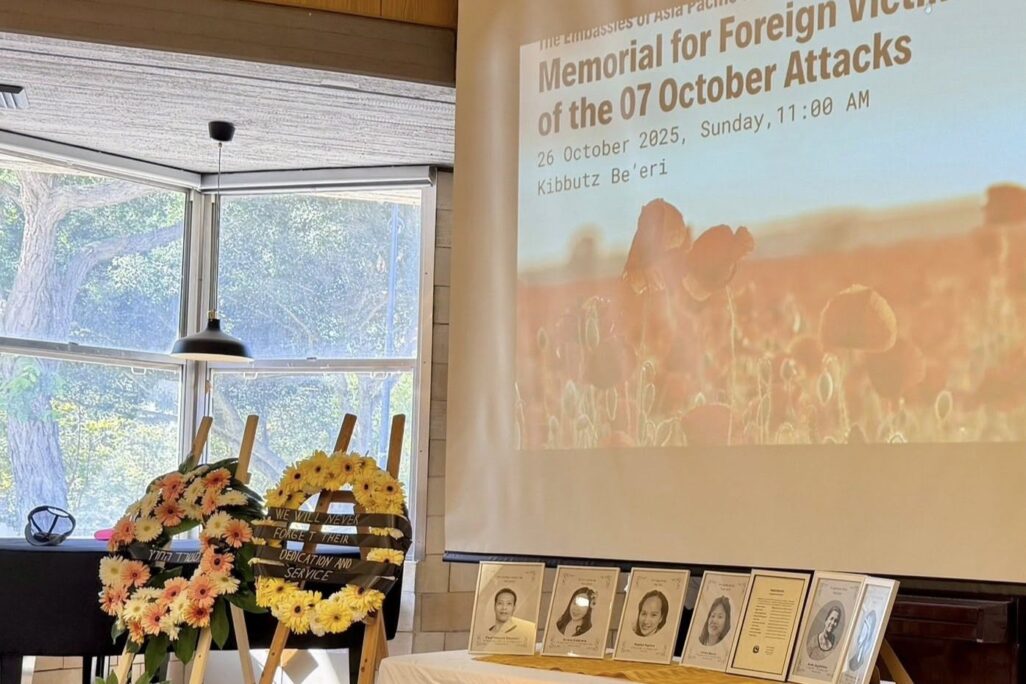
A memorial event for the four foreign caregivers who were murdered in Hamas’s attack on Israel, as well as honoring those who were wounded and survived while caring for the kibbutz’s members, was held earlier this week in Kibbutz Be’eri. The ceremony was attended by ambassadors from Thailand, India, the Philippines, and Sri Lanka, as well as clergy from Eastern countries and the Vatican, along with workers who survived the attack.
“On behalf of the Kibbutz Be’eri community,” said community director Yiftach Tselinker, “we want to thank you for your compassion, for your endurance, and for staying with us over the past two years as we moved between the hotel and Be’eri’s new neighborhood in Hatzerim.”
The foreign workers who were murdered by Hamas terrorists that Saturday were Grace Cabrera, the caregiver of Aviva Sela; Paul Vincent Castalvi, the caregiver of Evyatar (Tari) Kipnis — both citizens of the Philippines; Anola Ratanika, the caregiver of Eti Mordo; and Sujit Yatawara, the caregiver of Haim Zohar, both from Sri Lanka.

“On the morning of October 7, there were 28 foreign workers in Be’eri, and they are an important part of the kibbutz’s story,” says Inbar Isaac, who coordinates their work. “Throughout that day, they faced the immense challenge of protecting themselves and the elderly or disabled members they care for. They had to understand the situation they were caught in, make difficult decisions, and endure moments of unbearable terror. Again and again, the workers showed compassion and care even in extreme circumstances, often making choices that put them at risk in order to protect others.”
For Tselinker, the ceremony, the strengthened bond between the foreign workers and the kibbutz, and the fact that many chose to stay and continue working in Israel are all proof that Hamas failed. “The workers are not part of this conflict, they were dragged into it against their will,” he says. “If Hamas had a theory that by murdering the foreign workers they would frighten others from returning or discourage them from coming, it had exactly the opposite effect. The communities have embraced the workers even more, appreciate them more, and value them deeply.”
Tselinker emphasizes that even amid the grief, destruction, and shock that Be’eri endured on that day and in the days that followed, the attitude toward the foreign workers was exactly the same as toward the kibbutz members. “We didn’t abandon them, we treated them as we treat ourselves.”
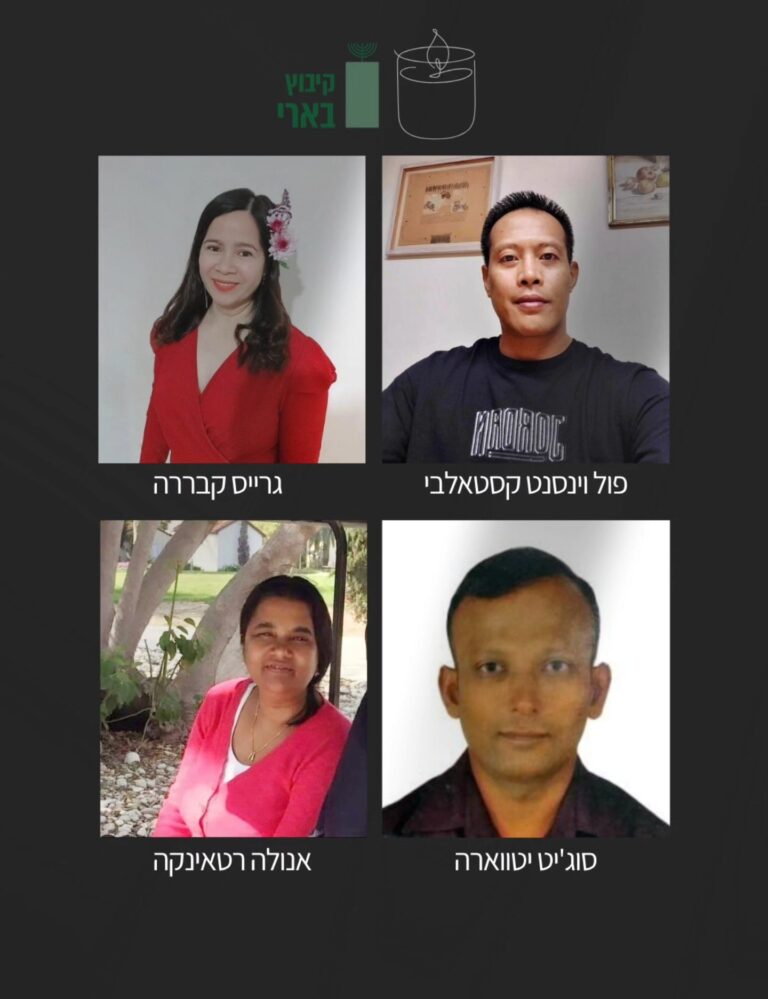
Paul Vincent Castalvi (42), originally from the Philippines, was murdered on October 7. In his youth, he went to work in Saudi Arabia, where he met the love of his life, Jubel Santiago. Later, the two came to Israel to work in communities near the Gaza border. On the morning of October 7, Castalvi was murdered along with Evyatar (Tari) Kipnis and his wife, Lilach. Jubel, who was working in Or HaNer, survived. She later gave birth to their son, Jason Paul, and returned to the Philippines to raise him.
Grace Cabrera (45), originally from the Philippines, did everything she could to help support her family, as her mother raised her and her siblings alone. She married Domingo, and together they adopted their son, Benedict, when he was two years old. In 2019, Cabrera came to Israel and began working in Ashkelon. About a year later, she moved to Be’eri, where she cared for kibbutz member Aviva Sela. The bond between them was warm and close, and Grace became part of the extended family. On October 7, she was murdered outside their home.
Anola Ratnayaka (49), originally from Sri Lanka, was known from a young age for her kindness and willingness to help anyone in need. When she came to work in Israel to fund her children’s education, she first worked in Ashkelon and later spent about six years in Be’eri. Ratnayaka developed a warm and caring relationship with Eti Mordo, whom she cared for. She tended a beautiful garden and treated all the animals and plants around her with compassion and love. A Buddhist, she had a small corner in her home dedicated to prayer. On October 7, she was murdered in the safe room.
Sujit Yatawara (48), originally from Sri Lanka, had to work from a young age to survive. As a teenager, he went to work in Kuwait, where he met Gianni, whom he married, and together they had two children. In 2014, he came to work in Israel and spent about four years in Be’eri, where he was deeply devoted to his patient, kibbutz member Haim Zohar. Yatawara was meticulous and precise, professional and caring, and the entire family loved his presence. He kept in close touch with his family in Sri Lanka through daily phone calls. Yatawara was initially listed as missing for a month, and it was later confirmed that he had been murdered.