
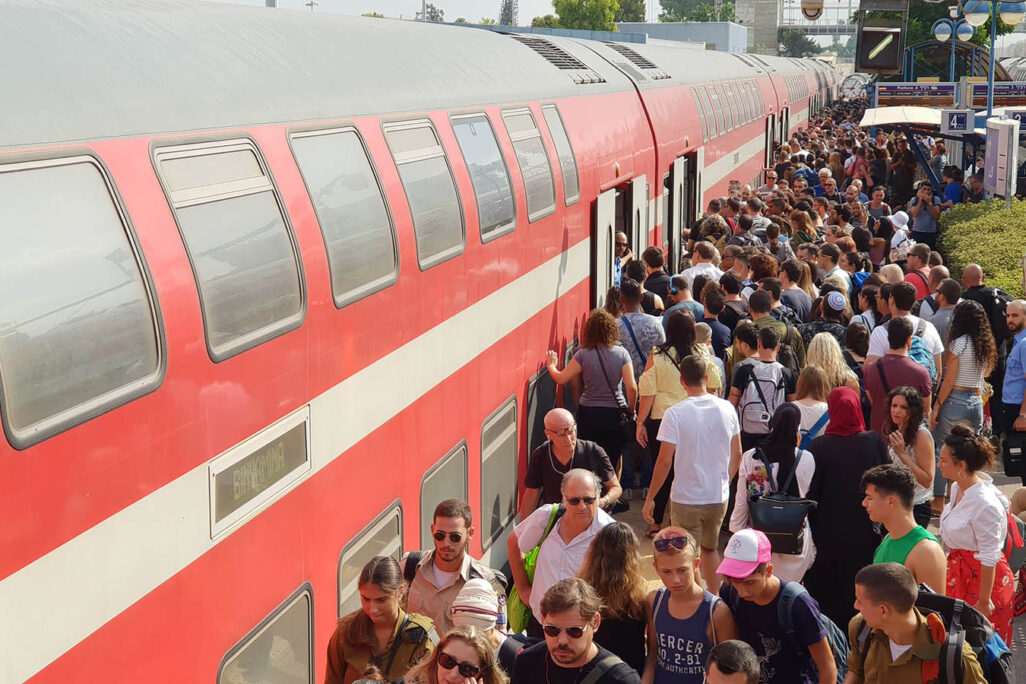
It has become clear that under the draft Economic Arrangements Law, the Finance Minister plans to privatize Israel Railways.
The Economic Arrangements Law is one of the more controversial legislative practices in Israel. Under this framework, the Ministry of Finance bundles a large number of economic and budgetary legislative amendments, covering various areas, into a single law, which is passed together with the state budget. This allows lawmakers to avoid debating and voting on each individual clause separately and enables the simultaneous passage of multiple wide-ranging structural reforms.
The proposal, framed as “streamlining service on Israel Railways,” suggests transferring the operation of railway lines and the maintenance of trains to one or several private concessionaires, similar to the model used by bus companies, while leaving Israel Railways responsible for oversight and infrastructure. According to the Finance Ministry, this move is expected to improve service for passengers.
Additionally, the proposal allows private companies to plan and construct sections of the railway under a PPP (Public-Private Partnership) model. In other words, a private company would build the section, jointly own it with the state, and collect fees for its use, similar to the arrangements currently in place on Highway 6 and other toll roads.
According to the accompanying explanatory notes, the proposal comes “due to the fact that the number of passengers has not increased since 2019” and because Israel Railways is “a large government-owned company with over 5,000 employees”; a situation that, according to the report, undermines its operational flexibility and responsiveness.
The number of passengers on Israel Railways plummeted during the COVID-19 pandemic, from a peak of 69 million trips in 2019 to just 20 million in 2020. In 2021, during the later waves of the pandemic, the numbers began to recover rapidly. By the end of 2024, despite the war and the prolonged closure of certain lines, around 65 million trips were recorded, and in the first half of 2025, during the peak of the fighting, approximately 34.5 million trips were counted.
According to data from the Central Bureau of Statistics, Israel Railways employed approximately 4,500 workers in 2023, with some sources estimating even fewer. This figure is not unusual: in Sweden, which has a slightly larger population than Israel, the state railway company SJ employs around 4,600 workers, even though it is not the only operator in the market, meaning partial privatization already exists there.
“The State Comptroller’s report on the light rail already showed that separating infrastructure construction from operations usually leads to a lack of interest by the concessionaires in both areas, and to a decline in service quality,” explained Ehud Uziely, a former senior official at the Ministry of Transport. “This is not an entity that makes sense to privatize.”

Uziely continues, “It is generally assumed that one of the advantages of implementing a project using the B.O.T. (Build-Operate-Transfer) method is that the project budget, financed by the state and set in advance in the tender, is considered protected from overruns. However, the audit findings show that this assumption does not hold up in reality,” the 2008 State Comptroller report on the light rail stated.”
“According to the State Comptroller’s Office, following the proposed budget cuts, this working model could lead to budget overruns and inadequate oversight, as demonstrated in the Jerusalem light rail project. The Ministry of Finance and the Ministry of Infrastructure must examine whether it is appropriate to continue this model of public-private partnership in infrastructure development projects, and if so, what improvements should be made to ensure the state benefits from it.” he says.