
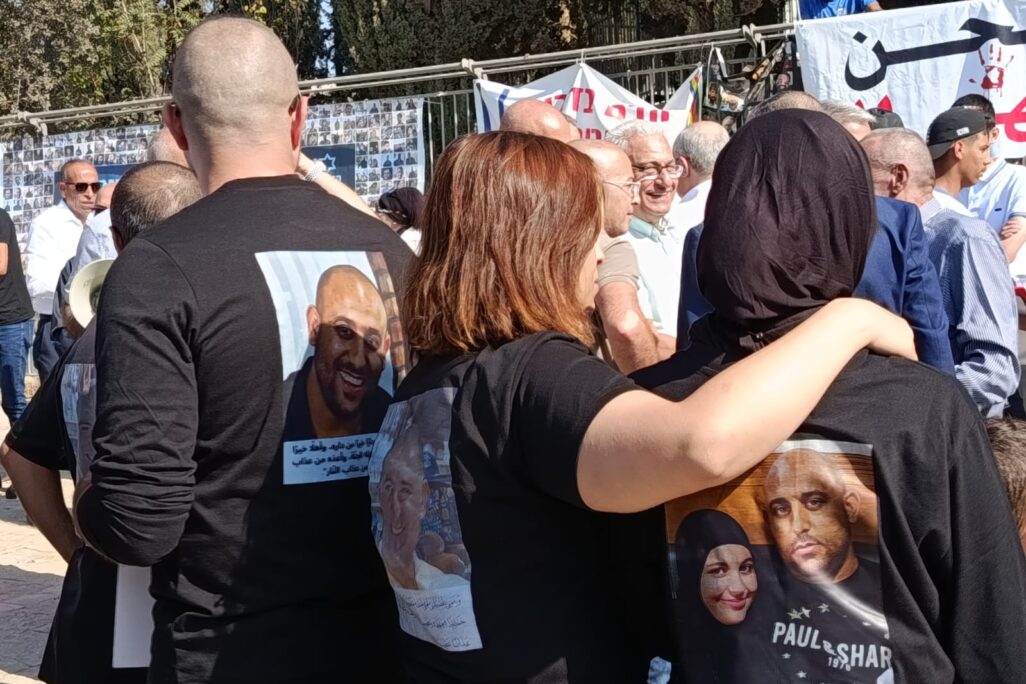
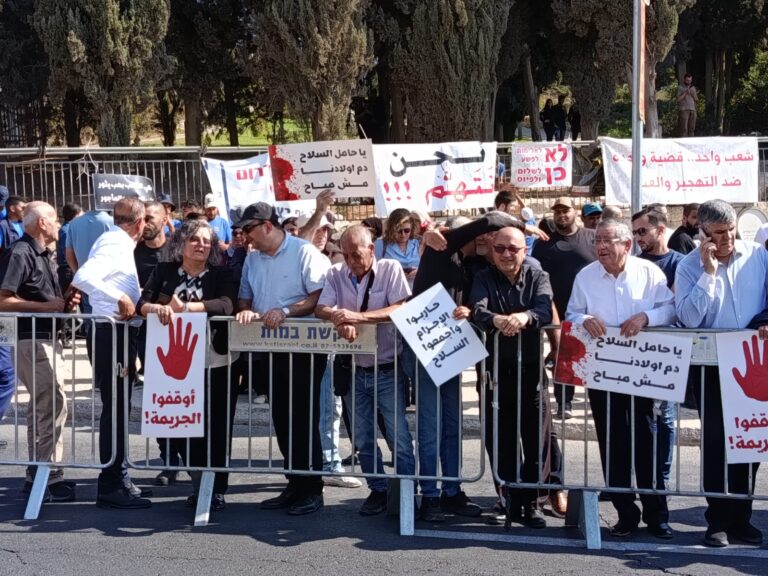
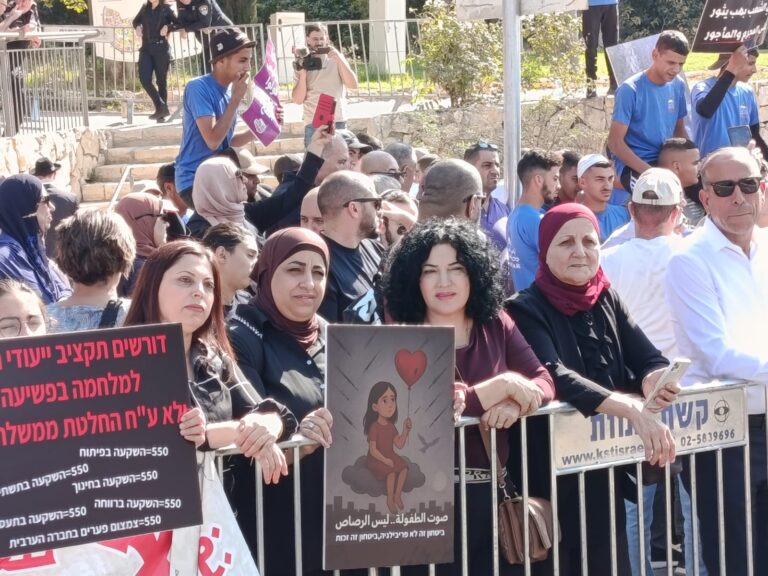
After a weekend in which six Arab citizens were murdered across the country, a protest against the escalating violence was held earlier this week outside the government complex in Jerusalem. Arab municipal leaders, Members of Knesset, and citizens from all over the country gathered to demand that the state take action against violence and crime in Arab communities.
Family members of the murder victims held up photos of their loved ones as they walked among dozens of demonstrators. Nearby, several older women stood close together beneath signs calling for an end to violence and for the release of the hostages. Protesters chanted, “Crime after crime and the police are asleep,” “Our children’s blood is not cheap,” and “Security in the streets, not occupation and wars.”
Since the beginning of the year, 223 people have lost their lives due to crime and violence in the Arab society, according to the organization “Abraham Initiatives.” This represents an increase of about 9% compared to the same period in 2024, which was already an extremely violent year in the community.
“A weekend stained with blood. The epidemic of violence and crime in Arab society is exacting a shocking toll, resulting in an unimaginable number of victims,” President Isaac Herzog said this morning. “This is a national blow, a real state of emergency, not just for Arab society, but for the entire State of Israel. We are dealing with matters of life and death affecting hundreds of thousands of citizens. We must urgently prioritize addressing this critical issue and activate all state mechanisms to stop the cycle of bloodshed.”
“Why does a 16-year-old have a weapon?”
Hanan, a municipal worker in Arraba and a resident who came to the protest at the Government Complex, asked angrily, “Why is the government silent?” She said, “We are a ghost town. Two weeks ago, three people were murdered here. It’s unbelievable that they haven’t caught the killer. Residents are angry about the situation, about the police; we don’t want criminals in our city. There’s so much weaponry in the city. Where is it coming from? Why does a 16-year-old have a gun? I worry about my son, who is 25, what will happen when he goes out into the street or to work?” she says.
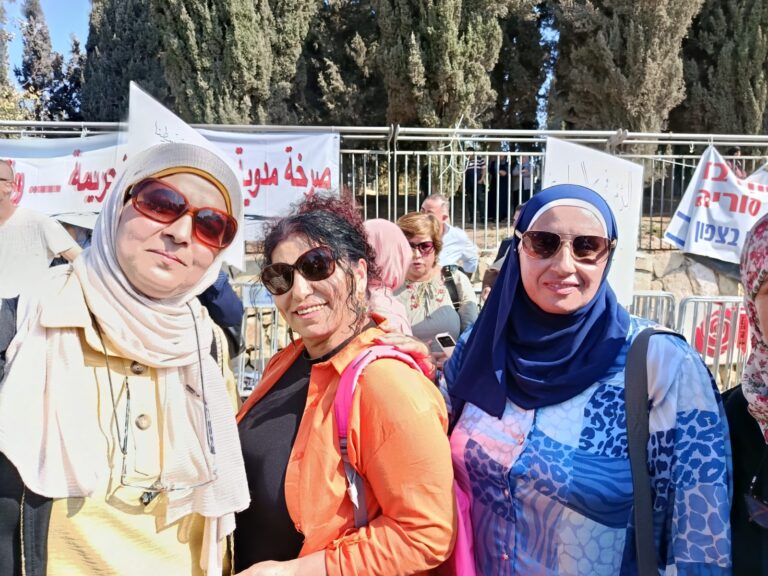
Young Bedouin volunteers in the leadership preparatory program of the “Desert Stars” association, also joined the protest. “Where I live, there is no peace, every day someone is killed,” said Rayan Abu Al-Rabee, a resident of Kseifa. “You don’t know who’s next, when it will be your turn. We want the state to protect us.” His fellow volunteer, Mohammed Aldada, also from Kseifa, added: “We hear a lot of gunfire where we live, and it affects us deeply.” Both agree that the solution depends on the government, but Aldada stressed: “When it’s our turn to lead, we will teach the children to stand against violence and crime.”

After countless protests, Amjad Shbita, secretary of the Hadash party, believes it’s time to change course. “Silent demonstrations won’t help. After the ceasefire, the issue can be raised again. We are considering organizing days of disruption. We are building cooperation with our Jewish partners and with labor unions, and this rally is the starting point.”
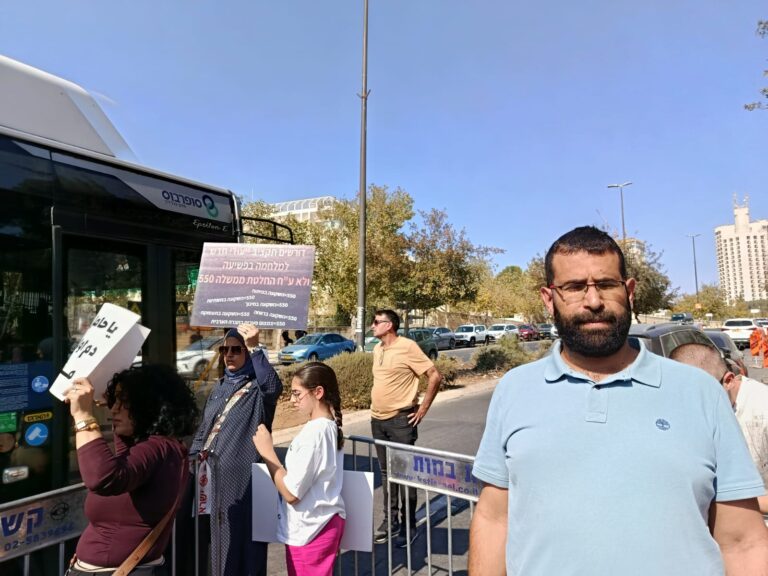
One of the speakers at the protest addressed Prime Minister Netanyahu: “Sir, maybe you should get up and do something. We have no security, each one of us is under threat. We know you are busy with many things, but your citizens are being killed every morning.”
Government Funding Cuts
This coming Sunday, the government will discuss a plan to cut approximately 3 billion shekels from the Five-Year Plan which is aimed at reducing gaps in Arab society. The funding may be redirected to combating crime in the Arab community. Under the proposal, initiated by the Minister for Social Equality, May Golan (Likud), around 2.55 billion shekels would be transferred to the Ministry of National Security and 375 million shekels to the Ministry for Social Equality.
If the decision is approved, the budgets for about 70 items covering education, welfare, health, infrastructure, and more, in the Five-Year Plan would be cut. According to the minister, these funds would not be used in the coming final year of the Five-Year Plan, while organizations opposing the proposal argue that the minister herself is responsible for implementing the budget in her official capacity. The reallocation of these funds also requires approval from the Finance Committee.
Change in Approach to the Problem
The proposed decision reflects a shift in addressing crime in the Arab community, which began with Itamar Ben-Gvir’s appointment as Minister of National Security. While the paradigm guiding the Five-Year Plan focused on a holistic approach to crime and its root causes, addressing the social aspect of the issue, over the past two years the emphasis has shifted toward law enforcement and policing.
Ahead of the cabinet meeting, the Association for Civil Rights in Israel (ACRI) appealed to the State Attorney, Gali Baharav-Miara, requesting that the proposed decision not be advanced. According to the organization, diverting these funds would undermine citizens’ right to equality, since The Five Year Plan was designed to correct budgetary discrimination against the Arab public.
The ACRI emphasized that the Minister for Social Equality is responsible for implementing the budgets under The Five Year Plan. Therefore, any anticipated under-execution of the program’s budgets stems from her refusal to fulfill her responsibilities and to convene the standing committee that approves and oversees the implementation of its budget.
“The justification for the decision to divert resources from the Five-Year Plan under the pretext that they are not properly allocated or utilized also amounts to clear bad faith, bordering on malice and gross unfairness, and relies on a partial and misleading factual basis that does not disclose under what circumstances the funds of The Five Year Plan remained unspent,” the appeal from ACRI stated. “In light of this, and given the potential conflict of interest involving the minister, there is a real concern that the decision proposed by the policymakers is based on extraneous considerations.”
“Undermining the tools meant to address the root of the problem”
At the same time, the organization “Abraham Initiatives” sent a letter to Prime Minister Benjamin Netanyahu urging him to stop the budget diversion. “It is impossible to fight crime and violence in the Arab community by undermining the socio-economic tools designed to address the root causes of the phenomenon,” said the organization’s CEOs, Amnon Bari-Soliziano and Sahira Shalabi. “Strengthening the education system, higher education, employment, and welfare is key to reducing crime. Further cuts will only deepen the crisis and expand the cycle of violence.”
They added that maintaining The Five Year Plan is not just in the interest of the Arab community, “it is a top national interest, crucial for strengthening social resilience in Israel and reducing crime at its roots.”
Attorney Nora Ashkar-Zohar from the organization Itach Ma’aki said: “The decision to divert funds from The Five Year Plan is the final nail closing the door of opportunities for the Arab community, particularly for its women. This harm is not in the future, it is happening here and now. Since the program’s implementation was frozen, the decisions made under it have lost their significance, and women have already begun losing their livelihoods. Women are at the center of life, in families, in society, and in the community, and when they are harmed, everything suffers” she says.