
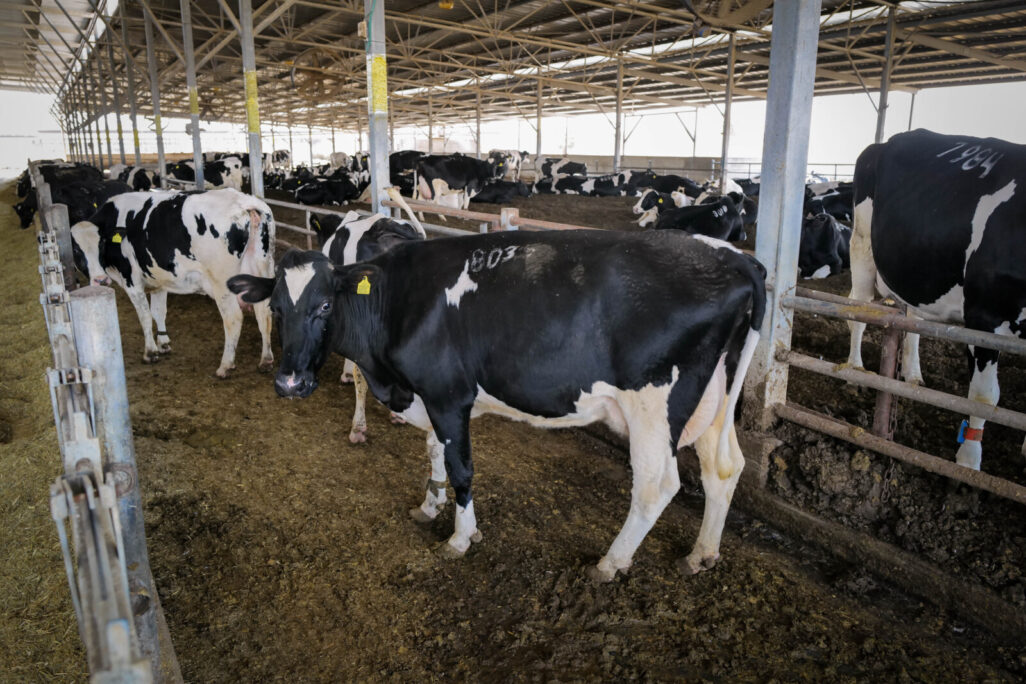
Israel’s dairy farmers are fuming following the Ministry of Finance’s announcement earlier this month of a plan to reform the dairy industry and open the market to imports. “At the Finance Ministry they are gambling with Israel’s food security,” a source from the dairy industry warned. “Dairies that close will not reopen.”
According to the document published by the Ministry of Finance, the reform is meant to address three main difficulties in the dairy market. First is the price of dairy products in Israel, which is 50% higher than the OECD average. Hard cheeses and premium cheeses are especially expensive.
Second is problems in supply continuity, evident in shortages of price-regulated dairy products during the Jewish holidays.
Finally is the problem of what the Ministry of Finance deems the "inefficiency" of some of the dairies, which it says affects the price of raw milk.
The goals that the Ministry of Finance sets for the reform are lowering prices, maintaining continuity of supply of dairy products, and preserving Israeli agriculture, while improving efficiency in the dairy sector.
But instead of influencing the reduction of feed costs for cows, which is the main component in the price of raw milk, or leading changes in the processing or marketing of dairy products, the ministry is directing the main part of the reform at the production segment: the dairies themselves.
The reform includes a change in the method of determining the price of milk, which the Ministry of Finance hopes will lead to a controlled decrease of about 15% in the price of raw milk. According to the ministry’s data, in the Israeli dairy market there are about 1.5 billion liters of milk that are divided into quotas for dairies. About 620 dairies of various sizes operate in Israel, and there is also variation in the scope of production of each dairy compared to its production cost.
The price of raw milk, known as the “target price,” is calculated in a formula based on production costs and is influenced by a voluntary survey that includes all dairies producing more than 800 thousand liters, small and large, more efficient and less efficient.
Will prices come down?
Although the Israeli dairy sector is among the most efficient in the world in terms of the amount of milk each cow produces, the Ministry of Finance insists that the efficiency of the dairies must be measured by production cost relative to investment and capital depreciation. The ministry claims that including “less efficient and profitable” dairies in the survey artificially raises the regulated price. Therefore, the reform includes the redemption of quotas from the “less efficient” dairies in the amount of half a billion liters, and the elimination of production quotas, so that each dairy will be able to produce as much milk as it wishes in accordance with agreements with the milk processing plants. Professional officials at the Ministry of Finance estimate that 10%–15% of the production capacity of the dairy sector is currently unused and expect that the dairies that continue to operate will increase their output.
The dairies that remain in the sector will be guaranteed a “protection price” calculated according to the existing methodology. The Ministry of Finance’s expectation is that the “protection price” will reflect production of more “efficient” dairies and therefore will be lower. The large processing dairies, which produce more than 10%–15% of the market, will be required by law to purchase 1 billion liters of milk at the new “protection price.” Any liter of milk that the dairies produce beyond that, they will be able to sell to the processing plants according to agreements signed between them. The ministry expects that the market price will be lower than the protection price.
Upon implementation of the reform and until the new “protection price” is calculated, the ministry plans to carry out an initial reduction of 15% in the target price based on current data. Later, a mandatory survey will be conducted in all dairies, and the protection price will be set by the Price Committee of the Ministry of Economy. Thus the operation of the committee that operated under the Dairy Law—which included representatives from the Ministries of Agriculture and Finance, from the dairies, and from the processing plants—will be canceled.
Some dairy products in Israel are price controlled by the state, including 3% milk. Many critics worry that deregulating the industry will incentivize dairies to turn their raw milk into more profitable products than standard, price-controlled milk.
The Ministry of Finance expects that lowering the price of raw milk will lower the price of regulated products, that the regulated dairy products market is already profitable enough, and that some of the processing plants want to enter the regulated products market. According to a preliminary check by Davar, no basis for those claims was found.
Since the Ministry of Finance does not intend to require the processing plants to produce regulated products, there is no guarantee that cartons of 3% milk will not be missing from the shelves even after the reform is implemented. Regarding lowering the price of non-regulated food products, the ministry has not promised that the reduction will indeed be passed on to the consumer.
The ministry didn’t learn its lesson from the rise in butter prices
Importers—especially the retail chains—will benefit from canceling customs duties on dairy products and opening the dairy market to free imports. The ministry believes that the main imports following the reform will be hard cheeses and premium cheeses, although there is feasibility for imports of liquid dairy products and soft cheeses as well. The hope is that import of dairy products, with emphasis on hard cheeses, will force processing plants to lower the prices of local products. But here too there is no guarantee this will indeed happen. Experience teaches otherwise: canceling the customs duty on butter led to the cancellation of price controls. The result: imports focus on premium butter products, which are 30% more expensive than local butter produced by Tnuva and even more.
Several important details regarding the taste and preferences of the Israeli consumer were also not taken into account. From attempts to import milk from Europe in the past two years, it’s become clear that although in many European countries consumers prefer much cheaper ultra-pasteurized milk, the Israeli palate prefers fresh milk. In addition, the ministry aims for a significant reduction in premium cheeses, but market data show that the Israeli consumer prefers non-premium cheeses such as “Emek” yellow cheese. Until now, the reduction was made possible through importing cheeses of European brands at regulated prices. Now it is unclear what mechanism will lower the price of imported cheeses.
“Dairies on the borders will close in order to enrich the importers’ pockets”
The dairy sector has expressed grave concerns for the local dairy industry and has announced a struggle against the proposed reform. According to representatives from the sector, the reform presented by the ministry does not include control and oversight mechanisms that will ensure that its declared goals are achieved. For example, no timelines were defined for evaluating the change, there is no mechanism to examine whether price reductions occurred, there is no follow-up to examine harm to local production capacity, and no parameters were set for the success of the plan. “When it comes to such a deep and irreversible reform, it seems the ministry is gambling with Israel’s food security,” a representative from the sector said.
“Unfortunately, the finance minister is aligning with the Budget Department officials, who have been trying for years to topple the dairy sector,” Dairy Council head Itzik Schneider said, noting that Finance Minister Bezalel Smotrich ought to understand the “critical national importance” of the dairy sector.
“His decision is to transfer production from the hands of Israeli farmers—who went through two years of work under fire and produce blue-and-white milk—into the hands of [Turkish President Recep Tayyip] Erdogan and European countries that subsidize their agriculture,” Schneider continued. “This is not a reform, this is a strategic mistake that will cost Israel dearly.”
The Israeli Farmers Front, leaders in the struggle against the reform, noted that the Finance Ministry itself has not committed that the reform will result in lower prices for the consumers. “This is a fake plan whose only achievement will be to close dairies on the borders in order to enrich the importers’ pockets and provide livelihood to farmers in Europe,” the group said. “If they do not know how to guarantee a price reduction for the consumer, then what is the purpose of the plan—just to guarantee that hundreds of dairies will close and then what will we see?”