
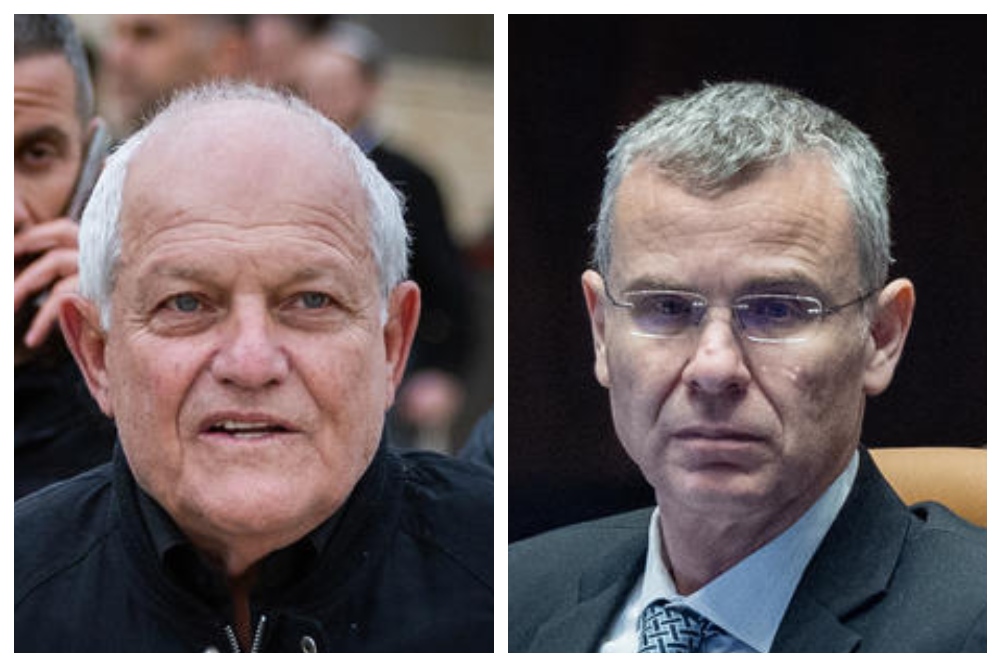
Two ministers for eight ministries: The Knesset approved earlier this week to permanently appoint Minister Yariv Levin (Likud) as Minister of Labor, Minister of Religious Services, and Minister of Jerusalem Affairs and Heritage, in addition to his role as Minister of Justice; and Minister Haim Katz (Likud) as Minister of Health and Minister of Welfare, in addition to his roles as Minister of Tourism and Minister of Housing and Construction. This comes after four months during which there were no permanent ministers in these ministries, including three months during which Levin and Katz served as acting ministers, and an additional month with no minister at all. At the same time, four Knesset committees have been without a committee chair for nearly two months, and they have not been meeting regularly.
The temporary became permanent
In July, when the Haredi parties left the government in protest over the delay in approving military exemptions for yeshiva students, this situation seemed to be temporary. But, as is often the case in Israel, the temporary became permanent: the Haredim are still outside the coalition, and key social ministries with budgets of tens and hundreds of billions of shekels, such as the Ministries of Health, Welfare, and Interior, are operating without a permanent minister setting policy, and with only a fifth or a quarter of a minister actually in place. The Interior Ministry still does not have a permanent minister (after Levin also served there as acting minister), and yesterday the Knesset approved transferring some of the Interior Minister's powers, related to foreign workers and municipal taxes, to Prime Minister Benjamin Netanyahu.
In a 'routine' situation, when there is no minister serving in an office, the Prime Minister automatically assumes the role. However, Prime Minister Benjamin Netanyahu is in a special situation: a ruling established by the Supreme Court states that because he is a criminal defendant, he is prohibited from serving as a minister, but he is allowed to serve as Prime Minister. As a result, the ministries remained vacant, and it was necessary to appoint acting officials for them, and now permanent ministers.
There was probably another motivation for the decision to appoint the permanent ministers besides functional continuity. The Civil Service Commission recently warned that should ministries be left without a minister, dozens of workers in the ministers' offices, who were appointed in positions of trust by former ministers from Shas and United Torah, Judaism, would be fired. Continuing the employment of these workers allows the Haredi parties to maintain a connection and influence over the ministry, and a kind of 'guarantee' that if they want to return to the coalition, their loyal staff will be waiting for them in the same offices.
A quarter of the Ministry of Health will deal with the measles outbreak and thousands of war casualties
This situation has a direct impact on the public. The Ministry of Health, whose total budget is the third largest among government ministries, operated for a month and a half without a serving minister. The ministry has to deal with a measles outbreak that has already claimed the lives of 10 infants, with preparations for the rehabilitation of thousands of war-injured individuals and tens of thousands of people with mental health issues, as well as a crisis in the appointment of the management of the Clalit Health Services. For all of these issues, currently only a quarter of the ministry is allocated.
"Imagine a country without a Minister of Health, where the health of citizens simply bores the government," recently wrote on Twitter the chairman of the Israeli Association of Public Health Physicians, Prof. Hagai Levine. "This is the current situation in Israel. The absence of a Minister of Health exemplifies the lack of political commitment to health. Israelis suffer the consequences of this, including decreased availability and quality of medical care, and the lack of protection for public health. There is no political power to defend health.”
In the Ministry of the Interior, which still does not have a minister, around 100 requests from local authorities for changes in municipal property tax rates for 2026 have accumulated – a decision that requires approval from the Minister of the Interior. The authority over municipal property taxes has been transferred to Prime Minister Netanyahu, which means that in addition to managing the ceasefire in Gaza and attacks in Lebanon, he will need to approve whether the municipal property tax in Tel Mond will be raised. But other decisions will have to wait. For example, several decisions regarding the correction of boundaries of local authorities, which would mean millions of shekels in municipal property tax revenue for those authorities, are awaiting the signature of a nonexistent Minister of the Interior.
Even the Ministry of Welfare, another branch that is supposed to handle the social crises resulting from the war, assisting about a quarter of the country's children who live in poverty, as well as preventing violence against women, had to settle for only a quarter of a minsitry.
The Education and Health Committees in the Knesset are not functioning
Even in the Knesset, whose position is already weakened, four permanent committees have been functioning without a chairman for nearly two months, some of them not holding discussions for over a month. The Health Committee and the Committee on Education, Culture, and Sports have not held discussions for more than a month; the Special Committee for Bridging Social Gaps in the Periphery and for public inquiries have not held discussions for five months.
Deputy Speaker of the Knesset and member of the Education Committee, Simon Davidson (Yesh Atid), tells Davar that he is acting in every possible way to get the committees functioning. "We are constantly contacting the Speaker of the Knesset and the coalition chairman to have a deputy appointed, so that the committees can work," Davidson says. "Right now, Aryeh Deri's Shas party has essentially slammed the brakes against appointing an interim or replacement chair for these committees. Over the past two weeks, we have already received several responses of 'it will be sorted out by the end of the week.' I don't see it being sorted out."
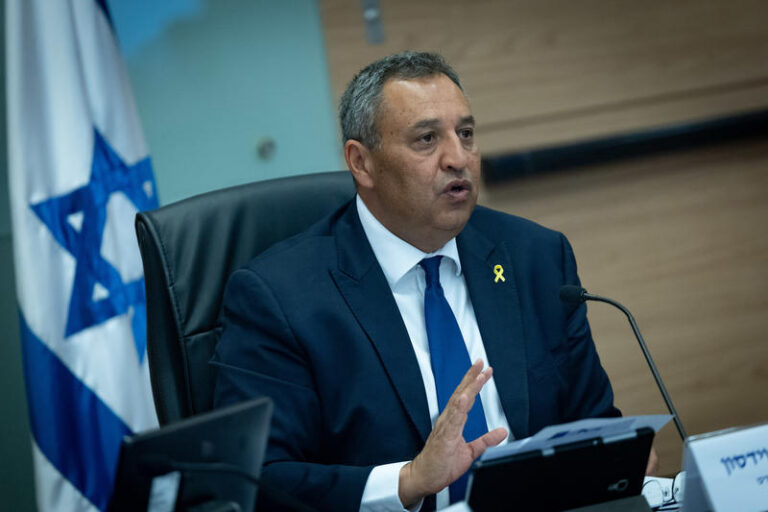
It is very important that everyone here, both inside and outside of this building, understands one thing: In Israel’s Knesset, for the past five weeks, two critical committees, Education and Health, have not existed, and this is only due to a political issue of struggles within the coalition. And I will say one more thing, if this is not resolved by the end of the week, we need to go into a much more intense struggle, and the public must understand that what is happening in this building is against the citizens of the State of Israel. This is just one example. There are dozens of issues that are not being addressed.”
Member of Knesset Michal Woldiger (Religious Zionism), who was appointed chair of the Labor and Welfare Committee after MK Yisrael Eichler from United Torah Judaism resigned, tells Davar that "the fact that there is no Health Committee and no Education Committee is a serious problem." According to her, with the appointment of a permanent Welfare Minister, the Welfare Committee under her leadership will also be able to operate. Woldiger urges Haredi Knesset members "to step up and help carry the burden. You came to work for all the people of Israel."
The chairman of the Education Committee who recently resigned, Yosef Taieb (Shas), told Davar that he does not oppose the appointment of a new chairman for the committee. “It is not the position that makes the person, but the person who makes the position. Whether here or there, the main thing is that it is done well. As for someone else taking over, please do so with great pleasure. The coalition chairman can appoint someone else. Has anyone told him not to? I didn’t tell him not to.” MK Moshe Arbel, also from Shas, told Davar: 'We need to ask the coalition chairman why committee heads are not being appointed. This is very serious.”
Chairman of Israel’s National Student and Youth Council, Dror Cohen, called on Knesset Speaker Amir Ohana to appoint a new chair for the Education Committee. In a letter sent earlier this week, Cohen wrote that “the absence of a chair reflects the Knesset's flawed priorities regarding the education system and its students. Instead of focusing on rehabilitation, improvement, and strengthening the future of education, we find ourselves in a state of uncertainty, with no indication of when a new committee chair will be appointed. Students and youth in Israel deserve to be given at least the bare minimum required – a committee chair who will attend to their needs and act on their behalf.”
Lapid: “We will establish alternative committees”
Opposition leader Yair Lapid (Yesh Atid) said in response to a question from Davar at the faction meeting that the opposition will set up 'alternative committees' in response to the paralysis.
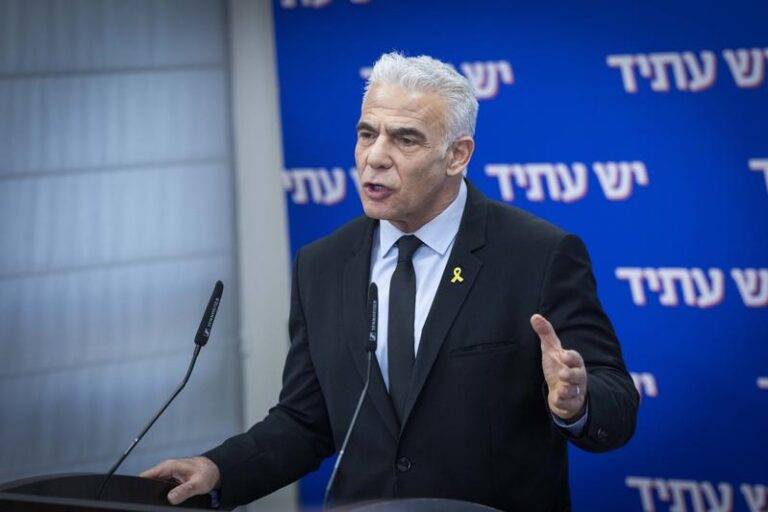
"At the end of the day, these are our children," Lapid remarked, "it's not like they stopped the school year, our children are still in school and need an education committee. Many teachers and education professionals came here to discuss the state of education, because they are desperate for someone to talk to them about the situation in education."
MK Eitan Ginzburg (Blue and White) submitted a letter this earlier this week to the Knesset Legal Advisor, Sagit Afik, demanding the appointment of permanent committee chairs, and even noted that the current situation could be considered a breach of the Knesset's role as a legislative and supervisory authority, as well as a violation of the public duty of the Knesset and its members.
MK Naama Lazimi (The Democrats) describes to Davar that “parliamentary oversight is paralyzed. I have discussion requests that I personally submitted to the Education and Health Committees that are simply waiting and have no address. I had to move a discussion on funding for early childhood programs for stateless children from the child welfare and education organization Unitaf to the Youth Committee, simply because there is no other committee that can deal with it. I will do the same with additional discussions, such as the discrimination against Sephardic girls in Haredi educational institutions. This is what a government who neglects its Knesset looks like, one whose only concern is political survival.”

According to Lazimi, "My first proposal is to act through all parliamentary tools, and to demand reasoned opinions from the legal counsel as well as clear rulings: you cannot gamble with the lives of citizens for chairs and jobs. This is a red line. I have already sent two letters, to the legal advisors of the Finance Committee and to the government's legal advisors, demanding an examination of huge budget transfers to ministries that have no minister and no ministerial responsibility or supervisory authority. In some of them there is no minister or director general. This is not a functioning state – this is a total mess. This is a blatant devaluation of the most basic duty of the state toward its citizens, to provide essential social services. This is a profound breach of trust by both the government and the coalition."