


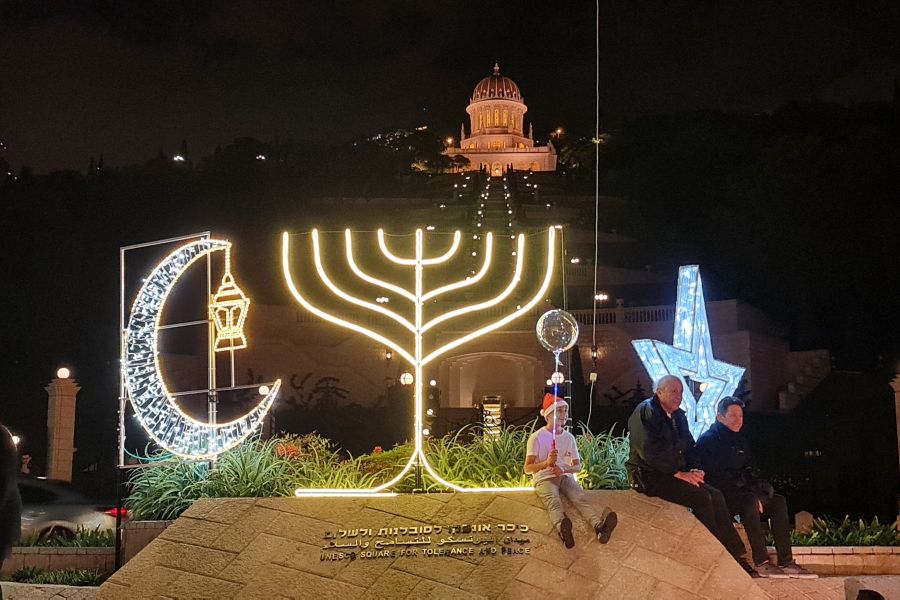
In Haifa, the Holiday of Holidays is once again being celebrated — a rare meeting of the three religions, taking place this year in a post-war reality. The long-running festival, produced by the Haifa Municipality and Beit HaGefen, the Arab–Jewish Cultural Center, continues to mark a space of connection, art, and hope.
‘I come from a worldview that a person is a person,’ Asaf Ron, the center’s CEO, tells Davar. “We don’t interrogate who you are when you come in. I know that on the political level there’s no chance I can change anyone, but what I can do is soften fear, break stereotypes, create direct encounters, and provide tools for living in a society with many stories.”
Beit HaGefen’s has 30 staff members, about 15 of whom are in the country’s only Arabic repertory theatre; a public Arabic library with activities for the Arab public; maintenance staff; and six to eight employees working in culture and festivals. The gallery, which hosts between six and eight original exhibitions a year, is run by one woman, and the Holiday of Holidays is produced by only two women. “On the one hand I cry, and on the other I’m proud, because we’re doing amazing things here” Ron says.
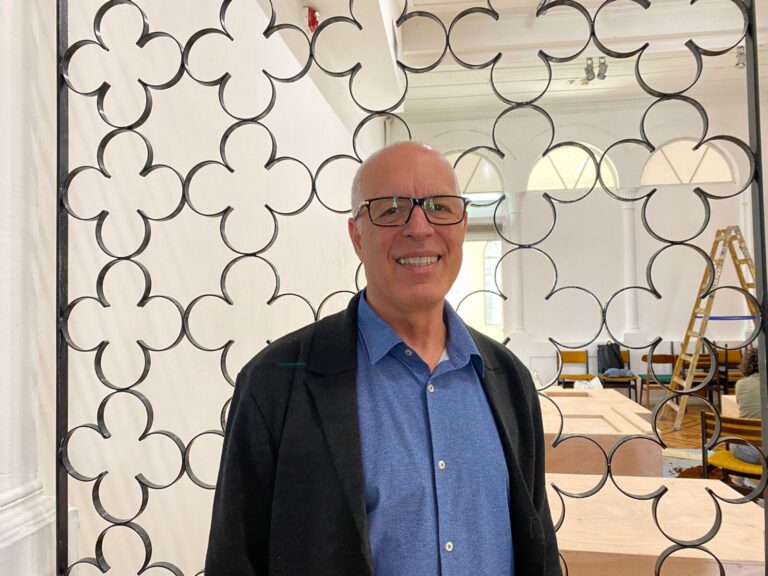
Ron, 65, a Haifa native who now lives in Gan Ner, has been managing Beit HaGefen for 15 years. In the past, he worked in education and training, and even went on a Jewish Agency mission to the United States. When he applied for the position at Beit HaGefen, he didn’t know much about the place, only what he remembered from his youth in Haifa. He quickly understood that managing Beit HaGefen resembled what he had done in the past. “What I did on my mission in the U.S. is similar, the work of connecting communities, working with values and beliefs.”
According to him, management is “flat” and non-hierarchical, and he makes decisions together with the staff. ‘That’s my role as CEO, to bring in people with skills and bring out their best. Of course I have the authority to cut, to decide on my own, and I do it when needed, but usually not on the values level; it’s generally on the managerial–technical level.”
“Anyone Who Comes Here Discovers a Whole World”
“The main tool for opening people up is art,” says Ron. “It’s universal.” And this is the basis of Beit HaGefen’s activity, which has been operating since 1963. “Beit HaGefen is an eclectic place; you could easily have four separate NGOs — and we work on creating the connections between them, wherever it fits. And we have an amazing facility. We’re creating here every single day.” In the long-term programs, there are 300 participants. In the elementary-school age group alone, there are 200 children.”
The Jewish–Arab youth club is thriving this year. “There are 100 Jews in it, and three groups that are half-and-half. It meets in the afternoons by choice, and there’s a bonus toward the social matriculation certificate. They still have to choose to come, and anyone who comes here discovers a whole world. There are also arguments, but the goal isn’t politics, it’s shared experience. We have two statements here: a) It’s not on your shoulders to bring peace, b) you don’t have to agree on everything. But you do have to be respectful. Of course, with no statements that negate someone’s existence or incite to violence.”
“A genuine process brings out statements of truth, and that’s scary”
“The Haifa Municipality, which is responsible for Beit HaGefen, places a strong emphasis on Jewish–Arab relations. The Third Space is one of our highlights. Its establishment cost millions of shekels, and it has been operating for seven years. The Third Space builds the shared. If you enter a room for two hours, you are equal, full equality in the room, with the understanding that there’s no equality outside. In politics, you and I glance at equality for a moment, but here at Beit HaGefen, we speak genuinely. Everyone wants genuine processes, but society has no patience for them. A genuine process brings out statements of truth, and that’s scary.” Ron says
Ron advocates using empathy and developing it as a tool for better mutual communication. “I can understand the frustration a person is speaking from, and instead of 100% anger at them, it might be 20% empathy and 80% anger. Empathy is about stepping back a lot, and understanding why they think it belongs to them. Most empathy is artificial, but in my view, empathy is about inquiry, understanding that there was a whole culture here, with all its complexity. I’m constantly checking whether I can go along with reality as it is now.” On the wall near his desk hangs a sticker: ‘We don’t have to believe everything we think.’
“Our very existence already brings criticism”
Since October 7, Israeli society has undergone many shocks, which have not spared Beit HaGefen as an Arab–Jewish cultural center. “The reality that Beit HaGefen tries to educate about and explain is complexity. Complexity is the first thing people lose, the ability to comprehend that there is such a war, that real events happened. I can’t even say that I don’t understand them. People lack sufficient knowledge and familiarity, and it’s our role to broaden objective understanding of different groups in society. We have an Ethiopian culture, we have a Russian audience, I think that’s real life. An institution where all languages are spoken. There was an amazing evening here, and I received criticism that many things intended to build familiarity actually reinforce stereotypes. But there was also a panel that discussed integrating Ethiopians into society. Our role is to bring everything that exists in society.”
The war has not spared the staff either. According to Ron, the team is in its toughest state since October 7. “Just as in Israeli society each side has become more entrenched in its positions since the war, the same is happening here. In the past two years, I’ve encountered for the first time a question from the staff: What are we doing?” As a manager, he tries to bring a boost of energy to staff meetings to cope with the despair over the situation, and the activities themselves provide a different perspective.”
“I try to focus on the small picture now, not the big picture.” On that same day, there was a large event for Haifa’s Ethiopian residents, an event for Russian speakers, and an event in Arabic. “Where else does something like this happen in the same institution?” he says excitedly, emphasizing the uniqueness of the activities. He adds that after days like these, he hears politicians say that such activities aren’t valuable unless Jews and Arabs participate together. "There is no understanding in politics of the value of the process.”
According to him, he censors himself about 10% more since the war, thinking that bringing in extreme voices would drive away the moderate voices from coming and engaging, and that would be a great loss. “We practice a high degree of self-criticism to allow people to meet and hear different opinions. No one can accuse me of not taking flak from all directions. You can’t run an institution like this without things happening, but you need to be sensitive to the environment at any given moment. I’m running a marathon. I won’t let myself stop everything and do nothing. There will always be criticism. Our very existence already brings criticism in the current period. Society struggles to absorb complexity, and sometimes we struggle to absorb ourselves. The idea that we can live here in a shared life together. People say, ‘It’s not the time to talk about it, we need time.’ But time, if you do nothing with it, only makes things worse.”
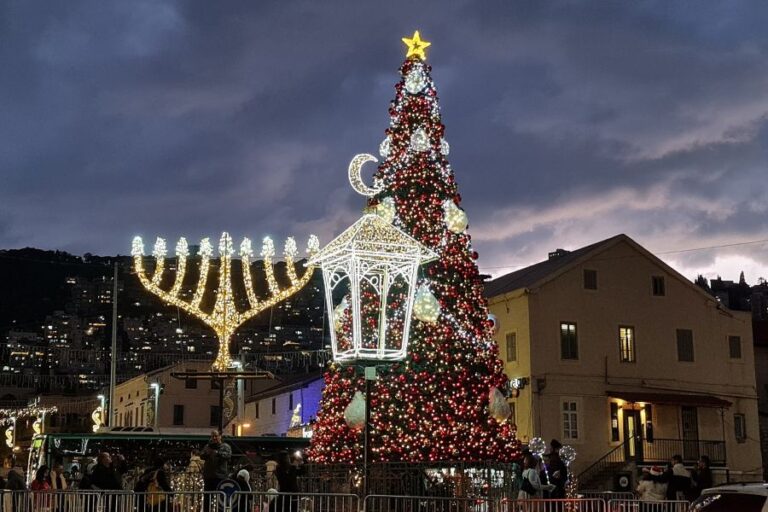
The Holiday of Holidays
“There’s a website for the festival. It makes me happy that it’s taking place. The criticism of the festival is that it tries to paint reality in pink. In my view, it shows Israel that it’s possible to see Arabic and Hebrew together in a positive way. The festival includes activities in Russian and an Ethiopian section, activities for the whole family, workshops, Christmas tours. The Holiday of Holidays is a cultural richness, decorating the city. Placing a menorah, and a tree, a tradition of Hanukkah songs, Christmas, the Haifa Symphony Orchestra combined with leading musicians, and an evening”
All of these, he says, are meant to instill hope in the participants. “The most dangerous thing is when people lose hope. All our workshops since October 7 have been aimed at sustaining hope. When you lose hope, you become desperate; when you’re desperate, you do nothing; and when you do nothing, an explosion comes. The Holiday of Holidays sells hope. It isn’t the one that creates deep connections, but selling hope is no less important.”