



"My attempt to convince my friends to leave the destroyed buildings was first and foremost political," says Kibbutz Be'eri member Alon Pauker. He was one of 195 residents who voted to preserve one house in a kibbutz neighbourhood that was completely destroyed in the Hamas attacks on October 7, while allowing the rest of the buildings to be demolished. “People stood in front of us and said: ‘We are rebuilding Be’eri, not a trace of ash will remain here.’”
Kibbutz Be’eri, from which 101 members were murdered and another 32 were taken as hostage, buried its last returned hostage, Dror Or, three weeks ago. In an unintentional but symbolic way, on the Thursday following the funeral the members convened to make one of the most significant decisions the kibbutz has made in the past two years — what to do with the western neighborhoods, “HaKerem” and “HaZeitim,” which were destroyed in the attack and stood at the center of a dispute that began already in the first days after the massacre.
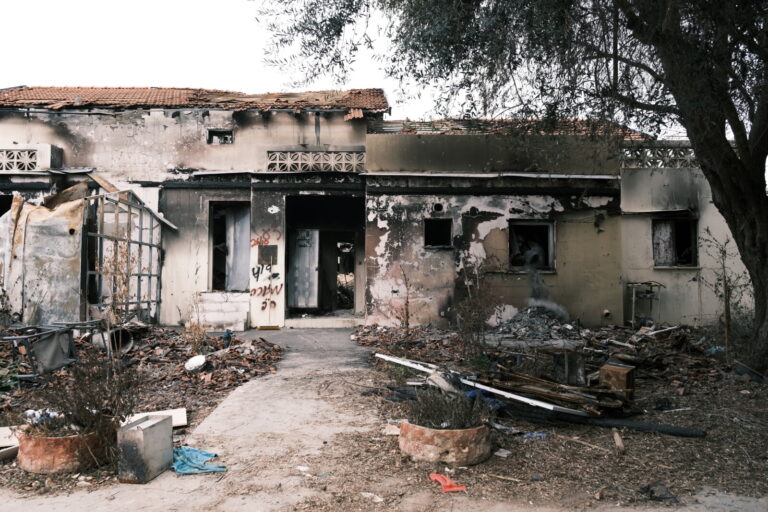
"Already at the Dead Sea [where the kibbutz members were evacuated to], in informal discussions, there were people who said that they would never return to these neighborhoods, while others firmly stated: This is the only place we are willing to return to!", recalls Pauker. The discussion quickly spiraled to extremes, between those who wanted to destroy everything so that it would be possible to return to the new kibbutz as soon as possible, and those who wanted to turn the neighborhoods, with all their houses, into an active memorial site. "It's like the Ghetto Fighters Kibbutz or Yad Mordechai, only they went outside the fence," explains Pauker, who, as a historian and one of the kibbutz's unofficial spokesmen for a long time, advocated delaying the return to the neighbourhoods. Instead he opted for the kibbutz to focus their energy in the fight for the return of the hostages, for the establishment of a state investigation committee and for being involved in the shaping of national memory. "I didn't think that an entire neighborhood should be left, but a respectable number of houses, and that just a monument by the side of the road and our internal memory wouldn't be enough."
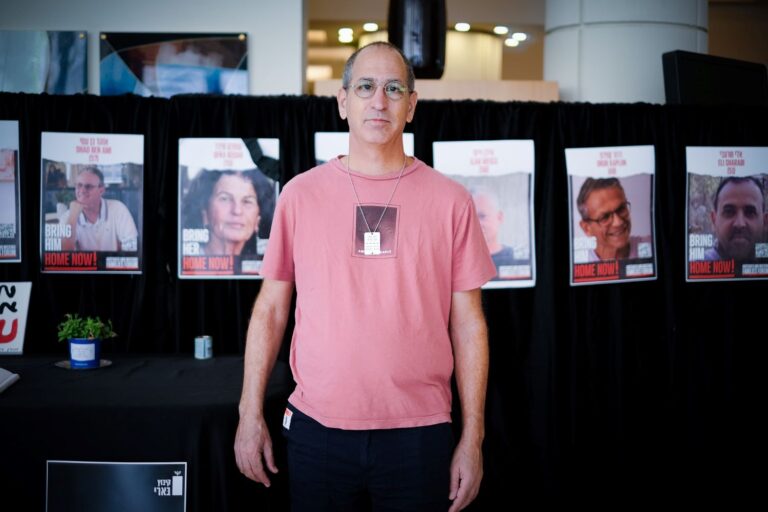
"From the beginning of the war, and in my other projects as well, I always say that we need to use this brand that we became, not by choice, to throw our full weight behind replacing the government and changing society,” Pauker says reflecting on the way that he and the kibbutz were able to channel both the disaster of October 7th, and the need for rehabilitation, into a tool for different struggles such as the fight to get the hostages back. “We need the memorial site here with us, and for it to be open and public, in order to fight denial from the outside and the shaping of manipulative narratives from within; I do not want Miri Regev or Amichai Eliyahu to shape the legacy of October 7 of my kibbutz. If the memory is ours, in our hands, then the story will be ours. For me, this is a much broader struggle. But many of my friends do not see it that way. They are very local—focused on personal and kibbutz rehabilitation."
![An event marking one year since October 7 at Kibbutz Be’eri, with signs saying ‘Kibbutz Be’eri Demand a Deal [in relation to a hostage-ceasefire deal] (Photo: David Tversky)](https://static.davar1.co.il/www/uploads/2024/10/תמונה-של-WhatsApp-2024-10-07-בשעה-09.23.07_e59d8ca4-768x512.jpg "An event marking one year since October 7 at Kibbutz Be’eri, with signs saying ‘Kibbutz Be’eri Demand a Deal [in relation to a hostage-ceasefire deal] (Photo: David Tversky)")
The State Offered a Compromise
The breakthrough that allowed the kibbutz to make a decision on the matter came a year ago, when the state itself approached the kibbutz with a proposal to preserve one house, at the state's expense, of the kibbutz's choice, so that in the future it could be turned into a memorial site. "They came and told us: Don't make a decision now, we will preserve the house, which will be protected for another 4-5 years. If you want to keep it with you, so be it; if not, we will move it to a central memorial site somewhere else."
There was complete consensus among the kibbutz members: nothing would be destroyed or built in the affected area before the last of the kibbutz abductees returned. This was not just a moral statement; the tours of the kibbutz ruins were a central part of the campaign to return them.
Pauker says that the state’s proposal lifted the stalemate among the members; on the side that wanted to preserve the ruins and were already worrying about the condition of the crumbling houses, they were happy that responsibility would be taken over them and that they could move forward with a plan for some kind of memorial centre. The other side understood that even if a building eventually remained, it would be the bare minimum – no more than one house.
When deciding how to choose the house that will remain, Pauker said: "The house will be at the edge of the kibbutz, close to the fence. We have already identified two possible houses, but the final decision will only be made after one of the families agrees."
There remains a question of what will be built on top of the ruins of the remaining houses that will not be turned into a memorial site. To this Paukers states that “there are still no building plans there. The expansion and construction of the kibbutz are taking place on the South-Eastern side of the kibbutz. In the meantime, people are not going to live where the deaths took place, and if later on a neighborhood is built there and members want to move there, I assume they will be able to request that. But that is still a vision for the future. I think that even at the beginning, the understanding seeped in that in the coming years, no one will return to live in that area, and on the other hand, no memorial village will be established there.”
"We have been going through a lot of decision-making for two years now,” Packers reflects.Kibbutz Be’eri is one of the last cooperative kibbutzim in Israel, impacting on the decision making process of the residents and how they related to, and continue to relate to, all the different aspects and phases of the war. “We had to decide on the option for members to live outside the kibbutz and continue to be kibbutz members. Budgetary decisions regarding the allowances that many members began to receive have greatly challenged the cooperativeness. I had a lot of concerns about the decision-making processes, but now we have shown ourselves that we have succeeded, that we are capable of making difficult decisions, even with a large majority.”
“After the vote, a member told me that the ‘how’ in which we make a decision is more important than the decision itself. As you can see in the numbers, it’s not that masses of people participate in the discussions; but every such vote shows you that you have a place and a way to express your opinion, and that it is far more important to try to make decisions by consensus. The social and economic reality challenged the kibbutz, and we turned toward changing our way of life in the coming years. The way I see it—this decision places us as a community in a good position because it provides security and allows compromise within us. Our ultimate goal is that as many people as possible will return to Be’eri and live in peace with the decisions.”
Translated by Katie Felstein