
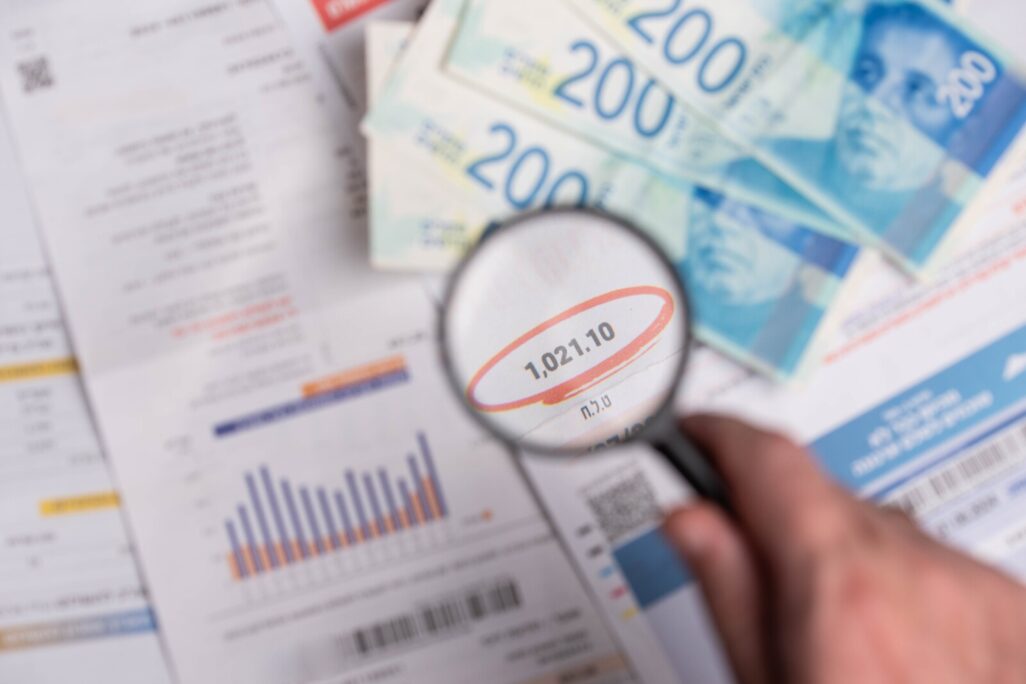
The start of the 2026 calendar year marks a point in time for various tariff and tax increases by the government and local authorities. As in previous years, price hikes will apply, among other things, to electricity, gas, and water, and increases in taxes on electric vehicles, municipal property tax (arnona in Hebrew), and National Insurance contributions will come into force. No less noticeable than the price and tax increases are the freezes, continuing from last year, in income tax credit points and income tax brackets.
Freezes and Indexation Changes: Complex Mechanisms Hitting Families’ Budgets
Freezing of Income Tax Brackets and Tax Credit Points
Income tax brackets in Israel are normally indexed to the Consumer Price Index (CPI), a mechanism that ensures workers’ taxes reflect real purchasing power. For example, a worker earning 10,060 shekels per month, the upper limit of the second tax bracket, is currently taxed at the first bracket. If their salary rises by 2.5% in 2026, in line with expected price increases, their real income and purchasing power remain unchanged. Accordingly, tax brackets and the value of tax credit points should increase from 242 shekels per month to keep pace with inflation.
However, the 2025 budget froze both income tax brackets and tax credit points for 2025–2027. This means that any salary increase during this period will push workers into higher tax brackets, even if their real income hasn’t increased. In effect, workers whose wages keep pace with inflation will pay higher taxes, as if their financial situation has improved. This confusing mechanism is projected to cost families hundreds of shekels per month, with the impact worsening by 2027. Without restoring pre-freeze brackets, households will continue paying more each year, as the cumulative effect of three years of frozen brackets grows.
National Insurance Contributions
National Insurance contributions (Bituach Leumi) have a single contribution threshold, currently set at 7,522 shekels. Workers earning below this threshold pay reduced contributions. As part of the 2025 Economic Arrangements Law, from 2026 the threshold for reduced contributions will no longer be linked to the average wage in the economy but will instead be tied to the CPI. Because average wages are influenced by high earners, this change will make contributions rise more quickly than wages for medium- and low-income earners, effectively increasing their relative tax burden.
The Knesset Research and Information Center estimates that this change will cost about 10 shekels per month in 2026, rising to 50 shekels per month by 2030. In addition, a temporary increase of 48 shekels in National Insurance contributions, set for 2025–2026, will remain in effect.
Price and Tariff Increases
Cooking gas
The price of cooking gas will rise by 5% from January 2026.
Water
The water tariff will increase by 2.35% — an increase of about 3.5 shekels per month for an average household consumer. The price will rise from 8.3 shekels per cubic meter to 8.5 shekels per cubic meter for the lower tariff, and from 15.26 shekels to 15.62 shekels per cubic meter for the regular tariff. The Ministry of Energy and Water spoke of a 7% increase in costs, but it appears that this year the main operational cost increase will not be passed on to consumers.
Electricity
The electricity tariff will rise by 1.5% in January, an increase of about 6 shekels per month for a household consumer. From 2026, the electricity tariff will be updated every six months.
Municipal Property Tax (Arnona)
Arnona is set to rise by 1.6% nationwide, though increases will vary across municipalities. For the average family currently paying 436 shekels per month, this means an extra 7 shekels, bringing the total to 443 shekels per month. In municipalities with the largest hikes, the increase can reach up to 75 shekels per month.
The nationwide adjustment is linked to changes in the Consumer Price Index for public-sector wages. Because of a temporary reduction in public-sector wages and a slowdown in inflation, this year’s increase is smaller than in the past two years. However, many municipalities have requested and received approval to raise Arnona rates, either across the board or selectively—for certain areas or specific properties, such as luxury homes and businesses. The largest overall increase is in Beit Aryeh, where Arnona will jump 16.6%.
Increase in Purchase Tax on Electric Vehicles
Until three years ago, the purchase tax on electric vehicles (EVs) was set at 20% to encourage their adoption. This year, the tax will rise from 45% to 48%, still significantly lower than the 83% tax applied to gasoline-powered vehicles, but higher than in previous years. The recent increases have already slowed the growth of EV adoption. The new rate does not apply to luxury electric vehicles priced above 250,000 shekels.
Public-Sector Wages
Following a 2.29% reduction in public-sector wages in 2025, another 1.2% reduction will take effect in 2026. These temporary cuts were implemented to help cover the costs of the Iron Swords war. From 2027, wages are expected to return to the levels agreed upon prior to these reductions.
Laws Not Yet in Effect
Property Tax
As part of the Finance Ministry’s 2026 economic plan, a property tax of 1.5% of the value of undeveloped land is expected to return. The tax will mainly apply to wealthy individuals holding land for investment, as well as many in the Arab community.
Tax exemption for new immigrants of up to one million shekels
As part of a Finance Ministry initiative to attract wealthy Jews living in the diaspora who face antisemitism, and to encourage them to transfer their economic activity to Israel, a provision is expected in the coming months as part of the Economic Arrangements Law granting a full tax exemption for new immigrants with an annual income of up to one million shekels. This exemption will gradually decrease to cover an annual income of 150,000 shekels by 2030. The tax benefit will apply only to those immigrating in 2026 and transferring their economic activity to Israel, and is expected to particularly benefit high-income immigrants. Returning residents who have not lived in Israel in the past ten years will also enjoy this benefit.
Widening of income tax brackets for earners over 16,000 shekels per month Income tax brackets will be changed so that the tax rate is reduced for those earning more than 16,000 shekels. This benefit will mainly help middle-to-high-income earners.
In addition to the changes taking effect at the start of January and those expected in the coming months, one measure already came into effect last week following the signature of Finance Minister Bezalel Smotrich on an order: the expansion of the duty-free exemption for personal imports of packages up to $150.
Public transportation fares were supposed to rise at the beginning of January from 8 to 8.5 shekels per urban ride, but this increase was postponed at the start of the month to an unknown date.