


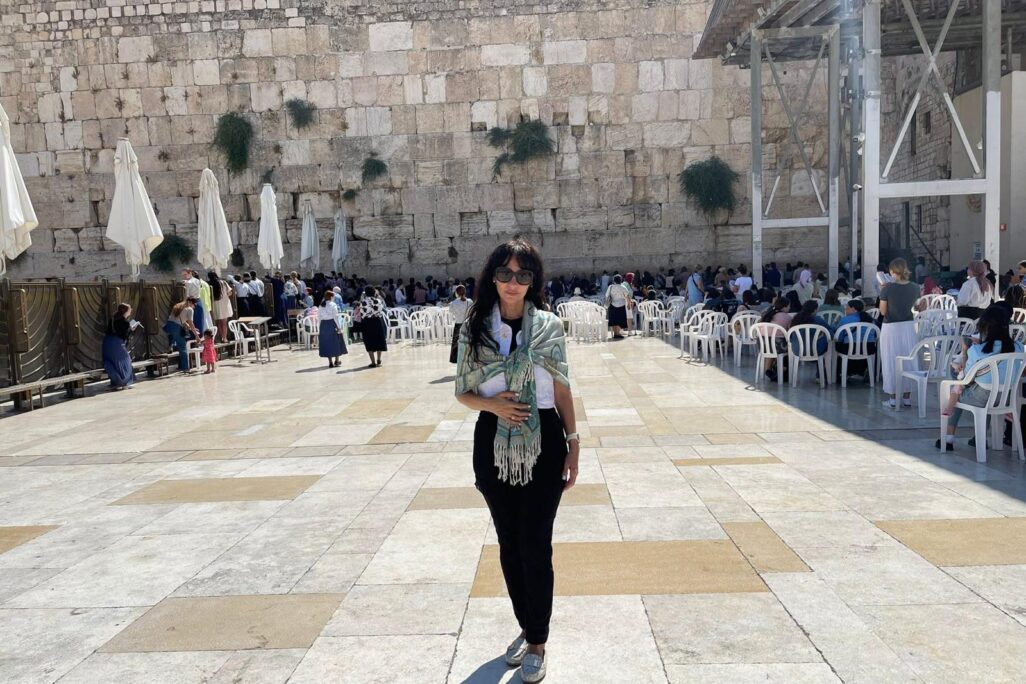
For Juliana Taimoorazy, 52, an ethnic Assyrian from Iran who has been living in the US since 1990, the yearning to return to Nineveh—now the modern city of Mosul in Iraq—is like the Zionist yearning for Jerusalem before the founding of the state of Israel. Hermiz Shahan, 72, who was born in Nineveh to an Assyrian family and has been living in Australia since 1981, feels the same way. Both spoke to Davar about their childhood experiences of persecution, assassinations, and a painful flight from home, and both recounted an ongoing sense of exile and a sense of affinity with Israel and the Jewish people.
The Assyrians are a Christian community belonging to the Assyrian Church, one of the early streams of Christianity. For centuries they lived as an ethnic and religious minority under various Muslim states in the northern Iraq region. As for other minorities in the Ottoman Empire, World War I brought massacres, expulsion, and wandering. Today the Assyrians number between 3 and 5 million, and their communities are dispersed across Iraq, Syria, Lebanon, Turkey, Iran, Armenia, and Western countries and Australia.
Taimoorazy’s family was displaced in 1915 to Russian territory, but even there they did not find rest. “February 5, 1938 is our Kristallnacht,” Taimoorazy recounts from her family history. “The Russians attacked Assyrian homes, took valuables, and deported the men to the Gulag. My grandfather, my mother’s father, was seven years in the Gulag. His brother was three years in Siberia, was captured by the Nazis, and transferred to Poland. Two additional brothers were murdered on charges of espionage.”
Taimoorazy’s father’s family was saved from such a fate thanks to her grandfather, who served in the Red Army as a physician. “My grandmother, my father’s mother, was sent to the Gulag for a year, and afterward was sent with her children to her husband in Iran,” she said.
Growing Up Assyrian in Revolutionary Iran
She remembers well the day of the Islamic Revolution in her homeland Iran. Taimoorazy, who was then six years old, recalls it vividly. “It was frightening,” she says. “People on the rooftops shouting: ‘Allahu akbar, Allahu akbar.’ It was everywhere, it echoed in the darkness. A few months before the fall of the Shah, my sister, who was studying at the American University, returned home in her car, which was smeared with blood. My father jumped from his chair when he heard her screams: ‘Where is Benjamin?’ That is my older brother, who did not go to the university that day. When she saw him at home, she fainted.”
At the entrance to the university her sister encountered burning tires, her car windows were shattered, and a bag full of blood was thrown at her. “This is your brother’s blood,” they shouted at her.
After the revolution the atmosphere changed. “At age eight, when I went to school, I could not make the sign of the cross or pray in public; I had to cover my hair. My best friend in class was Jewish. We are friends to this day. Students harassed us and tried to Islamize me,” she says. “My neighbors spat every time I passed in the street with my friend. I will never forget that one of my friends, a nice Muslim girl, told me during Ramadan not to touch her. ‘You are Christian and I am fasting,’ she said. They treated us as impure. My brother was forbidden to practice medicine. I hated Iran.”
When the Shah left Iran in 1979, Taimoorazy’s mother stood in the street and cried. “A Muslim man approached her, grabbed her by the throat, slammed her against the wall, and said to her: ‘Your father is dead, filthy Christian,’” Taimoorazy recounts.
Her sister left Iran in 1980 after her wedding. Her brother, who was smuggled from Iran to Turkey during the Iran–Iraq War (the family paid smugglers $25,000), reached Germany and was granted asylum.
When she was 16, Taimoorazy was offered to flee Iran in a livestock truck, marry the smuggler, and convert to Islam. In the end, she and her family reached Switzerland. From there she crossed the border into Germany and turned herself in. In December 1990 she arrived in the United States and became a citizen.
When ISIS Awakened an Assyrian Identity
In the United States the Assyrian community numbers about 400,000 people and is considered the largest Assyrian community in the world. Integration into American society has a price, according to Taimoorazy: “We are being killed in the East and assimilated in the West.”
The embrace the community receives threatens its uniqueness. Yet unlike the first generation of immigrants, who wanted to assimilate, part of the second generation is already searching for its identity. “Their children are already asking: ‘We are not just Americans—who are we?’” she says, adding that many young people are rediscovering Assyrian culture. “They are learning the language and going on roots trips to Iraq.”
She attributes this awakening to ISIS attacks: “On February 23, 2015 I was at a Christian conference. A friend of mine of Syrian origin answered the phone during dinner and began to scream. ISIS attacked in Syria and took seven of her family members hostage. They destroyed 35 villages in Syria. On another day they destroyed in Iraq the remains of the city of Nimrud, remains 3,000 years old, and the gates of the city of Nineveh. My mother saw me crying and asked why. I told her what had happened. She answered me: ‘ISIS put the name Assyria on the map.’ ISIS awakened the Assyrian giant.”
Taimoorazy organizes roots trips for young people. “Ages 20–40 come to Iraq and for two weeks tour and learn,” she says. “They also volunteer and assist the displaced and meet with local organizations. They return flooded with emotions. This region is enchanted. An Assyrian who comes there does not return the same.”
She continues, in her words, the path of her family members in preserving Assyrian tradition. “My grandmother was an expert in traditional Assyrian dance and participated in the ceremonies marking 2,500 years of the Persian Empire,” she says. “Another grandmother wove the first Assyrian flag. My grandfather, who was killed in 1926 by Stalin, is considered the Assyrian Theodor Herzl. He studied important Zionist thinkers.”
In 2016, Taimoorazy visited Iraq for the first time. “On the flight from Istanbul to Erbil we passed over the areas where our blood was spilled in World War I—Diyarbakir, Hakkari. I burst into tears, my makeup ran,” she says. “I kept the handkerchief with which I wiped my eyes. I have roots in Iraq from the beginning of the 19th century. I began to write without stopping. I asked forgiveness for abandoning Mother Assyria, Yemma Atur, the homeland. When we landed I kissed the ground and inhaled the air, I said the names of my family members. They came with me to the homeland. I came home. I felt a peace I had never felt before.”
Years earlier, in 2007, Taimoorazy established the “Iraqi Christian Relief Council,” which assists victims of al-Qaeda and ISIS and operates in 13 countries, including Syria, Iraq, and Lebanon.
During her visit to Iraq she traveled to refugee and displaced-persons camps. “We arrived in the town of Tel Skuf in northern Iraq. The town’s houses were destroyed. Baby clothes were scattered in the street. It broke my heart. The people there begged for help to get out of Iraq. ISIS were still fighting a kilometer away,” she says.
Her second visit was in 2018. “We visited with an archaeologist the Tomb of Jonah and the palace of the last king of Nineveh. We went underground. I brought stones from there. My boots got dirty with mud. I refused to clean them and kept them with the mud and dust.”
During the visit there was an attempt on her life. “I spoke on television against ISIS. They lay in ambush on rooftops when I visited the ruins of the city of Nimrud. The American consulate in Erbil asked that I not return to Iraq because I am wanted by the government in Baghdad due to my ties with Israel,” she says.
Connections to Jews and Israel
On one of her visits to Iraq, a group of American Jews and Christians joined her. Among other things, they visited the town of Nona in northern Iraq. “We arrived at a destroyed synagogue and welcomed Shabbat there,” she says. “We did it quietly. An elderly resident of the town approached us, held my hands, and cried: ‘For so long I have not heard this language. Thank you for returning our people to their place.’ Jews lived there for thousands of years.”
Her father, she says, supported Israel and taught her to love Israel: “When I was seven he told me: ‘We must love the Jews in Israel, not because of Jesus, but because of their good-heartedness.’”
Taimoorazy has visited Israel 14 times. “When I left Israel after the 2012 visit, I burst into tears. I felt as though my roots were torn from the ground. Israel is my second home. When I arrive in Israel I feel that I was summoned here.”
The Hamas attack on October 7 “destroyed a deep part of me,” she says. “The pain was so deep and the anger so alive that I swore to fight antisemitism everywhere. I studied and researched the Holocaust, visited Auschwitz and Majdanek. I, who fight for the Assyrian cause and am a descendant of victims of the Assyrian genocide in World War I, am determined to fight hatred of Jews.”
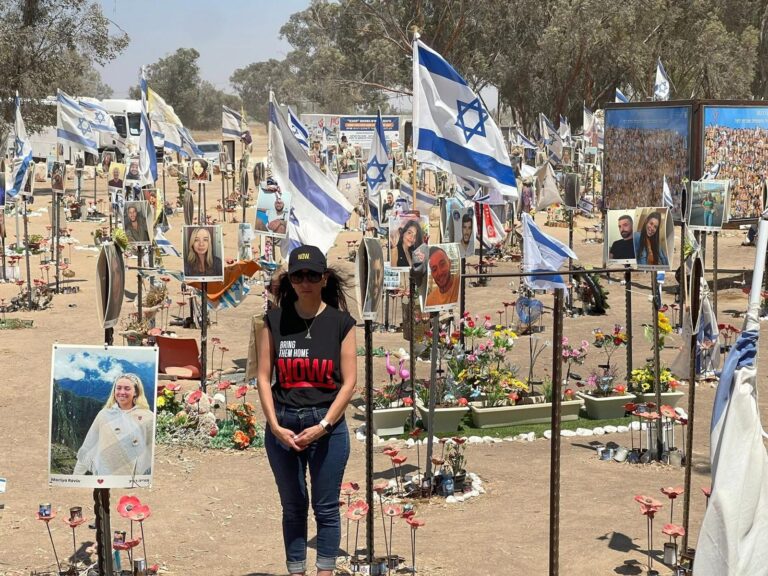
The Abraham Accords gave her hope that realizing the dream of returning to the homeland is possible. “We want a place at the table. We waited a long time and made do with crumbs. We want true friendship with Israel,” she says.
“There were many attempts to return, but we never organized as you did,” she continues. “Many betrayed us. There is despair. Hopelessness is rooted in the souls of the Assyrians. Many acted to return but failed and died of heartbreak.
“As Herzl wrote: ‘If you will it, it is no dream.’ Since 2014 there is a sense that there is a movement. But we will not survive for long; we understand the curse of the West. We are losing ourselves nationally. We need our own Zionism. Many young people want to establish an autonomous district in Iraq. Many of them understand that if not, we will remain only as an exhibit in a museum.”
A Parallel Life in Exile
Much like Taimoorazy, Shahan, too, struggles to preserve Assyrian heritage and believes that the Assyrian people and the Jewish people have much in common. “There is a historical and spiritual connection between us,” he says. A significant part of his activity is devoted to creating and strengthening ties with the Jewish community in Australia. After the October 7 attack and the recent bloodshed in Australia, he repeatedly emphasizes the importance of the joint struggle against antisemitism.
Shahan was born in 1953 in Nineveh, the cultural capital of the Assyrians. His family history is also steeped in pain. His father’s parents were murdered in the Assyrian genocide of 1915.
“One of my uncles was sent to the city of Habbaniyah beforehand. But my father, who was four years old, and his two-year-old brother were separated and sent to an orphanage,” he says.
When the American mission in Mosul gathered the Assyrians and offered to take Assyrian orphans for 60 rupees per child, the uncle rescued his father and raised him. “My father was 12, I think. Until the day he died he did not reveal what happened to his brother.”
Shahan’s mother was born in Iran. “They used to kidnap Christian girls there. Her parents sent her to Habbaniyah to live with relatives. There she met my father and married him,” he says.
He remembers from childhood the Officers’ Revolution of July 14, 1958, which overthrew the monarchy, and remembers the days of Abdul-Karim Qasim’s rule. “Qasim was good to Christians; even during the monarchy the situation was good, but after the assassination of Qasim the situation became bad,” he says. “In Mosul we were under constant curfew. Young men were taken from their homes and murdered. One day the communists attacked the nationalists and hanged them in the street—we had to go out and applaud them. On another day the nationalists hanged the communists in the street and again we had to go out and applaud them, otherwise we would be in trouble. As children we saw people murdered and hanged in the street. It was chaos.”
After the 1963 coup, under the rule of Abdul Salam Arif, things calmed down, but the situation of Christians did not improve. After completing university studies and serving a year and a half in the Iraqi army, he was told that in order to get a job he had to join the ruling Baath Party. He chose to work with foreign companies, worked with Germans and Japanese, was drafted again into the army for eight months. Saddam Hussein’s security services began to follow him and try to persuade him to work for them. “I was interrogated twice,” he says. “After that I decided to leave the country.”
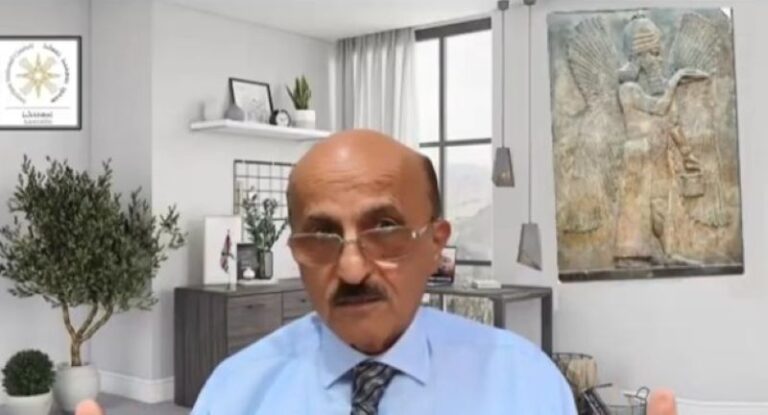
In 1981 he traveled to Australia and applied for asylum. “When I arrived I was full of national feeling. I left my country by force. I did not want to leave Iraq—this is my history, my homeland,” he says. “My parents in Iraq suffered. The security services threatened them and asked for information about me. They were forced to sell the house and leave Iraq. They moved to Jordan, from there to Syria, to Turkey, to Greece, and to Yugoslavia, where their passports were stolen. When my asylum request was approved, they arrived in Australia. Those were difficult times. In retrospect, these are dark memories.”
When Shahan arrived in Australia, the Assyrian community there numbered, by his estimate, about 20,000 people. They had several organizations. He joined the Australian branch of the Assyrian Universal Alliance, was elected secretary of the branch and later deputy secretary-general.
“At that time,” he recounts, “the secretary-general was a member of the Iranian parliament. When they discovered that I had visited Israel, they published an article against me in an Iranian newspaper. It was like calling for jihad against me. The matter was discussed in the parliament of New South Wales and in the Australian parliament.”
‘At the Moment, the Assyrians Have No Friends’
Today, after a legal struggle and under a new name—“The Assyrian National Council”—they have distanced themselves from Iranian influence, “and now we are free to work with whomever we want, without fear.”
He is devoted to preserving heritage. On the wall of his office hangs the Assyrian flag, and beside it a picture of ruins from the city of Babylon. “Assyrians have a strong national feeling,” he says. “This is the reason we survived the repeated acts of murder and massacre since the fall of the Assyrian Empire. It is because of our love for our history and our heritage. We also used to observe here every year the Fast of the Prophet Jonah, a three-day fast commemorating Jonah’s mission to Nineveh. These are things that bring us closer to the homeland, even though we lost it.”
As part of his public activity he has participated in dozens of conferences, including the Indigenous Peoples’ Conference in The Hague. He led the establishment of extra-parliamentary organizations and the organization of an Assyrian heritage festival. “We started with 2,000 people, and today we expect 15,000. The Australian public knows us,” he says.
“Even in exile we are trying to revive our language and our tradition. We established here, in Sydney, our own schools,” he continues. “1,400 children study in them.”
The extensive social activity and the flourishing of the community in Australia are supported by the establishment of the Assyrian Church: “We have a large group of enthusiastic young people. They are very active.”
He too, like Taimoorazy, traveled for visits to Iraq. Since the fall of Saddam in 2003 he has visited Iraq four times. “The first time was to celebrate his fall,” he says. “Everyone was happy. The war was still raging. We flew in a small plane from Jordan to Iraq. When we landed there were bombings everywhere. We had to hide until they evacuated us to a safe place. We stayed a few days in Baghdad; the city was destroyed. There was a curfew, and it was impossible to go out after dark.”
After a few days they traveled to northern Iraq. “We went to strengthen our people. We visited Erbil and Beth Nohadra [in the city of Duhok in northern Iraq] and monasteries. We wanted to create contact with the Assyrian organizations there, but the Iraqi regime made this difficult. The situation there is not good,” Shahan says.
And when the extremists rose, the situation deteriorated: “It started with al-Qaeda. As usual, at first they focused on the weak communities—Christians. People were burned; they killed people, our clergy.” According to Shahan, Christians fled from the large cities northward to the Assyrian region, and from there continued to flee to European countries, the United States, and Australia.
The second wave of flight occurred following the rise of ISIS. “What ISIS did was another horror,” he explains. “They forced people to leave the homeland. They destroyed city after city and village after village. They destroyed churches, homes—everything. Many Assyrians fled to Syria and settled near the Khabur River and in the Hasakah region. There were 35 villages there numbering about 30,000 residents. After the ISIS attack, about 1,000 people remained in the area.”
According to Shahan, the situation of the Assyrians in the Kurdish autonomy in Iraq is also not good. “When extremists rose in the Kurdish political system, they closed the Assyrian schools and imposed the Kurdish curriculum and the study of the Kurdish language. They settle in our villages and force people to leave.
“The Kurds,” he says, “must understand that we are part of the region. Historically, the region is not Kurdish land—it is Assyrian land. The Barzani people arrived there 80 years ago, after the destruction of Mahabad [the short-lived Kurdish Republic in Iran, which was dissolved in 1946]. They fled here and we protected them and helped them flee to the USSR. We expect the Israeli government, as part of its good relations with the Kurds, to try to change the course of events.”
When he is asked about the future of the Assyrian people, he hesitates. “We will have a good future when we have friends,” he says. “Unfortunately, at the moment the Assyrians have no friends.” Despite the sense of acceptance in Australia, he looks to the United States and Israel as those that can influence the situation.
Assyrians around the world are organized in different communities under different churches and find it difficult to unite. “Like the Jews, we dispersed all over the world. There were several attempts to unite, but they failed,” he says.
Recently, however, at a conference in Armenia, an Assyrian parliament was established with representatives from all the communities, and in the future a large conference is expected in Sweden. “There is a thirst for an international umbrella organization. There are federations in different countries. Now we need an institution that will unite everyone,” he says.
Shahan’s goal is clear. “We want self-rule or an autonomous district. We deserve a homeland,” he says. “We are located in an important place in northern Iraq, in the Nineveh Plains region; most of the population there is Christian. We are a buffer zone between the Arabs in the south and the Kurds in the north. It is possible that this will contribute to bringing peace between Arabs and Kurds.”