

Two crane operators from Akko were removed earlier this week from a construction site of the company M.S.A. in Akko after refusing to work in dangerous wind conditions. The incident was immediately reported to the Safety and Health Administration at the Ministry of Labor, which is expected to conduct an inspection and visit the site.
In a photo obtained by Davar from Akko, the crane’s control panel can be seen indicating wind speeds of 65 km/h, along with an emergency warning issued by the crane.
“If there’s strong wind, you shut down the crane and come down”
- (full name withheld), one of the crane operators, told Davar that he has been working at the site for five days. “Yesterday there was some wind, but we managed. We lifted items only to a low height of up to one meter, and even then it was lifting steel mesh, which has less wind resistance and sway. But this morning, when we got to the cranes and climbed up, we saw the crane was beeping, indicating wind speeds of 65 km/h. We debated among ourselves what to do, because it felt dangerous. We were given a task to lower a cable and turn over a concrete container. We decided it wasn’t right to do that at this point.”
-
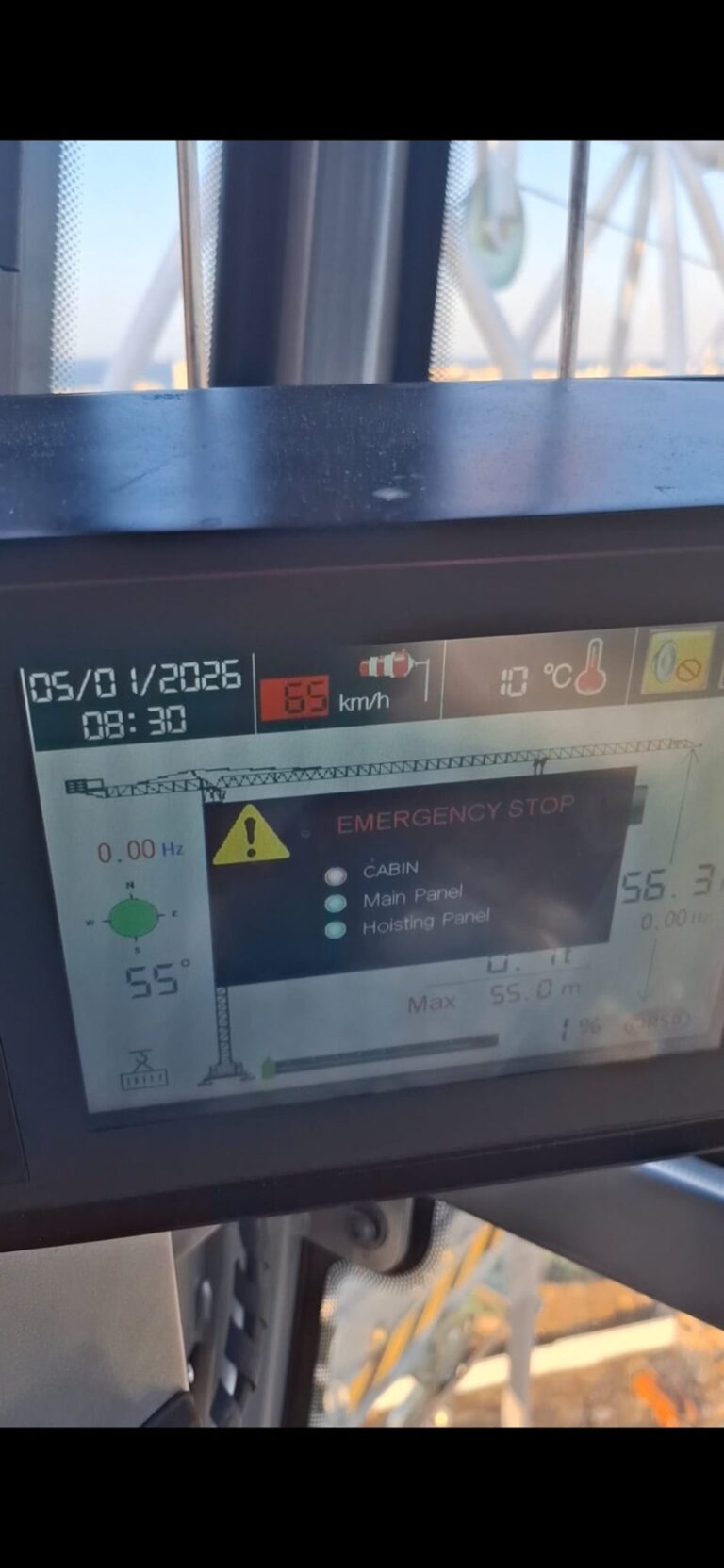 Emergency announcement from the crane at the construction site in Akko about the strength of the wind (private album)
 -
- noted that the Ministry of Labor’s guidelines state that the decision to stop work in windy conditions, certainly above 40 km/h, rests with the crane operator alone. “If there’s strong wind, you shut down the crane and come down. It’s no joke being up there in strong winds. It’s dangerous and frightening. We told the site manager we would come down, wait an hour or two until the wind eased, and then continue working. But then the project manager arrived and started asking, ‘Why did you come down?’ We tried to explain that it’s impossible to work in such winds, that it’s dangerous, that if we lift something and the wind causes it to sway or swing, we could injure someone or kill them. He told me, ‘You shouldn’t have come down, I’m finishing the job. You’re fired as far as I’m concerned.’”
- said it was his first morning on the site. According to him, when he arrived at work he immediately informed the site manager that there were strong winds. “They told me they were working. I was surprised, but I said, fine, let’s go up. At 20–35 km/h there are things you can still lift. But when I got up to the crane, I felt the extreme winds. You climb the crane by ladder, and I was almost thrown by the wind while climbing the last three rungs. I entered the cabin and saw the computer beeping, and saw the wind readings. I said, ‘No chance.’ I took photos and sent them to the site manager, and I didn’t get any response, even though I saw that he had read the message.”
According to him, the feeling at a height of 80 meters was simply one of mortal danger. “You feel everything shaking. I opened the door and it flew open, I almost flew out myself. It’s truly terrifying. You can’t explain how much. Our guidelines are clear: above 60 km/h you have to shut down the crane and come down, there’s no point in taking risks and staying in the cabin. When I got down, the managers started mocking me: ‘Oh, you came down from the crane? Finished for the day?’ I told them that instead of protecting my life, they were endangering it. After that, they called the contractor and said they didn’t want us on the site.”
Both crane operators stress that in the surrounding area, an area dense with construction sites in a new neighborhood being built in eastern Akko, all the cranes were shut down: “Only we were pressured to keep working.”
“Not an unusual incident”
The incident was reported by the National Crane Operators’ Committee to the Safety Administration at the Ministry of Labor. However, the Ministry of Labor said that inspectors did not arrive to do a site inspection, although they did visit other sites where there were wind-related risks. The Chief Labor Inspector and head of the Safety Administration, Hazi Schwartzman, told Davar that “the administration views these phenomena very seriously and addresses them by dispatching inspectors for urgent inspections at reported sites. Yesterday, for example, supervision was directed to a suspected crane in Tel Aviv for an immediate inspection. In Akko, a supervisory visit will be carried out in the coming week. The issue of cranes and crane operators is handled on an ongoing basis through the disqualification of rogue operators and the issuance of orders to construction contractors.”
“The unfortunate incident in Akko is, regrettably, not an exceptional case, but rather another manifestation of a deep and ongoing crisis in the field of crane operators, one of the most sensitive and dangerous sectors in the construction industry,” says Mazal Golan, chair of the Histadrut Union of Construction, Wood, and Related Industries Workers. According to her, this is a sector that has for years suffered from insufficient oversight, repeated violations of mandatory safety regulations, and abusive employment practices that require workers to operate under harsh and sometimes unreasonable conditions. In many cases, crane operators are employed through manpower agencies that do not operate in accordance with the law and safety regulations, causing direct harm to workers and to public safety.
“The Histadrut views with utmost severity any violation of workers’ basic rights by employers who do not respect the industry, or the workers themselves, and who place them in an unacceptable dilemma between safeguarding their safety and securing their livelihood.”
She added that the crane-operator sector is characterized by a dangerous combination of heavy responsibility, a high level of risk, physically demanding working conditions, remuneration that is not always adequate, and insufficient enforcement. “Alongside violations of safety laws, we are also witnessing ongoing harm to employment conditions and basic social rights of workers in the sector. This reality requires comprehensive and swift regulation, a significant strengthening of oversight and enforcement mechanisms, and the guarantee of fair and safe working conditions through a general collective agreement for the industry. The Histadrut stands, and will continue to stand, alongside the workers, will act to represent them, and will continue to fight with them against any party that violates the law or endangers human lives. The role of the Histadrut is not limited to reacting to events after the fact, but to proactive action to create a comprehensive framework of protection, rights, safety, and proper working conditions, with the aim of preventing the next incident.”
Roi Weinstein, chair of the National Crane Operators Committee in the Histadrut of Building and Wood Workers, said: “This case is one of hundreds each year in which a crane operator is forced on the ground to choose between safety and livelihood. After speaking with the two crane operators, we contacted all the relevant authorities and reported both the violation of safety laws and regulations and the public danger resulting from them, with the aim of eliminating these distortions from the industry. We attach paramount importance to employers recognizing the professional judgment of crane operators in the field, and we hope that this serious incident will not only be addressed, but will also send a clear message to the field and to construction companies regarding the preservation of human life.”
Weinstein shared with Davar blunt messages he received from a site manager of another contracting company in Holon, who allegedly tried to remove him from a construction site after he reported a series of safety violations on a crane located in the middle of a residential neighborhood.
M.S.A., the contracting company at the Akko site, told Davar: “The claim that two crane operators were removed from the construction site for refusing to work in wind conditions of around 65 km/h is false and a deliberate distortion of the facts. The crane operators were not removed from the site; they abandoned it of their own accord without informing the site manager.”
According to the company, attempts were made to contact the manpower company that employs the crane operators “to clarify the reason for their departure,” but no response was received for several hours. M.S.A. is now considering whether to continue working with that contracting company.