


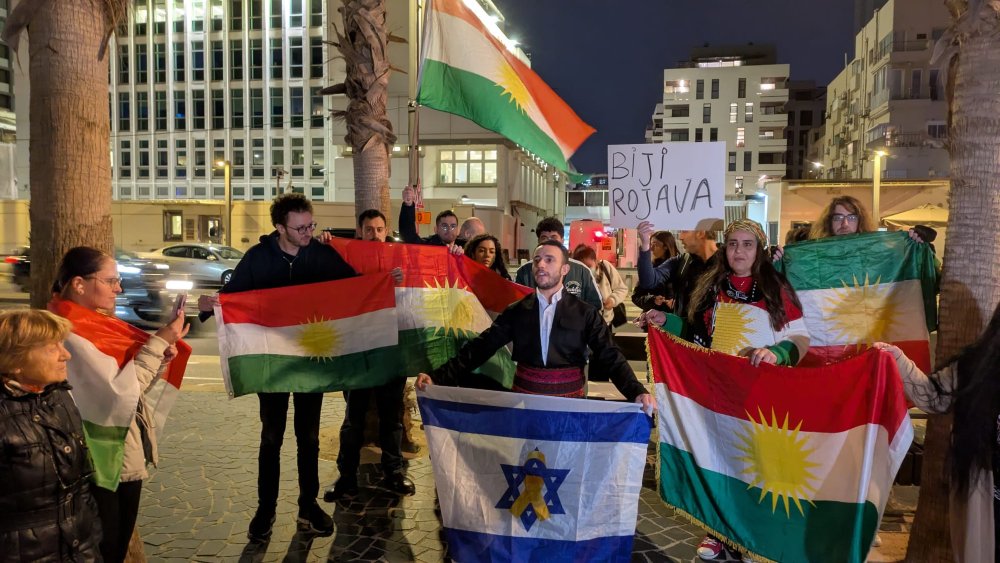
Dozens gathered on Wednesday evening for a protest vigil outside the U.S. Embassy in Tel Aviv. The protesters are calling for international intervention to halt the massacre of Kurds in northern Syria by the regime of President Mohammad al-Sharaa, which is backed by Turkish military forces.
“We are seeing images of Kurdish women who fought against ISIS being taken captive to a horrific fate, beheadings and the murder of children and families,” said Elyana Elyan, one of the protest’s initiators. “Despite the ceasefire agreement and the Kurdish withdrawal, we see that the massacre continues, and hundreds and thousands of ISIS fighters are being released. This is a threat not only to Kurdistan but to the entire world. If the West does not stand by its allies, this disaster will reach it as well.”
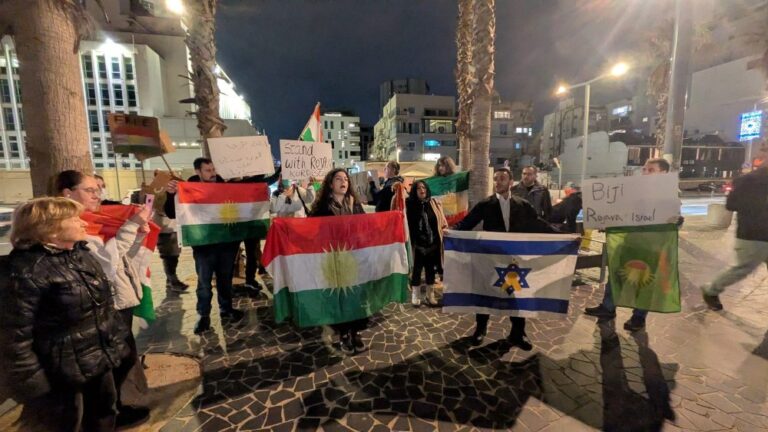
Walad Mahdi, a Kurdish student from Amed in northern Kurdistan (under Turkish rule), who is studying for a master’s degree in diplomacy at the University of Haifa, told Davar: “What Israel does now will also affect its own future, because what is happening in Syria right now is a replay of what happened to Israel on October 7, on a much larger scale and with the de facto support of the Western world.”
According to him, Kurds from areas under Turkish control are “slipping across the borders” toward their brethren in Syria in order to join the armed forces fighting for their lives there. “Al-Jolani and the Turks are now releasing around half a million ISIS terrorists who were held in prisons run by the Kurdish autonomous administration. These are people who could eventually reach Israel’s border and threaten it, maybe not this year, but in the future.”
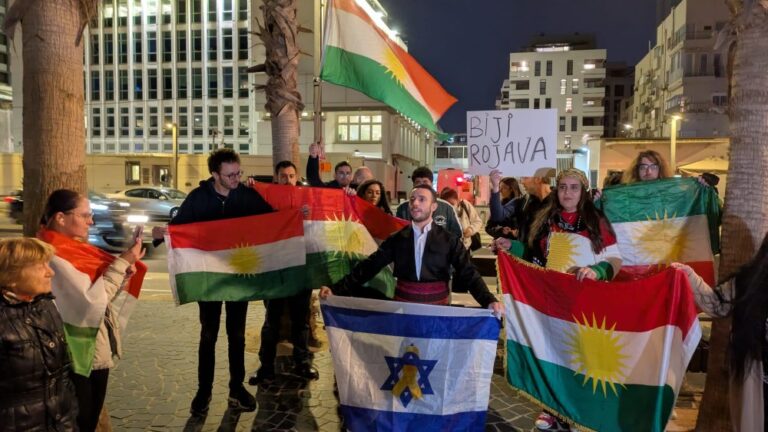
Mahdi notes that the Kurdish autonomy, also known as the Syrian Democratic Forces (SDF), was built on ideas of equality, direct democracy, ecology, and an alliance among minorities: “These are ideas that are unfortunately difficult to implement in the Middle East. They tried to build a utopia not only for themselves, but also for the other minorities in northern Syria. The question is: why is it that around us there are Iraq, Syria, Turkey, and Iran, and yet 50 million Kurds do not have a state of their own?”
Esther Alzam, who was born in Kurdistan, arrived carrying the Kurdistan flag— a red, white, and green flag with a sun emblem at its center. She said: “Turkey has always been our enemy. It causes all this chaos. It supports Hamas and massacres Kurds. Why is the UN silent? They only know how to condemn Israel.”
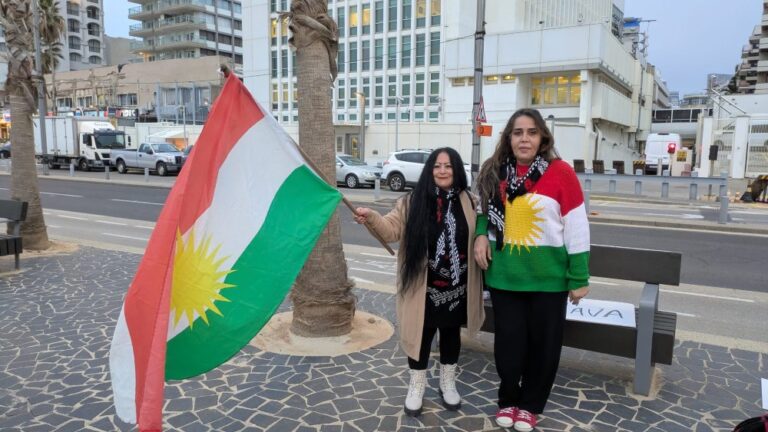
Emanuela Sayar Barzani, whose family immigrated from Kurdistan in the 1950s, says that for the past twenty years she has been active in promoting rapprochement between peoples and in solidarity demonstrations on behalf of the Kurdish minority under attack in various countries.
“I still have family in northern Kurdistan under Turkish occupation. I grew up on the stories, traditions, and foods of that region, and in the internet age Kurds all over the world are connected to one another. Sadly, in all the countries occupying Kurdistan, Syria, Turkey, Iran, and Iraq, our culture is under repression, our language is under repression, and the Kurdish people are under repression.”
“Our people are occupied by so many evil states”
Sapin and Nask (pseudonyms) moved to Israel with their two children not long ago. Nask is Israeli, but Sapin still has family in northern Kurdistan, so he avoids being photographed or identified in order to protect their lives.
“Our people are occupied by so many evil states,” he says. “We have always seen Israel and the United States as friends and partners. In Kurdistan, people love and support Israel. They talk about us as the ‘second Israel’ of the Middle East. That’s why we’re waiting for them to help us, to support us, to not allow us to be slaughtered and murdered in the name of religion.”
Yehuda Ben Yosef, president of the Kurdish community in Israel, says the Syrian army’s massacre of Kurds is horrifying, especially given that an agreement had already been reached between the Kurdish forces and the Syrian regime: “They just saw that the world’s attention is on Iran and decided to start the genocide. They are displacing hundreds of thousands from Aleppo and other cities. They are looting the oil wells. This is revenge from the murderer Erdoğan, who has been slaughtering Kurds for years because he fears the Kurdish minority in Turkey, and the oil is just a bonus.”
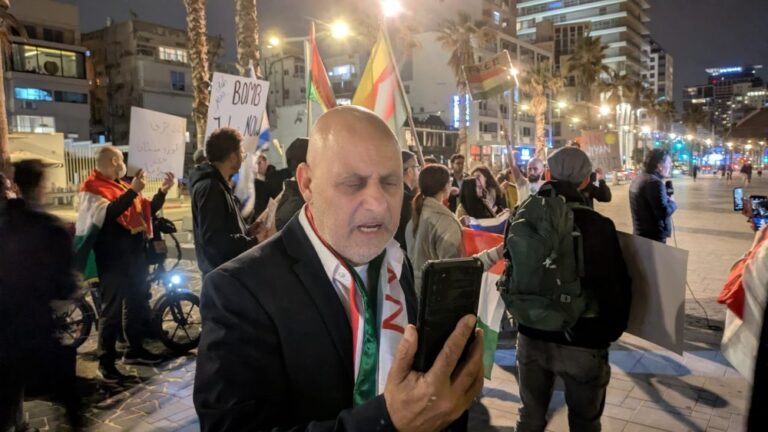
Ben Yosef says he has not yet lost hope that the United States will intervene. “We spoke with Jewish senators who care and applied pressure, and we also spoke with members of the Knesset. I hope that in the end the pressure will prevail, because even Trump does not want people to keep being killed.”
During the demonstration, he spoke by phone with Adel Maroujba, who told Ben Yosef that some cities have been split in two between the regime and the Kurdish forces, which are under constant drone attacks: “We are in continuous and regular contact with the Kurds in northern Syria and with other Kurdish communities around the world. We feel what is happening to them. I call on you, Benjamin Netanyahu, help the Kurdish people— the protector of the State of Israel. If they are not there, the jihadists will be there.”