


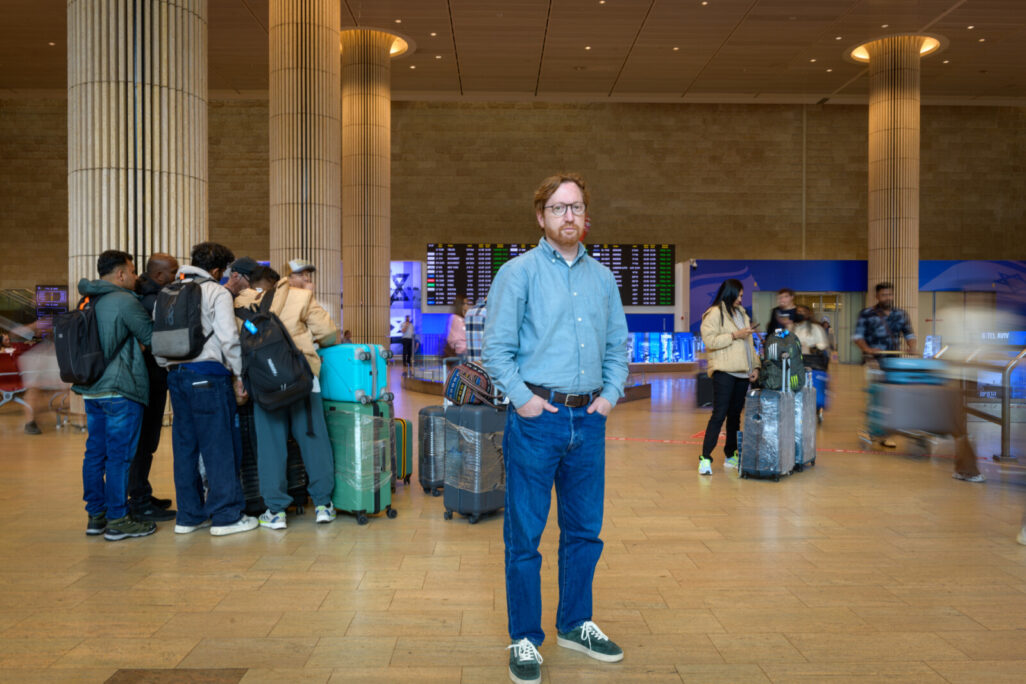
Even after the last foreign hostage was returned to their family and homeland, Josh Lawson continues to care for them and their needs. Lawson, who was appointed at the start of the war, almost by chance, to head the Foreign Desk in the Prime Minister's Office, sees looking after foreigners as a great mitzvah (religious obligation). At the farewell ceremony for the Tanzanian hostage Joshua Louito Mollel, a 21-year-old agriculture student killed on October 7, Lawson eulogized him
"One mitzvah stands out above all others– the mitzvah of caring for the 'stranger among us'. As taught by Rabbi Lord Jonathan Sacks, this mitzvah appears more than any other in the Bible: 36 times. The Torah's insistence, 36 reminders, tells us that this may be the most important moral duty in all of Judaism, and perhaps in all religions."
Lawson, a Jerusalemite and son of immigrants from the UK, is a neurophysiologist in civilian life and a medical officer in the military reserves. Until October 7, he worked in medical equipment. On October 8, he suddenly found himself in command of the mental health system at Camp Shura
"I was called up for reserves," he recalled in an interview with Davar. "I arrived at the Home Front Command operations center and happened to see the order. I asked, 'what is Shura?' That's how it all unfolded. We had to reinvent the wheel while all the moral standards around us were collapsing."
For about two weeks, he worked on identifying 1,150 casualties and dealing with their families and the bureaucracy. "At the end of Shura, I had the option to go home and recover, or to throw myself into something I had no idea what it was. And that changed my life."
"Suddenly, three more hostages arrive, and they're not on the lists."
In the last week of October 2023, Lawson received a mission through a civilian organization: to assist a severely injured Thai man, an amputee, whom no one had helped. "A truly unfortunate person," Lawson says. "I asked my commanders, 'Are there foreign hostages?' When I joined, there were still 500 missing. Our job was to understand the situation and support the families. return.”
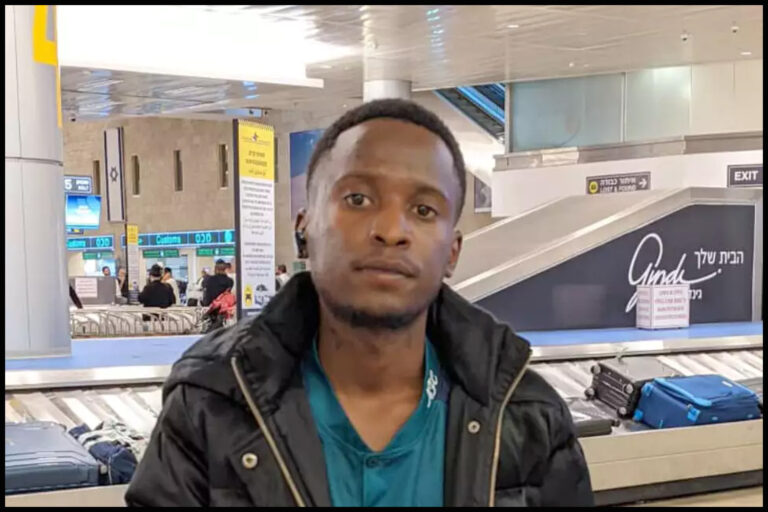
It is now known that 35 foreign nationals were abducted on October 7 from communities, fields, and orchards in the Gaza border area. Twenty-nine of them were returned alive in the first two agreements, including 27 men and one woman, all Thai citizens, along with a Filipino citizen. A Mexican citizen, a Tanzanian citizen, and two Thai citizens were killed on October 7; their bodies were taken and later returned to Israel and then to their home countries. Two others, a Thai citizen and a Nepali citizen, were abducted alive, killed in captivity, and their bodies were returned to Israel and then to their home countries.
But in those early days, the lack of clarity was so great that in the first round, under the first agreement, three Thai citizens were returned whose abduction had not even been known. "Until then, we knew there were 32 hostages; suddenly three more arrived, and they weren't on the lists, we didn't even know they were in the country. This exposed the limits of the staff's transparency, given how long it took, relatively speaking, to identify who was actually missing. Identification was based mainly on testimonies, either from the field managers of specific kibbutzim or from their colleagues if they were contract workers, moving from one place to another week by week.”
"I don't know what the employers knew. The employers were also deeply affected. It's possible that people from their families were also abducted and killed. These were the first weeks of the war. An undocumented worker moves between employers, so the handling is adjusted accordingly."
Another example of the chaos and lack of information the Foreign Desk team had to navigate can be seen in the following story. In May 2024, seven months into the war, the Foreign Desk received a request from a Thai family about a missing relative. "What it turned out," Lawson explains, "is that he was a troublemaker, both in terms of the law and especially with his friends. He moved from place to place, sometimes following the rules, sometimes not, and no one really missed him."
"We collected DNA from his parents, and the IDF's POW and Missing Persons Unit worked with Interpol to search for him. They ran the genetic data through Shura and forensic medicine databases, and he didn't show up anywhere. Then, one day, he was arrested in the city of Netivot for wandering. That was it. Until then, I was operating under the assumption that there was a Thai national we didn't know the whereabouts of, and parents who didn't know where their son was.”
"I'm the leader, the decision-maker, but based on what?"
Lawson came, without any relevant training, to the sensitive and complex role of gathering information on hostages from around the world, which required, among other things, communicating with people who didn't speak English, mostly from remote villages in northern Thailand. In addition, during the early period, he says, he didn't really have "any mandate."
There was no clear definition or formal appointment for his role. He recalls that "some people even thought it wasn't worth doing, since their own countries would handle it. In the end, the role is what you make of it. Who am I? I'm a lieutenant colonel in the reserves, and I became the point of contact for the Foreign Ministry, the Ministry of Labor, and the International Migration and Absorption Center. I'm the leader, the decision-maker, but based on what? I had no idea. Ultimately, the answer was: there was no parent here. There was no authority. When it came to Israeli hostages, the Ministry of Health and the National Insurance Institute sent a representative, right? I got lucky that when it comes to granting rights to foreign citizens, everything I asked for was approved."
"There's no one who comes and says, 'Guys, they're mine, they're my responsibility.' It's uncomfortable to say, but the fact that a lieutenant colonel from the Home Front Command took responsibility for this is a disgrace."
Lawson admits, with a rare honesty and humility, that under the circumstances, mistakes may have been made in handling the foreign hostages and their families: "There's no one who comes and says, 'Guys, they're mine, they're my responsibility.' It's uncomfortable to say, but the fact that a lieutenant colonel from the Home Front Command took responsibility for this is a disgrace. I'm certain I messed up."
"Always afraid I'd bow at the wrong time"
During the dramatic rounds of the first agreement, when women and children were returned, 23 Thai citizens and a Filipino citizen were also returned alive. Lawson was at Shamir Hospital, where they arrived for initial treatment. Dressed in his IDF Class B uniform, he had to provide answers and solutions, bridge gaps between different agencies, and ease tensions.
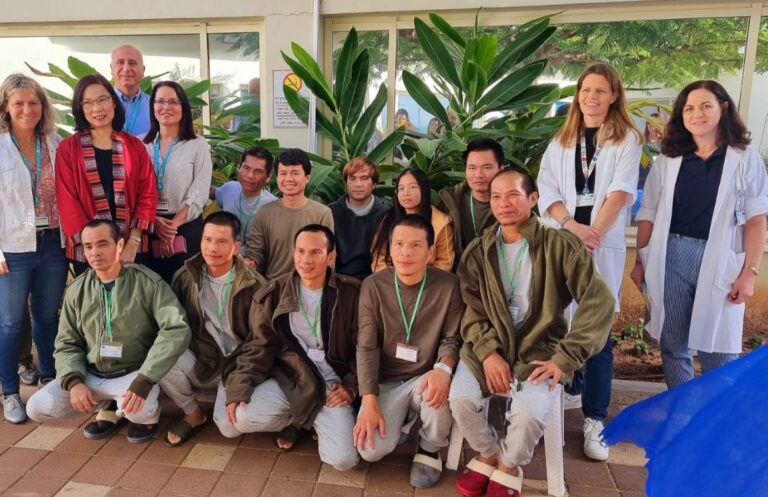
It was there that he realized just how little he understood, especially the cultural gaps and the sensitivity required, and it was also there that he met many compassionate citizens who helped him fine-tune the care he provided. The problems were plentiful; ""It was mostly the things we didn't know to ask. I mean, we didn't think about them at all. I was always afraid I'd say the wrong thing, that I'd bow at the wrong time."
Only thanks to psychologist and Thai speaker Daniel Porat and labor migration researcher Dr. Yahel Kurlander, who stood by the Thai hostages and those injured from the very beginning of the war, made Lawson realize that touching a Thai person's head is almost forbidden.
"The aura comes from the head, so someone who has survived fire is on a sacred level. Touching their head is a huge honor and requires permission. The whole story of how to speak, hand gestures, physical contact, I hadn't thought about any of it, let alone that they actually feel inferior to us."
When the living hostages returned home, Lawson continued to handle the rights and benefits they were entitled to from the State of Israel, and maintained contact with families still waiting for their children in captivity.
“I didn’t travel to visit the families in Thailand or Tanzania, the challenges were immense, and we had to come up with solutions that hadn’t existed before. Like for example, how do you provide psychological care in the East? How do you fund medical treatment for those who endured torture? It was a significant bureaucratic challenge.”
“We knew we were dancing in a minefield”
One of the key achievements of Israel’s handling of the abducted foreigners is that they and their families are entitled to the same rights, “down to the shekel,” as Israeli hostages. The laws passed in the Knesset under the administration’s auspices were designed to also apply to foreign hostages and their families.
“The state very quickly realized there was a need for legislation and care that went beyond the rights of victims of terror and bereavement. We had to ensure the law didn’t just say ‘Israeli citizen,’ as in the first draft, but rather ‘returned hostage’” says Lawson.
Alongside pride in Israel for the moral treatment of those affected by the Hamas attack, even when they are not Israeli citizens, and admiration for the ability of the systems to mobilize and understand the needs in the early days of the war, Lawson is also critical, sometimes sharply, of the willingness and flexibility of the agencies to meet the various needs.
At the Hostages Administration, the care of foreigners and their families took place in the shadow of the treatment of Israeli hostages: “There were all kinds of jokes about it, a kind of cynicism, but there was also a lot of embarrassment, so much embarrassment.” Some of that embarrassment stemmed from the state’s decision to appoint Lawson to this sensitive role. He arrived with plenty of good intentions, empathy, fighting spirit, and motivation, but with zero experience in anything remotely close to what was required of him.
When asked about balancing representing the families interests while protecting the state budget, Lawson replies, “There are no rights they didn’t receive, but every right had to be pushed for. With Israelis, it was enough to meet the requirements; with the Thais, we had to make it happen. For the National Insurance Institute to send money, a claim had to be filed. It took many months to get the claims from the foreigners. At one point, there was a concern that if they received money from Israel, it might harm their relatives. We knew we were dancing in a minefield.”
“To understand that these families’ lives had been shattered”
What was your role for them? Were you the family? The social worker?
“I was the State of Israel. I was the ‘Prime Minister’s Office.’” says Lawson
Unlike the families of Israeli hostages, the foreign families couldn’t go to the media. “In the first release, they arrived in the country without shoes. Okay? No shoes. What happened? All the other hostages came back with flip-flops or whatever, but their families had brought them shoes. Not the foreign hostages. So I reached out to a well-known clothing chain, and in the middle of the night, near Rehovot, they opened one of their huge branches for me. They said, ‘Please, take whatever you need.’ So I got them shoes, clothes, everything. It was easy. We brought them jeans in multiple sizes, no questions asked, nothing was refused.”
When asked what could have been done better Lawson replies: “I think the state, even though I understand why, didn’t leap to help the foreign families the way it did for Israeli families. And when I say ‘leap,’ I mean truly grasp that the lives of these families, despite sending someone for years to another country, were shattered. Even though the consulate in Bangkok was working tirelessly, truly tirelessly, and continues to do so, it didn’t hold the families the way we think about ‘holding’ them. Maybe it would have required Israel to pay the local monastery in that village, so that the Buddhist monk would have an incentive to check in with the family every day. I don’t know, I’m just throwing ideas out. But we didn’t really turn on the burners for the families. We didn’t really turn on the burners for them.”
As of today, five families of returned hostages and hostages who were killed receive psychological and medical care from the State of Israel. Parents and children, if the hostage had any, receive the same support as Israelis. However, unlike Israeli families, the bereaved siblings of foreign hostages who were abducted and killed are not entitled to the same benefits. “Financially,” Lawson says, “this goes above and beyond what’s expected of us, but there’s always the question of where our sense of responsibility begins and ends.”
“The voices of the ambassadors were barely heard”
In February 2025, when the second agreement was signed and five living Thai hostages were returned, the system was already better prepared to handle such a complex event. Porat held an official role, and Ofer Adi, the Buddhist monk who accompanied them spiritually, was brought into the loop. Thai restaurants, which had generously contributed during the first release, were part of the support system, and family members of some of the hostages came to Israel.
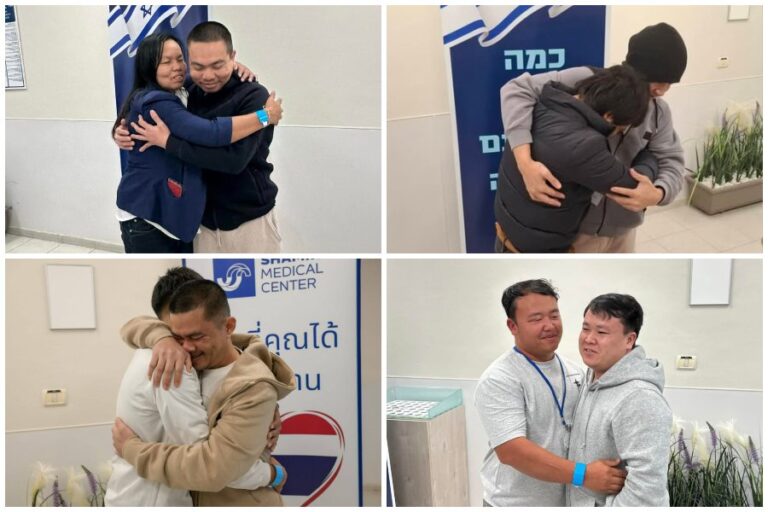
In contrast to Israel’s care for foreign hostages, Lawson criticizes the handling by the countries of the abducted citizens: “In the end, all the foreign hostages returned, but was that because their action was successful? The voices of the foreign ambassadors were barely heard. Where were their countries? Sorry, where was the Tanzanian ambassador? Did you hear from them? Do you even know who they are? The Thai ambassador decided the best way to handle things was to ask headquarters not to announce the names of the Thai hostages at ceremonies and to avoid showing their photos.”
"An enormous opportunity to care for the foreigner, to show kindness"
The only time Lawson had direct contact with a hostage’s family was when he, together with officers from the POW and Missing Persons Division, broke the tragic news to the wife of the late Nettaphong Pinta. “Talking to someone for the first time to deliver news like this, there’s something profoundly humbling about it,” he says. “The moment feels much more dramatic than it actually is. In reality, I was just knocking on a door. No prior training, no door, no knock, no face, no touch. Not even the quiet that comes afterward. You get one chance to do it properly. There was a point where we had to pause the conversation, switch to Hebrew, and make sure we said the words: ‘He’s dead.’ We had to confirm it with each other, me and the other officer, make sure we actually said it.”
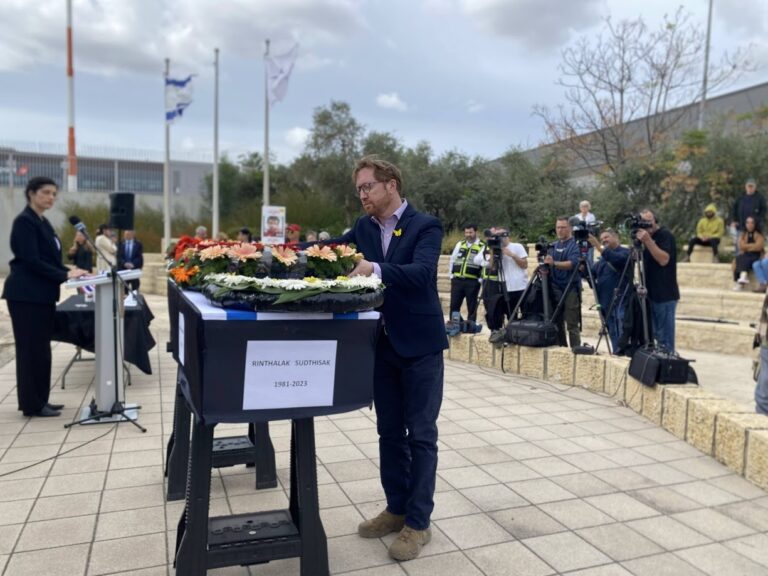
At the farewell ceremonies for the foreign casualties, returned under the latest agreement and held at Ben Gurion Airport, Lawson eulogized those who, even in this difficult moment, were not accompanied by their families. In his remarks, he spoke of Israel’s commitment to these individuals, who came here to rebuild, were caught in a bloody conflict that was not theirs, and whose lives ended so tragically. “Each time I stood at Ben Gurion,” he said, “I apologized on behalf of the state. The work of rehabilitation and support for families, both in Israel and abroad, is not yet finished, there is still much to be done.”
“Sitthisak Rinthalak z”l was the last foreign abductee returned to Israel (before Ran Gvili z”l). Lawson finds meaning in this: ‘It took me months to even say the name Sitthisak Rinthalak, and today there isn’t a person who doesn’t know his name. I think there’s a recognition of the situation here, of this shared fate.’”
"One of my earliest memories of my father, who was a building contractor, is him in his office talking to one of the workers. Another contractor comes in and wants to interrupt, and my father says, 'Excuse me, I'm talking to someone.' I remember that as a compass, a reminder that every person has the same intrinsic value. I saw in our work with the foreign abductees an opportunity to demonstrate immense humanity, completely independent of anything else. It's true kindness, whether because they've died or because the moment you finish, they board a plane and you'll never see them again won't even know it. It's an extraordinary opportunity to love the stranger, a real chance to do good."
He defines his Judaism as a "social Judaism": "There are two types of religion. One is vertical, between the individual and the divine. The other is horizontal—community. On this spectrum, between holiness and community, I lean much more toward community."
"My faith in communal Judaism, in the power of the community, was fully realized. It proved itself with our community, which went through two very severe traumatic events but held itself together."
Translated by Nancye Kochen