
Arab media outlets report that disruptions in “gas production in the Mediterranean”, that is, in Israel, are leading to a gas shortage in Jordan and, as a result, to power outages in Syria. According to a report published last week in the Jordanian newspaper Khaberni, Syria is suffering from electricity outages due to a decline in the flow of gas from Jordan. The gas that reaches Jordan is, for the most part, produced in Israel.
According to reports from additional Arab media outlets such as Arabi21 and The New Arab, incidents of electricity outages in Syria have increased due to the halt in the supply of natural gas “from the Mediterranean” to Jordan.
The flow of gas “from the Mediterranean” almost certainly refers to Israel’s gas fields. Under normal circumstances, Israel supplies Jordan with natural gas that accounts for about 70% of its annual gas supply, which is also the primary source for the vast majority of electricity generation in the kingdom. According to a report by the Gas Authority, this amounts to approximately 3.1 BCM (billion cubic meters) in 2024. The gas is supplied to Jordan from the Leviathan reservoir.
On March 1, two days after the outbreak of the war, the Jordanian news network Roya reported a halt in gas supply from “the Mediterranean,” as well as a shift to an “emergency framework” in the local energy sector as a result. Israel’s Ministry of Energy and Infrastructure announced that the operations of some of Israel’s gas rigs would be temporarily suspended due to concerns they could be targeted. This move was intended to minimize damage, which could be far greater if the rigs were operating at the time of an attack. As a result, there was a significant reduction in the amount of gas produced in Israel.
Due to the nature of Israel’s gas export agreements, the gas produced is first used to meet the needs of Israel’s domestic energy sector, and only the remaining surplus is exported. Although the Ministry of Energy confirmed today that natural gas is being supplied to Egypt at least part of the time, it is unclear whether Egypt, the primary consumer and first destination of the gas, receives all of it, or whether some of it also reaches Jordan.
Only a little over a month ago, the flow of natural gas from Jordan to Syria began, with the aim of restarting gas-powered power plants in southern Syria, which has been suffering from a severe energy crisis after years of civil war. According to a report by the Reuters news agency, the gas was supposed to reach Jordan from Qatar in the form of liquefied natural gas (LNG) to the port of Aqaba.
However, even if some LNG is managing to reach Jordan from Qatar despite the blockade of the Strait of Hormuz, it appears that it is not reaching Syria. Jordanian sources did not elaborate on the matter and, as noted, blamed “supply problems in the Mediterranean.” However, it is possible that Jordan prefers to use whatever gas does arrive, if any, to make up for the shortfall created by the halt in supply from Israel.
The pipeline connecting Ashkelon and Damascus
The unusual situation, in which problems in Israel’s gas sector deeply affect the electricity sectors of neighboring countries, is a result of the structure of the region’s gas pipeline network. Despite its name, the “Arab Gas Pipeline” did not begin as a cooperative project among Arab states in the region, but rather as a joint initiative between Egypt and Israel. The first section of the pipeline was built in 1998 to transport gas from Egypt to Israel, from Port Said to Al-Arish and from there to Ashkelon.
Delays related to Egypt–Israel relations, alongside the initial discoveries of small gas fields off Israel’s coast, hindered the realization of the pipeline’s original purpose. Instead, in 2001 Egypt signed gas agreements with Jordan and extended the pipeline southward, parallel to the border with Israel, in order to connect to Aqaba.
In 2002, the leaders of Jordan, Lebanon, Syria, and Egypt convened and signed a memorandum of understanding to extend the pipeline to Damascus and from there to Beirut. It was then that the pipeline received its name—the “Arab Gas Pipeline.”
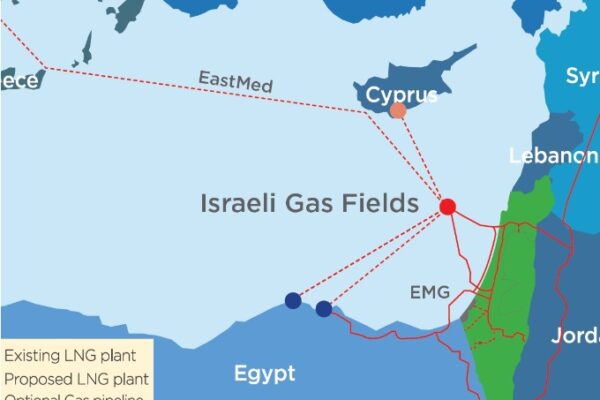
In practice, the pipeline was barely used by Syria and Lebanon, mainly due to internal conditions in both countries, as well as gas shortages in Egypt. Instead, the infrastructure was used to export gas from Israel to Egypt following the discovery of the large Israeli fields “Tamar” and “Leviathan,” and to transport gas from Israel to Jordan.
Immediately after the signing of the major export deal between Israel and Egypt in December 2025, Egypt began signing a series of gas and oil contracts with Syria and Lebanon. These agreements were likely made possible by the large gas surpluses flowing from Israel to Egypt, which enabled it to transfer gas (partly Israeli) to its neighbors that do not have peace relations with Israel.