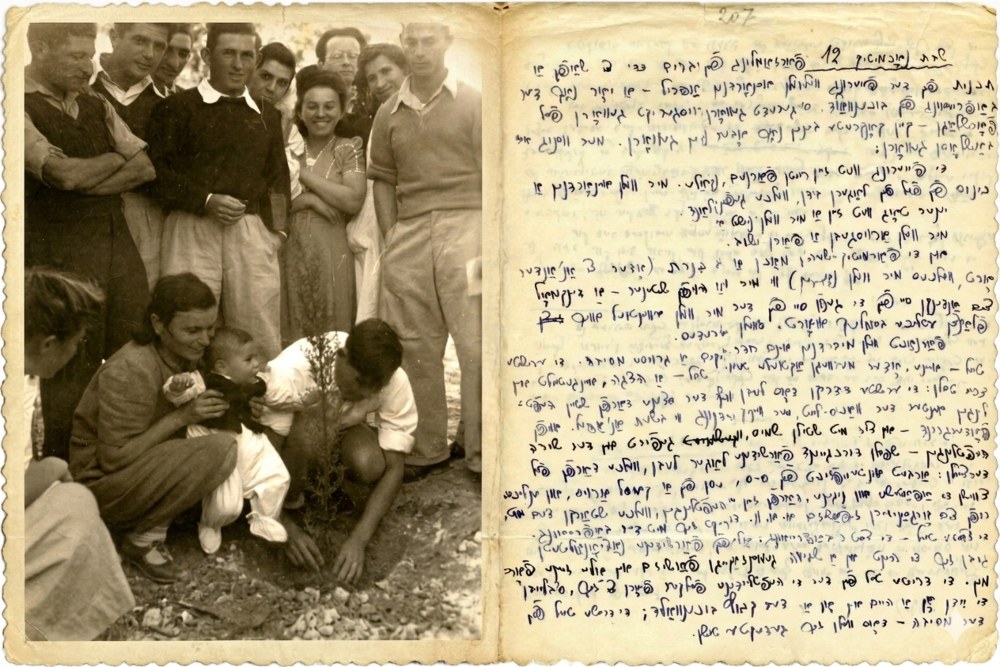
The first Holocaust remembrance ceremony in Israel was held by members of Kibbutz Buchenwald. This kibbutz, established in June 1945 and later becoming Kibbutz Netzer Sereni, was the first training kibbutz in Germany [training kibbutz refers to the pioneering training centers in the 1920s-40s in Europe where young Jews learned agricultural skills and Hebrew in preparation for aliyah to Mandatory Palestine] and the first kibbutz in Israel founded by Holocaust survivors. The members of the group, who immigrated to the Land of Israel in September 1945, chose to process their experiences through collective writing in a shared diary documenting three years of recovery and rebuilding.
In my book Building Together Anew: The Story of the Buchenwald Kibbutz Diary (Yad Tabenkin, 2025), the first four months of this diary were published for the first time. Ahead of the launch of the diary’s digital archive, created in collaboration with the Schuster Foundation and Dr. Yael Netzer, additional excerpts are published here for the first time. These passages document the early ceremonies and the profound transformation the survivors underwent on their journey to becoming free individuals. The excerpts were translated from Yiddish by Rachel Shalita. Published courtesy of the Netzer Sereni Kibbutz Archive.
Among the apathetic and humiliated prisoners, there should also be some prisoners who have courage.
The first excerpt here was written in Yiddish by Avraham Gottlieb-Ahuvia, the driving force behind the kibbutz diary. It describes the preparations for marking the anniversary of the liberation of Buchenwald, which began three months earlier. The core group from which Kibbutz Buchenwald emerged was formed within the Jewish cell of the communist underground in Buchenwald, and it is represented in the ceremony by “a few prisoners who have courage and who call for organizing against fascism.”
For the kibbutz members, who immigrated to the Land of Israel in September 1945 and were at that time training for kibbutz life at Kibbutz Afikim, it was important that the ceremony have a formal, national character and that it include not only Holocaust survivors and members of the local community, but also broader circles. Representatives of the Jewish Agency, the Histadrut, and Kibbutz Afikim took part.
The gathering included speeches, a photography exhibition, singing and music. Students from Tel Aviv planted 300 trees in the name of Kibbutz Buchenwald, and on a sign in the kibbutz dining hall were inscribed the words of Ezekiel: “I will seek the lost and bring back the strayed; I will bind up the injured and strengthen the weak.”
Saturday afternoon, 12 January 1946
A meeting of some of the members to plan an event to be held on April 11—one year after the liberation of Buchenwald. There was much discussion and many proposals were put forward, but no concrete decision was made. What little was decided: the event would be on a broad scale, not a local one. We would hold a gathering of many Jews who had been liberated from the camps and are now in the country. It would be a day of rest and we would not work. We would publish a booklet for the Yishuv. In the afternoon, we would organize a procession to the Kinneret (or another place to be determined), where we would cast handfuls of stones in memory of those who fell and those who were liberated. We would plant trees there, and there would be several speeches.
Toward evening, we would organize a large event in the dining hall of Afikim. In the first part—one or several speeches on current issues. The second part—a play, divided into three parts: the first is meant to express life in the camp. On stage, prisoners will stand under the guard of SS men, as during roll call. At the front of the stage—alongside quiet conversations within the rows of prisoners—various episodes from camp life will be performed, meant to convey much: labor under SS supervision, the distribution of food from a pot, and among the apathetic and humiliated prisoners there must also be a few who have courage and who call for organizing against fascism, etc. The first part ends with the liberation.
The second part—the period after liberation: all the prisoners, of different nationalities, join hands in a shared, silent oath to fight against fascism in all its forms. The third part of the play—the prisoners of different peoples depart, and the Jews remain, without a home, at a crossroads. The formation of Kibbutz Buchenwald. The third part of the event will take place around tables, covered or uncovered.
“Part of a people that must rebuild the people”
The following excerpt appears on a separate page, and its first part has been lost. It documents (again in Yiddish) the ceremony marking the first anniversary, and opens midway through a speech by Ahuvia. It includes a variation on a poem by the kibbutz member, the poet Mordechai Strigler, which would be published in full in the diary two years later, in May 1948 (see below).
It also contains a reference to “Shir Boker” (“Morning Song”), written by Natan Alterman to a melody by Daniel Sambursky for a song from a play staged in Berlin in 1932: “In the mountains the sun is already blazing / and in the valley the dew still glistens / We love you, homeland / in joy, in song, and in labor.”
It also mentions the song written by Shimshon Halfi and composed by David Zehavi for the soldiers of the Jewish Brigade during World War II: “Left, left, raise your leg! / Set out on the road, young men!”
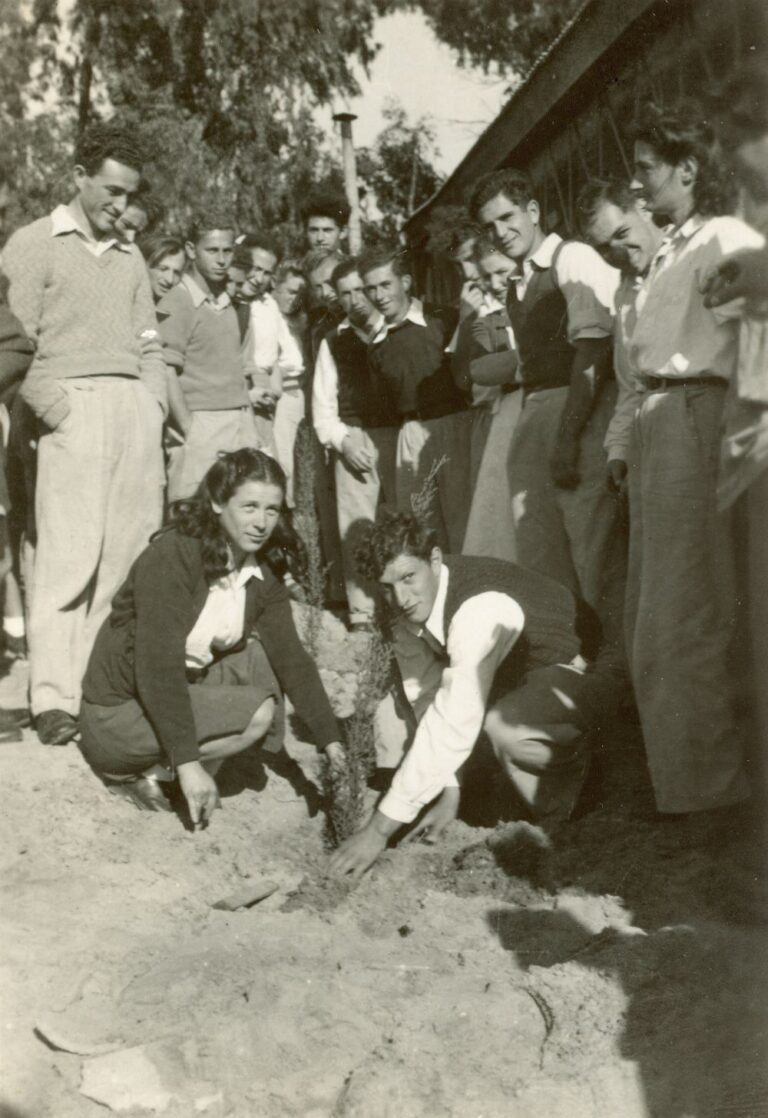
Members of Kibbutz Buchenwald plant a tree at the first memorial ceremony for the liberation of the Buchenwald concentration camp in Afikim (Photo: Netzer Sarni Archive)
Ahuvia describes the transformation the survivors underwent, and alongside the bleak landscape of the camps he sets the breathtaking landscapes of the Land of Israel and the youthful vitality of the group. Yet, he writes, doubts begin to creep in: “Can the revival of the dead be associated only with joy? Last night, during the gathering in the large dining hall, shadows of those times hovered in the air, and voices crept in.”
"These People in that desert… my People! Millions of its sisters and brothers now lie burned and tortured, turned to nothing, covered in earth! Your martyrs of Treblinka, Majdanek, Auschwitz, Sobibor, Buchenwald! Rise from your rest—we want to see you. All of you! Stand in a circle, you beloved and dear ones, and be with us… On the anniversary of our liberation, so few of us remain. Part of a people that must rebuild the people. A part of that people will rebuild the People! And within this part of the people, their memory will live forever, even as it is engaged in the work of creation! Even during a celebration, the memories live. There in Treblinka… a camp somewhere, with forced labor in munitions production… transports, transports, long lines of prisoners on the Germans’ roads—westward, westward—and traces remain of those lines: hundreds, thousands dead by the roadside… And Buchenwald… there, deep in the forest, among gray barracks and tall trees, are lives that were lost… In place of a woman with a child, there is a crumpled photograph—and this will quiet our longing… And where will the bell of liberation ring, where will a trumpet be heard—liberation?
Even the Yishuv rejoices in this. Dr. Joseph offers greetings on behalf of the Jewish Agency, Cohen on behalf of the Histadrut, a member from Afikim expresses the feelings of every worker in the land toward those who came “from there.” Native-born children plant a grove of 300 trees—the people are not alone… As proof of a return to life, the excursion along the road leading from Afikim to the Sea of Galilee can be seen. The Land of Israel is blue. Sky above our heads. To the right, the mountains of Transjordan, the Golan Heights, and in the middle—a deep and wide wadi through which the Yarmouk flows. To the left—the Lower Galilee, and farther beyond, the Upper Galilee. Ahead, far in the distance above the Kinneret, Mount Hermon with its white cap of snow. “We love you, homeland, in joy, in song”… Two boats sail on the blue waters of the Kinneret. At the same time, a storm of emotions rises in the hearts. Blue waters… so peaceful, quiet… The Arab houses in Tzemach recede and grow smaller; Ein Gev, green and white, becomes clearer and clearer.
The sound of dozens of feet on the road and the healthy breathing of young people can be heard. More than a hundred young men and women walk there—in groups—stretching over more than a hundred meters along the road. One group speaks with excitement, another sings, a third laughs and tosses jokes into the air… And when one calls out enthusiastically: “Left, left, raise your leg!”—a chorus of more than a hundred bursts forth: “Set out with vigor, young men!”—and a song rises over the fields of the Jordan Valley, ascending to the high mountains that surround it… And the healthy breath of free people is heard…
Today they celebrate a holiday. A year ago, on this day, a tremendous change took place in their lives: the fences of Buchenwald were opened, and pain was felt together with freedom, over the mountains of Thuringia and the wide fields that awakened to life after a deep winter. People began to breathe deeply, looked around at the landscape that now appeared different, and in disbelief repeated the thought: Are we truly free? Do we really have human rights? Can we truly lie peacefully beneath a shady tree on a sunny day—and no one will disturb us? Is it really true that no one has the right to come to us and shoot us? Can we truly live? And gaunt faces smiled strangely, dim eyes were lit with the fire of life, and weak bodies trembled with the warmth of happiness.
And today—those shadows of the past are healthy people on the soil of their homeland. From different corners of the Land of Israel, they have gathered and come to Afikim to celebrate the great anniversary together. The joy of revival, the joy of life, the joy of standing beside the machinery of creation, the joy… joy? Can one really say that? Can the revival of the dead be tied only to joy? Last night, during the celebration in the large dining hall, shadows of those times hovered in the air and voices crept in. The free people returned in their thoughts to the desert of the past, to where fate had cast them, surrounded by barren emptiness, with the sky above them. There they forgot what grass looks like, what rain smells like, what a fresh, shady tree is… They called upon snakes to carry their anger to all corners of the world…”
The Second Anniversary: the bonfire burned and called to the friends
In the following excerpt, Ahuvia (this time already writing in Hebrew) describes the second anniversary, which was also marked during Kibbutz Buchenwald’s training period in Afikim. While the first anniversary was commemorated on the German calendar date of Buchenwald’s liberation (11 April), the second anniversary was observed according to the Hebrew date (29 Nisan). In addition to Ahuvia, the kibbutz members Meir Ahuvia (his brother), Shoshana Steinkler-Shelu, and Yehuda Lukemburg are also mentioned here; Lukemburg was killed a year later in the Egyptian air force bombing of Tel Aviv on 18 May 1948. The voices of the women in the group are barely reflected in the diary, and Shoshana is among the few who wrote in it and spoke within the kibbutz.
Members of Kibbutz Buchenwald were among those who rescued, supported, and educated about nine hundred Jewish children who arrived in Buchenwald in January 1945. The excerpt mentions a telegram sent on the occasion by the Buchenwald children, who were at that time staying in Ecouis in France. It also records the custom of singing the song “Tecḥezakna” alongside “Hatikvah.” “Hatikvah” was adopted as the Zionist anthem at the Sixth Zionist Congress (1903), while “Tecḥezakna” is the name by which the first stanza of Hayim Nahman Bialik’s poem “Birkat Am” (“Blessing of a People,” 1895) is known. This stanza was set to music by Abraham Zevi Idelsohn and adopted as the anthem of the Israeli labor movement:
“May the hands of all our brothers who cultivate the soil of our land wherever they are be strengthened; let your spirit not fall—joyful, singing—come together with one shoulder to the aid of the people!”
Friday night, 28 Nisan, 18 April 1947
On 29 Nisan, two years earlier, we broke through the barbed-wire fences of the Buchenwald concentration camp and knew that we were free. In honor of that day, we held a roll call on this Friday night. At exactly eight o’clock, at the sound of the bell, the group assembled in three squads in three different places—each squad with its commander—from there they came to the lawn in front of the club, which was beautifully lit with electric lamps.
When the roll call stood at attention, a lamp was lit, and immediately afterward Aharon A. [Ahuvia] stood beside it and mentioned the souls of the tens of thousands of Jews who had fallen…; Meir proclaimed the fourth anniversary of the Warsaw Ghetto Uprising; Shoshana S. recited a poem by Yitzhak Katzenelson; Yehuda L. spoke about what this day means for us. The roll call ended with the singing of “Hatikvah” and “Techezakna.”
But the bonfire was burning, and it called out to the friends. They sat around it and sang many songs, especially songs from the camps and the ghettos. On the second liberation day, we received a congratulatory telegram from the Buchenwald children in France.
Third anniversary: we were liberated and are being liberated, until complete liberation
In September 1947, Kibbutz Buchenwald began its transition to settlement as an independent kibbutz in the Rehovot area. There, the members marked the third anniversary of the liberation. Meir and Aharon Ahuvia present here a translation from Yiddish of Mordechai Strigler’s poem, “Deep in the Forest.”
Mordechai Strigler was one of the founders of Kibbutz Buchenwald, but his role in the kibbutz was later forgotten. During the war, Strigler wrote poems for the children of Buchenwald, and shortly after liberation in May 1945 he published the first newspaper of the displaced persons, Resurrection. The passages written by Meir and Aharon Ahuvia were composed in May 1948, at the height of the War of Independence, and culminate in a complex dialogue with Hayim Nahman Bialik’s poem “In the City of Slaughter.” While Bialik expressed anger at the cowardice of the victims of the Kishinev pogrom, the members of Kibbutz Buchenwald emphasize that the lives and deaths of their friends were part of the process of national liberation. For them, liberation is not only the moment the camp gates opened, but an ongoing process of becoming and creation.
Kibbutz Buchenwald, Nechalat Yehuda, 29 Nisan 5708 – 08.05.1948
Three years have passed since we were liberated from the concentration camps in the land of the impure.
“Deep in the Forest” / Mordechai Stigler
Deep in the forest, in gray barracks,
in the secrecy of gigantic trees,
human beings are imprisoned like beasts of prey,
cut off from the world of freedom,
and condemned to silence, to stillness!
In blocks like cages—suffocation and narrowness—
for a decade they are thus imprisoned;
deprived of air and home,
the memory of child and wife erased from their minds,
heavy dead, shriveled…
The camp is mute and silent;
only a number, aching and screaming,
the sole master is the whip, and mercy far away, far away…
Buchenwald—there, a name of beauty,
tyrants examined and found the mask;
only the quarry rocks know
the value that life once had
for a Jew, a Frenchman, a gypsy…
Human beings—numbers—come and go;
indifferent—toward life, in dismissal.
They are swallowed into the abyss
trains with screaming whistles—
the roar of the final chapter
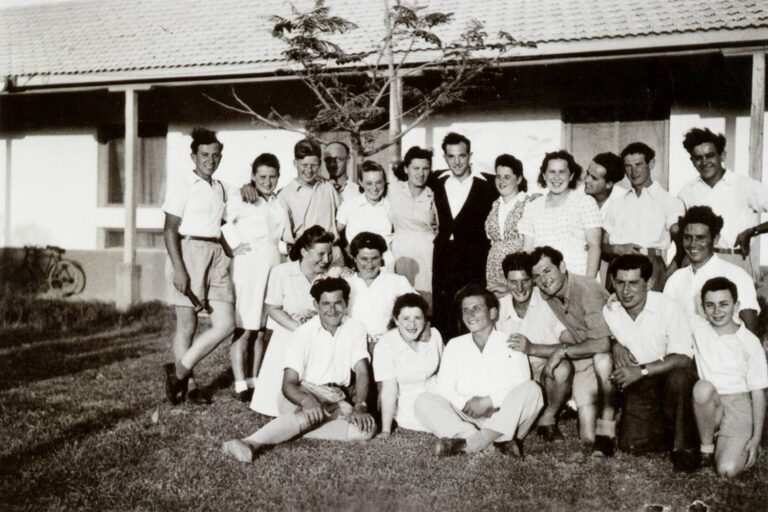
Members of Kibbutz Buchenwald in Afikim (Photo: Netzer Sarni Archive)
Bundle of Memories (Fragments from Life in the Camps)
There are human beings on earth, pursued by fate; they were isolated and forbidden to dwell among human habitations. And so, across mountains and valleys, in barren fields, in the depths of dark, dense forests, in every corner of the earth, barracks appeared: low, long, gray barracks. And around them—a tangle of barbed wire: electrified, piercing. One cannot approach them; they inspire fear and terror of death. Tall watchtowers with pointed roofs were also placed around them. Spiral staircases wind around them. Guards lurk there, casting cold, furious glances downward, rifle barrels protruding. Guards pace back and forth in heavy boots within a harsh, silent stillness.
And there, within, dwell the persecuted, as if they had always been there. See them in their tattered clothing, emaciated, hollow-faced. They move like shadows around the barracks, their large eyes—filled with fear—staring into the void of the world. They lie exhausted on filthy bunks—who knows? perhaps dozing, perhaps thinking? Ah, they do not think much; the mind is dulled, almost dead. Dull and gray thoughts creep here within the barbed-wire fences, dragging themselves along like their owners… And sometimes, through a shock of force, through news from the outside world, through the whistle of a locomotive passing nearby, the thread of thought is severed from the gray darkness within and drifts beyond the iron thorns, toward the vastness of the world.
There he lies, the outcast, on hard wooden planks. He is not asleep now, but in truth it hardly matters: his wakefulness is like the sleep of a person from the outside world. For hours he lies with open eyes and does not think at all, like a worn-out part of a broken machine lying useless, waiting for the decree of his fate.
How heavy the body is, how difficult it is to move a limb; hands and legs seem no longer to obey him… Ah! One desire only: to swallow, to swallow without end, perhaps then the tormenting cramping of the stomach will cease… But—suddenly: a ray of light has broken into the dark barrack! It enters through the window and patches of light flicker here and there on the bunk, and see: it touches the face of the man—the skeleton is revealed in his eyes. Ah… something stirs within him, his heart trembles and his breathing shortens. He closes his eyes, and slowly fragments of memory rise up, chapters of life from days gone by… sunlit streets filled with noise and movement… crowds flowing back and forth… the tolling of a bell… and far beneath a bridge, waters flowing somewhere into the distance… home… a mother whispering words of tenderness, a child singing a song… women’s eyes smiling with desire… his heart beats quickly… what has happened? New waves of life rise from hidden sources: as if new forces have been infused into his limbs. He frees his thin legs and shifts on his bunk, pressing his lips together… a little peace… he takes stock of his life. Outside, life roars and flows onward… and somewhere far away the earth trembles, cannons smoke, bombs explode, devouring… and he knows: these are the labor pains of a new world being born… fate has denied him the struggle, isolating and distancing him, for he was born to Jewish parents… a sin and transgression.
He bites his lips, listening to a silence that sounds like noise in his ears… they are there, shadows drifting in the corners of the barrack, someone moves slowly on the bunk, dull and empty words arrive in a whisper. A thud comes from outside. A door slams somewhere violently, someone shouts—and in the barrack silence reigns; all are sunk in sleep, the bunks doze and fall silent, in a corner someone scratches vigorously at a tin bowl…
What time is it? The stomach contracts… Has the prisoner truly become a number… marching each morning through the gate in a dense group to a day of labor, under armed guard, digging earth, carrying stones for walls, iron, mixing concrete—building Pithom and Rameses. The strength is fading, weary, helpless, drained. But he knows the purpose clearly! He knows the meaning!—to endure suffering, to endure, to endure, to be hardened. To wander constantly from camp to camp, to bear the number, the fate—and the awareness…
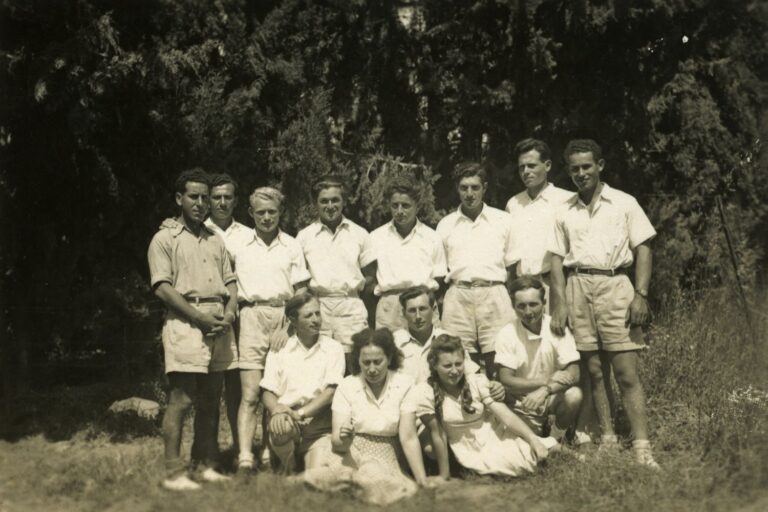
Members of Kibbutz Buchenwald in Afikim (Photo: Netzer Sarni Archive)
For the Festival of Liberation
There was such a moment, and then each one of us felt: I am a free human being… I may walk down the street if I wish, and on the pavement specifically, and if I wish I may sit at home, in a room, at a table covered with some tablecloth or another… Only a few days ago, many days ago, I alone determined their content… And just yesterday I was nothing—dust in the hands of evil winds…
It was a great moment, immensely great, so great that it was impossible to grasp its magnitude. And then came days, ordinary days, until they themselves caused astonishment: how can the days be so ordinary, how can the sun simply rise and do nothing more, and everything around, everything, as though no great event had ever taken place in my life?…
And afterwards we became accustomed to the ordinary days of ordinary people. We surrendered ourselves to those days and almost forgot the great moment. We drifted farther and farther from it, until at times it causes wonder: that such a great moment existed—how is it that its imprint is so little felt within us, and so rarely occupies our thoughts?
And once a year we celebrate the Festival of Liberation. Then a bonfire burns, and tongues of flame seem to rise from the depths of the earth and the depths of time… Then we recall and are recalled, and we reflect. And we reflect…
Festival of liberation… festival… festival? Is it truly a festival? What is it for? Because we survived? It seems that the word “we survived” brings sadness, though perhaps not the word itself but the association it awakens. I do not mean here the millions of victims (for the word “million” says almost nothing; it is a dry word. A detailed description of the abuse of a single Jewish girl, the murder of a single child, is far more shocking than the routine phrase “six million victims”). The word “we survived” evokes sadness because its form is passive—we survived…
We were enslaved not only during the raging years of war, but also before that. The massacre carried out by Hitler was preceded by many other massacres, pogroms, and lives of humiliation. And we survived. Is there not also great shame in that fact?
There was the Kishinev pogrom, and in its wake a great poet arose and told of the “City of Slaughter”—a vivid description of frozen blood and hardened brains on plastered walls; a story of a torn-open belly filled with feathers; of nostrils and nails, skulls and hammers; of a baby found beside its stabbed mother, a cold breast in its mouth; a grim image of dark cellars where the pure daughters of your people were defiled among utensils. Woman alone against seven men; daughter before her mother and mother before her daughter. Before slaughter, during slaughter, and after slaughter. And when the poet went out to the “house of eternity” to visit the graves of the holy dead, his heart melted with unbearable pain and shame. “Behold the calves of the slaughter… I grieve for you, my children… your slain are slain in vain, and neither I nor you knew why they died or for what and for whom, and there is no meaning in your deaths as there is no meaning in your lives…”
The poet’s heart aches, but more than that it burns with shame—shame over the nation’s descent, over the fact that tragedy did not leave the survivors even a single consoling legend, not a story of heroism or sanctified death; that in the dark cellars even “husbands, grooms, brothers” hid, peering through holes like trembling corpses beneath animal flesh… and did not move, did not stir… pain and shame!
We have moved away. In time, in place, and above all—in character and in essence. We have been liberated. The attitude of the nations toward us has not changed; as before, they are bloodthirsty and cruel. But within us a fundamental change has taken place. The pain is still great, but shame is gone! In the cemeteries new graves have been added. When we go to visit them, the heart is crushed with pain. Heroes, sons of the Maccabees. We grieve for you, children… but your fallen are not fallen in vain. Both I and you know why they died and for what and for whom they died. And there was meaning in your deaths as there was meaning in your lives…
We have moved away and are moving further away. We were liberated and are being liberated, until complete liberation. Therefore, the Festival of Liberation. Each year we celebrate, not only the single great moment of 28 Nisan 5705, but also the multitude of moments that followed, in which a continuous process of liberation was formed and is still being formed. And the marked date we shall designate as the beginning of the process…
“They are not at all ashamed of these numbers… these arms are working in the fields of grain farming”
At a memorial evening held in Tel Aviv marking five years since the liberation of the camps, Kibbutz Buchenwald member Haim-Meir Gottlieb-Ahuvia took part. In its aftermath, he sent a letter to the newspaper Davar protesting what he saw as a tendency among Holocaust survivors in Israel to conceal their identity. He felt that survivors who spoke at the event were ashamed of the tattooed number on their arms: “These numbers now evoke among former inmates, dispersed in the cities of the state, a feeling of shame and inferiority.”
Gottlieb emphasized that the members of Kibbutz Buchenwald, by contrast, were proud of their “Buchenwald identity” and did not conceal it. Their pride lay in the transformation they had managed to bring about—from “Buchenwald” to “Kibbutz Buchenwald”: “They are not at all ashamed of these numbers […] because these arms work in the agricultural fields, in vegetable gardens, in the dairy, in the poultry farm, in workshops; […] in a just life of labor.”
In a letter to the editor published a week later in response to Ahuvia’s statement, members of the “General Organization of Former Nazi Prisoners in Tel Aviv” denied his claims: “It is not true, and no speaker intended to suggest that there exists shame in bearing the number on the arm, a shame supposedly unique to the urban survivor in contrast to his kibbutz counterpart, who is supposedly freed from this feeling ‘through work’ […] The number engraved on the arm is a mark of honor for each of us, wherever he may be.”
***
Dr. Lilach Naishtat is a senior lecturer in the Department of Literature at Seminar HaKibbutzim and a visiting researcher at the Katz Center for Advanced Judaic Studies at the University of Pennsylvania. Her book Building Together Anew: The Story of the Kibbutz Buchenwald Diary was published by Yad Tabenkin and Kibbutz HaMeuchad in 2025. Her forthcoming book, Coleridge and Hebrew: Origin, Translation, and Lament, will be published by Indiana University Press.
Acceptance constitutes acceptance of the Website
Terms of Use