


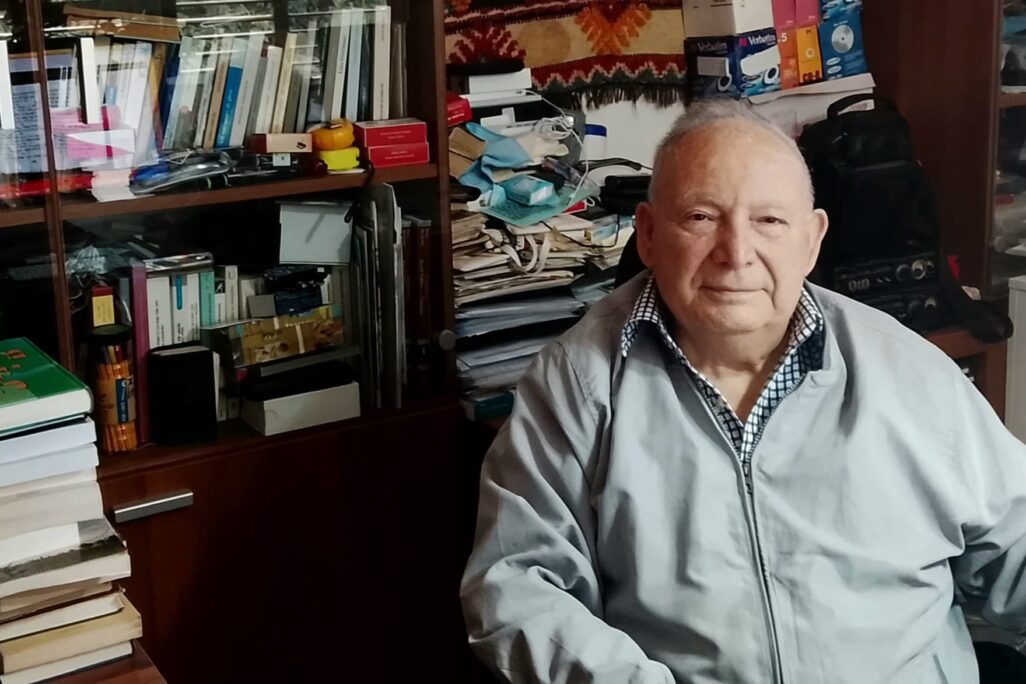
The new Israel Prize honoree, Prof. Joseph Chetrit (85), pulls an old recording device from the shelf. "I researched Judeo-Arabic in Morocco for over 40 years," he shares, "and I recorded more than 1,500 hours of speech in these languages." While I record him on my smartphone for the interview, Prof. Chetrit displays the black device full of buttons. "There were no smartphones back then. I would show up with a tape recorder like this and record. If someone knew another language, like Hebrew, they tended to switch to it even when speaking Arabic. So, I would stop them and say: 'You know, this tape recorder only understands Judeo-Arabic. If it hears Hebrew or French, it stops.'"
Prof. Chetrit won the Israel Prize in the field of Hebrew Language Research, Jewish Languages, and their literatures. The "Study of Jewish Languages" is his life's work, in which he feels a moral and historical responsibility towards himself. "A language that passes from the world is a culture that goes with it," he tells 'Davar', "along with thousands of proverbs, hundreds of songs, in other words, we are forcibly eradicating a part of human culture. And to that, I certainly could not agree with."
When asked how he feels about winning the Israel Prize this year, Prof. Chetrit replies, “Grateful, certainly. Even if it is late, the Israel Prize is not given for free. It is the result of decades of work, and your research must have exceptional qualities.”
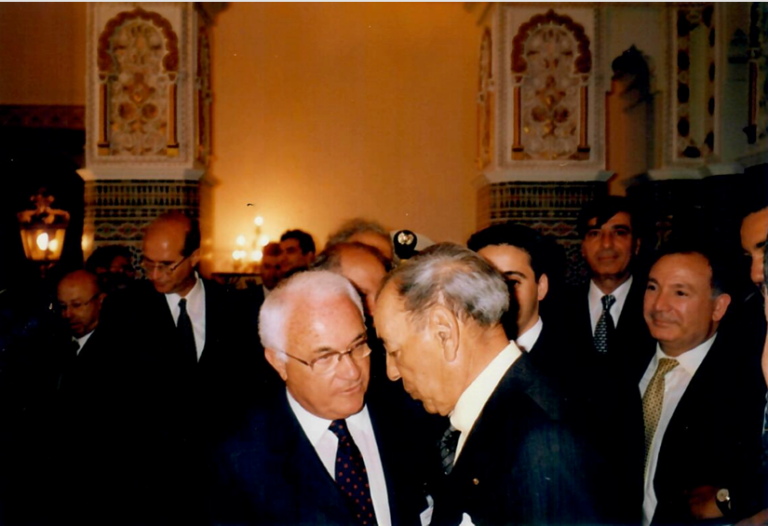
To prevent the extinction of language and the culture that accompanies it, Chetrit made many journeys across Israel, France and Morocco, over many decades. He located "messengers", elderly men and women who carry the linguistic and cultural memory, and spoke with them in various dialects of Judeo-Arabic. He documented and immortalized songs, proverbs, and ways of life in languages that "the Israeli establishment, like any European establishment, helped to extinguish through the Melting Pot policy." Until his retirement in 2009, he also taught for many years at the University of Haifa, holding various roles, including Dean of the Faculty of Humanities and Vice-Rector. He is married and has one child.
A treasure that could have been lost.
We met at his home in the Givat Oranim neighborhood of Haifa, sitting in a separate level designated for work and research. The room is filled from corner to corner with books in Hebrew, Arabic, English, and French. Alongside dictionaries and Jewish history books, as well as many books written by Chetrit himself. In the room are three large screens; carpets are spread across the floor and walls; on the tables lie magnifying glasses, notes, and old photographs. A researcher’s mess.
Your research went beyond the boundaries of the archives; you went into the field, and you met people. Why?
"First of all, I also sat alone, I went to libraries to locate manuscripts and songs of Moroccan Jewry. I found many songs in manuscripts that I later recorded myself. But every community had its own variations of the same song, and that, for example, is a treasure that would have been lost if I hadn't done this work."
Tell me something from your journeys, an experience that stuck with you.
"I had an entire research project in the town of Shlomi from 1979 to 1981. I was looking for messengers, men or women who had stories about themselves and their community, and who remembered proverbs and songs by heart. For example, I met Yamana Dayan; she was blind, in her seventies, and her narrative knowledge was inexhaustible. She possessed the true art of storytelling. She knew I was recording on tapes of thirty minutes or one hour per side, so she would ask me: 'How much time do you have left on the tape?' Five minutes? Ten minutes? And based on that, she would construct her ending. In 1981, I stopped my research in Shlomi because of the Lebanon War (Operation Peace for Galilee). There were shellings from Lebanon.
Likewise today.
“Yes. I returned more than ten years later, with a researcher from the United States of America.”
“The first recording was with my late mother."
Like his messengers, Chetrit knows how to tell long stories, and he recalls more anecdotes from his research in the northern settlements. He is captivated by the power of memory. "Zohara Buzaglo from Shlomi, whose songs I recorded, was also blind from the age of seven. When I would travel to Paris for conferences, I used to return with small gifts. The elderly women from Morocco wore head coverings, and I would always bring Zohara a beautiful headscarf. Once, she asked what color the scarf was, and I answered 'brown.' She asked, 'Why didn't you bring red?' For more than sixty years, she hasn't seen, but the memory of red remained."
Prof. Chetrit emphasizes the importance of the human connection with his research subjects: "I was only able to research their culture and oral knowledge in depth because of the family-like relationships I created with them." When asked if this is connected to his own family, he answers in the affirmative: "I conducted my first studies, the first recordings, with my own family members, with my late mother z”l."
He grew up in the city of Taroudant, in southwestern Morocco. "I was there all the time until the age of 14," he shares, at which point he moved to Casablanca to attend high school. In Casablanca, he also studied to be a teacher of Hebrew and French.
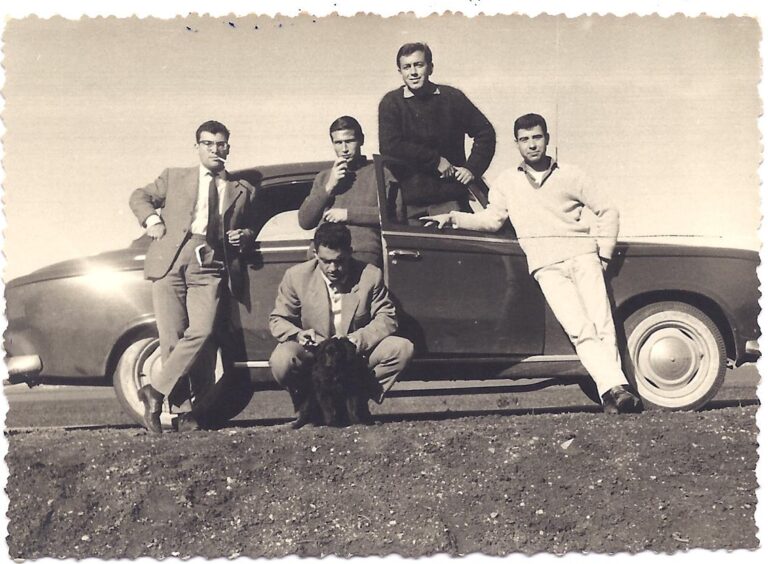
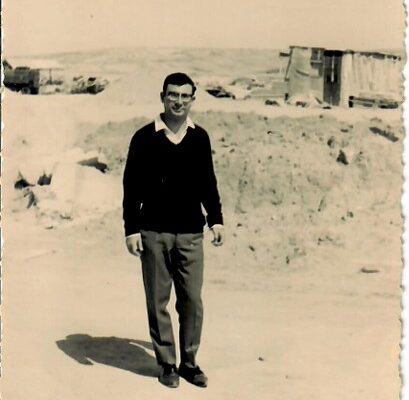
“I immigrated at the age of 22 by ship with my family, and we arrived at the ports of Haifa", he continues. "A taxi took us to Ashkelon. I sat next to the driver and started speaking to him in fluent Hebrew. He was astonished. I told him: 'What do you mean? I was a Hebrew teacher.' I went to the Ministry of Education and to All Israel’s Friends (Alliance). I said I needed a school where French is taught. They said a school was opening in Dimona, so I moved from Ashkelon to Dimona, as I was the primary provider. I was among the founders of the high school in Dimona, and they remember me to this day. When I received the Israel Prize, they told me that Dimona had also won the Israel Prize. I came to the country with a French education and a profession in hand, so I didn't experience all the absorption problems, but I am aware that they existed."
Did you experience contempt towards Eastern (Mizrahi) cultures?
Prof. Chetrit laughs. "Certainly. When I returned from Paris after my doctorate and began teaching at the university, my colleagues saw that I was, so to speak, 'wasting my time' recording elderly people. 'Why are you dealing with folklore?' It is not folklore; it is a magnificent communal culture."
He protests against the assumption that oral culture is of lesser value. "For Israelis, not knowing how to read or write means you are ignorant and uneducated, almost subhuman. But I recorded hundreds of women who could neither read nor write, yet whose memory and cultural knowledge exceeded what university graduates achieve. And I have educated university graduates for more than 40 years."
The Dark Period for Moroccan Jewry.
Contrary to what one might imagine, Prof. Chetrit does not present a romanticized picture of Jewish life in North Africa. He describes extensive research he has conducted in recent years into a dark and relatively unknown period in the history of this culture. "There was a dynasty of kings who established an empire called the Almohad (Al-Muwahhidun), which was fundamentally Islamic. It did not tolerate the existence of any human being within its empire who was not Muslim, according to its extremist system. Because of the forced conversion, the Jews of North Africa lived as Muslims for more than 120 years, from 1145 to 1269. There was one community in southern Morocco that refused to accept Islam. In 1145, the Almohad troops destroyed it entirely, men, women, and children."
This period is described across more than a thousand pages in a three-volume book written by Prof. Chetrit. "During the first forty years, the Jews could maintain their Judaism at home, but outside they had to look and behave like Muslims. Afterwards, they were also forbidden from performing any Jewish ceremonies at home, reciting the Kiddush or keeping the Sabbath. Their sons were taken from them to be raised in Muslim families. But there was resistance and the preservation of Judaism in every possible way. There are testimonies that they dug niches under the floor and would pray while lying down. After one hundred and twenty years, a new dynasty arose, and the Jews were able to return to Judaism; otherwise, I wouldn't be here today speaking with you."
The struggle with this threat, he explains, deeply shaped the heritage of North African Jewry. "As a result of the forced conversion, the culture of North African Jewry changed, and the traditions shifted. The Jewish poetry whose origin is Muslim was preserved by the Jews as a memory of it from the time their ancestors were forced to live as Muslims."
Young students performing traditional songs.
You speak of preserving a magnificent culture that survived the danger of extinction. But in recent decades, the Eastern (Mizrahi) culture, and within it, Moroccan culture, has been more present in Israeli society. For example, I celebrated Mimouna this year at a kibbutz, where it has been a tradition for over a decade, and most of the celebrants were not of Moroccan descent. Is this what you hoped to see?
Prof. Chetrit does not answer directly. "To enlighten you," he says, pulling a record by the band "North-West" (Tzafon Ma'arav) from one of the shelves, showing seven musicians dressed in traditional white clothing. "You spoke of this cultural awakening, which began as early as the end of the last century, before you were even born. And the one who contributed to it is your faithful servant. In 1972, I was at the University of Haifa, which wanted to encourage higher education among young leaders from development towns and disadvantaged communities."
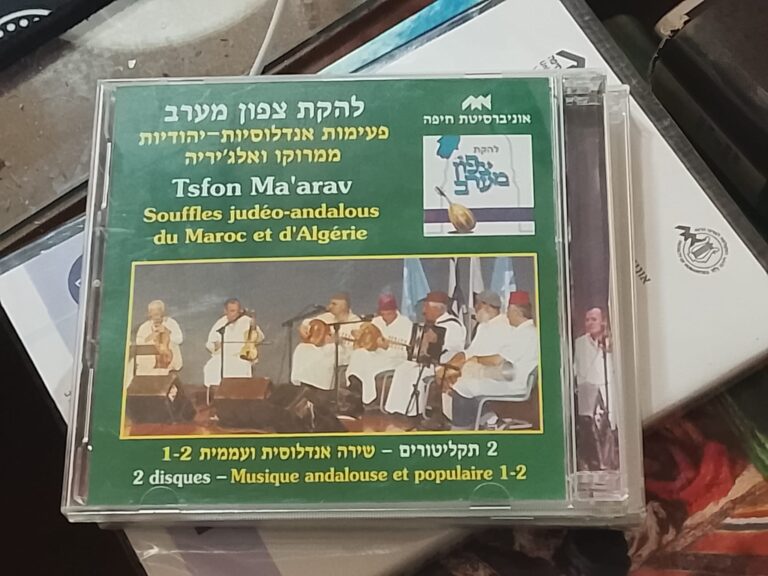
"I was the academic advisor for hundreds of these students in the late 1970s, and I had to interview each one and advise them on what to study. I realized that the problem for these students, who hadn't graduated from high school, wasn't just socio-economic, but also cultural. They consumed Israeli culture, were disconnected from their parents' culture, and had no common language with them. I wanted to show them that their parents' culture was valuable, so I founded the 'Tzafon Ma'arav' (North-West) band, composed of Haifa University students, and I managed it for forty years. In the 80s and 90s, we plowed across the country to give concerts. When we played ancient songs for the elderly people from Morocco, who thought this had disappeared, and suddenly saw young students performing it, it was a source of supreme pride for them. By the way, after a break of several years, we are returning for a one-time performance in June, at the Andalusian Festival in Lod."
"The Andalusian music that exists today," he says, not hiding his pride, "is a descendant of the 'Tzafon Ma'arav' band. The first Andalusian Orchestra was established in Ashdod, and not by chance. The Moroccan Jewish community in that city is very confident and proud of its culture. When I hosted cultural evenings there with the band, I would say: 'I hope that next year we find a local ensemble group that will compete with us.' That prayer was answered. So many ensemble groups arose from different places that they eventually stopped inviting us."
"This culture is making its way slowly, and that is the right direction, despite the critics. All the racists who think that the East (Mizrahi) is ruining our culture, is nonsense. Culture is essentially an open system, and if it is not, it dies. The nature of culture is change. You hear Israeli singers who grew up on the tradition of Hebrew song; they simply forget that its base was Russian, and no one complained, 'Why are you taking from Russia?' The Eastern (Mizrahi) sounds slowly conquered the ear and became common property.”
Prof. Chetrit continues, "culture is a political matter. There is nothing in the world that is not political; even the air you breathe is political, because you need a strong municipality to ensure clean air. Therefore, every culture manages its political struggles in its own way."
“Without solidarity, the Jewish communities would not have survived.”
What do you think Israeli culture should take from the cultures you have researched?
"Solidarity. Most of the communities were poor, with very limited means, and yet they cared for those even poorer among them with the little they had. For example, they ensured visits to the ill; everyone received medical care, and it was a mitzvah (obligation) to visit the dying. This human warmth no longer exists here; everything is handled through financial services. This doesn't mean there weren't tensions there, I am not idealizing traditional life, but rather that there were values without which the Jewish communities would not have survived."
Still, people here do look out for one another.
"Yes, relative to other nations. Because we still have a memory. Remnants of these values."
Which proverb would you like Hebrew speakers to know?
"Regarding what we are experiencing today in Israeli politics, with the division and the 'Kaplanists' versus the 'Bibi-ists,' there is a fitting proverb from Morocco. Translated into English, it says: 'He who found his wealth in madness, why would he need sanity?' One who lives in an insane world finds that the right thing to do is not to act rationally. Another proverb: 'If a person's life is limited, why all this suffering?' This is almost a defiance against God. You created man, why do You let him suffer if he is only living temporarily on this earth?"
On Israel’s Independence Day, what is your wish for the country and for the younger generation?
"The primary value that is important for the state, the quality necessary for its leadership, is sanity. To be aware of your strengths, of your possibilities, and to act rationally, not just through messianic faith. You must be sane to survive in a world entirely full of interests; therefore, what I wish for is, first and foremost, that sanity returns to our policy. And I wish for the young people that they continue with the bravery they have shown throughout the three years of wars, bravery that allows Israel to survive and flourish."