


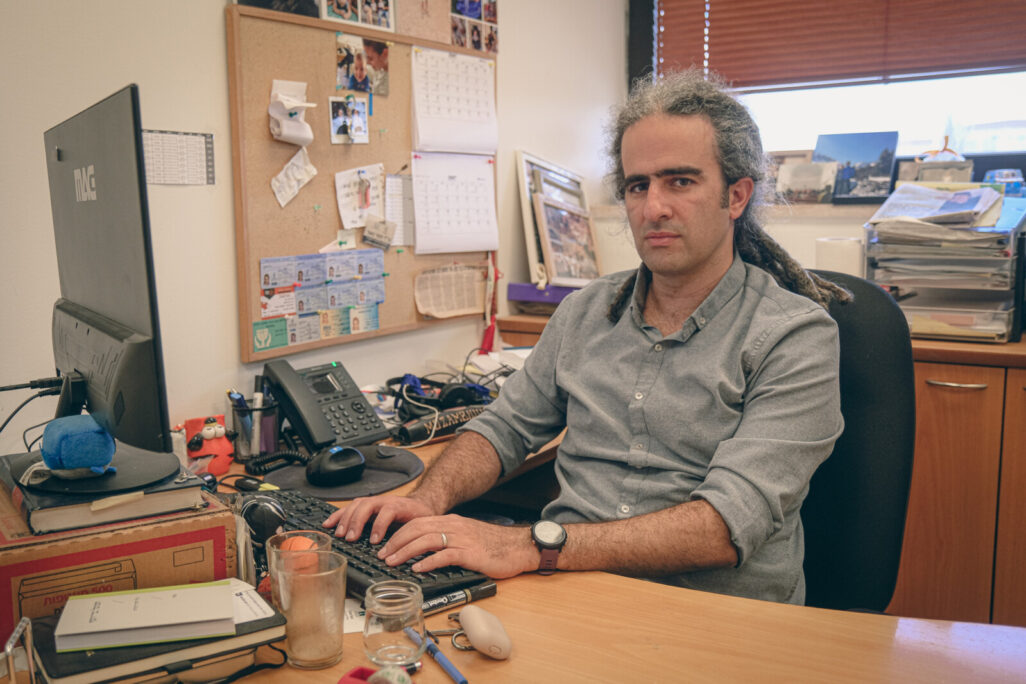
Adv. Tomer Naor from the Movement for Quality Government is indeed convinced that the High Court of Justice (HCJ) needs to force the government to establish a state commission of inquiry into the October 7 disaster, but he is not enthusiastic about the need to bring central issues on the national agenda to the doorstep of the HCJ. While the petition he is leading to restrict the State Comptroller's investigations into the core issues of the disaster succeeded in freezing some of the investigations, this time he says, "I know the previous ruling is against me, but in our opinion, we have reached a point where the decisions being made are super unreasonable." Meanwhile, the HCJ gave the state an additional two-month extension to begin the investigation, but did not reject the petition.
Why turn to the HCJ in the first place when it is known that the chances of it forcing a commission of inquiry or forbidding the Comptroller from investigating are low?
"The court has never intervened in government decisions regarding the possibility of establishing a state commission of inquiry. But, since common law relies on past rulings, we see that every time the court is required to address the matter, such as in the petition to establish a state commission after the Second Lebanon War, the Meron disaster, and the submarines, in all of which we failed, it ultimately said: not right now, but there is a possibility that a day might come and something exceptional will happen, that a super unreasonable decision will be made, and there – intervention will be required. Today we are there."
What is different this time?
"What's different this time is that the heaviest security disaster in the history of the state happened here, which the government genuinely does not want to investigate because it knows it bears responsibility for it. The court is not mathematics. I can't say that this event is a nine in severity compared to another that is a four. It is such a complex event, encompassing so many aspects, officeholders, and authorities that only the tools of a state commission of inquiry can handle it. The other side criticizes me, saying I want to help the justice system escape investigation. I say – no problem. By all means, investigate judges, investigate the media. The one who determines what the commission will investigate is the government. So what are you afraid of?"
But the other side says that here again, people identified with the opposition are trying to sabotage a legal and legitimate decision of a government.
"Morally, I would not want the court to be required for this story. But what do you do against a government that avoids, thwarts, and truly does not bring other alternatives?"
Isn't the National Commission of Inquiry, the one promoted by MKs Ariel Kallner and Simcha Rothman in recent months, a real alternative?
"No, because it is not really being advanced. It's a complete lie. They are stalling and simultaneously fixing narratives – and that is where our criticism of the State Comptroller comes from. There is contamination of the investigation, testimonies, and evidence happening in the background.”
What are your chances in court?
"No petition related to a state commission of inquiry has ever received a conditional order, but I think this time there is an understanding that something very severe is happening here. The rules of administrative law allow the court to adjudicate only after an administrative decision has been made. For a year and a half, the government refused to even discuss the matter. They say: we never said a commission wouldn't be established. The court went along with them on the claim that as long as there is a war – you don't investigate. But the war is over."
State Comptroller: "At best, severe negligence"
At the end of the past year, the HCJ partially accepted a petition submitted by Naor seeking to restrict the State Comptroller from investigating October 7, and ordered a freeze on the Comptroller's examination of core issues related to the disaster. This success by the Movement for Quality Government also drew criticism, arguing that it harms the institution of the State Comptroller.
"The State Comptroller is conducting a 'crippled investigation' here.” Naor says. “He does not have the tools in the law that a state commission of inquiry has. He cannot speak to those whom a state commission of inquiry can speak to. No one owes him anything."
")
"He can summon witnesses but he does not have the authorities of a state commission of inquiry – he is not transparent and not public. An investigation by the State Comptroller has never been conducted during combat. Not in the Gulf War or the Second Lebanon War. The war hasn't ended and we are already a year into investigations. In the army and the Shin Bet, they tell him: you are interfering with us fighting, while the state says this is not the right time to start investigating it. I don't think he does it maliciously, but he writes very severe reports without summoning the subjects of the audit. Like with Chief of Staff Halevi. He is fixing versions here without hearing the other side; this, by the way, is also the argument of the Military Public Defender's Office. Our fear is that the investigations, combined with the absence of a state commission of inquiry, will fix a very specific and thin version, which exempts the political echelons from responsibility and blames mainly the military ones. And on the day the investigations conclude, they will say: there is no longer a need for state commissions of inquiry. Here, you already have a Comptroller's report and a political committee that gave it a kosher stamp."
The State Comptroller says clearly – the investigation is specific and limited, and when the commission is established, everything will be submitted to its desk.
"He presents this as some kind of neutral action, but this is not the reality – there is contamination of the investigation here. Testimonies become fixed in a certain narrative and that is very bad. You cannot take a person and collect testimony from them in an unprofessional manner when you don't have the tools to verify them and look at the evidence fully. Judge Alex Stein, a conservative judge, said this directly – you do not have the authority in law to investigate policy – what was right or wrong. And this is exactly what the Comptroller does, and worse, he does it and does not admit he is doing it. This raises suspicions."
Are you saying the Comptroller's action is tainted by politics?
"Or very severe negligence, at best. And in the less good case, and I am careful with my words, in actions with certain intentions."
Meaning that he aligns with the government?
"You said that."
Yoram Rabin, who served as the legal advisor to the Comptroller for about a decade, claims your petition could cause severe damage to the institution of the Comptroller.
"Of course it could. Therefore I ask – why did the Comptroller enter into these corners in the first place? In the first case, I argued there is no problem with his authority to investigate. I don't think there is a limit on his authorities regarding what to investigate and what not to. The court disagrees with me. I am an organization that has supported the Comptroller for years. My goals are to protect and strengthen this institution."
If so, there is a contradiction here.
"A smart State Comptroller doesn't get into a situation where he is in court to begin with. He examines the question of his authority with himself, and doesn't get into questions of where the authority ends. And he also doesn't deal with policy, and certainly not in an event so burning, unique, and nationally painful. While he himself understands that the high road for this investigation is the state commission of inquiry.
"Opinion around him is divided into two – those who understand there is a serious problem with his work in general, and those who seek to defend the institution because ultimately – the Comptroller will be replaced. Rabin is not wrong – the fact that a court convenes and dictates what a State Comptroller is allowed or forbidden to do is a malfunction. It is very bad. I said this myself in the hearing, but the current situation is so severe that the judges themselves raised a question mark here – and issued the orders."
Supports the compromise proposal: "Lets just advance the event"
In the end, the same picture could be painted here again of "here is the liberal camp, hysterical about the government again, running to the court."
"I go everywhere that is willing to listen to me where there is opposition to the commission of inquiry. To say that a significant part of the public opposes the state commission of inquiry, is far from reality. There are always opponents, but that is partly because there was a very strenuous effort here to convince people that Yitzhak Amit is corrupt. State commissions have historically enjoyed a consensus because they have a reputation for being matter-of-fact. I don't underestimate the fears of the other side – but in my eyes, it is the product of amazing propaganda. What does it have to do with the liberal camp wanting a commission, what does 'mine' mean? Am I the only one who wants things here to really be investigated? It's the other side that constantly shouts: investigate Oslo, investigate the Disengagement. No problem. Put everything on the table. Let the government sit down and determine the broadest mandate. Let there be an unprecedented panel of seven members – which has never happened. But determine it."
What do you think about proposals, like that of jurist Gil Bringer, to appoint the Deputy President, Justice Noam Sohlberg, to be the one who appoints the commission?
"I personally supported this proposal. From the movement's perspective, and this is a position I can understand and connect with, it's another part of the governmental game of filling the public space with garbage so that in the end, no one deals with what's important. I say – take this solution, just let's advance the event. I trust Deputy Sohlberg, our next President in two years, that he can appoint professionally and seriously. The problem is that it has nothing to do with the identity of the judge – they don't want to investigate the event."
If the commission is established in another two to three years from today, what will be the impact on the quality of the investigation?
"Very difficult. There is critical importance in attaching the commission as close to the event as possible. In another three years, there will be a thousand versions here. The relevant people will leave their positions. People forget, pass away, evidence becomes corrupted, lost. And worst of all – enough poison will be spilled that will know how to cast a flaw on any result of a future commission of inquiry."