


Anyone driving between Tel Aviv and Jerusalem this past summer probably noticed the sights of the forest scorched from the Jerusalem Hills fire during Israel’s national remembrance days in 2025. For a moment, the nation's eyes were fixed on the forests going up in flames, but attention soon shifted to the war against Iran, the release of hostages, routine, and then war with Iran once again. The views seen from Highway 1 have also become less and less dramatic; beneath the dead trees that remain standing, which can resemble healthy trees after autumn shedding, vegetation has grown, restoring a green appearance to the Ayalon Canada Park.
")
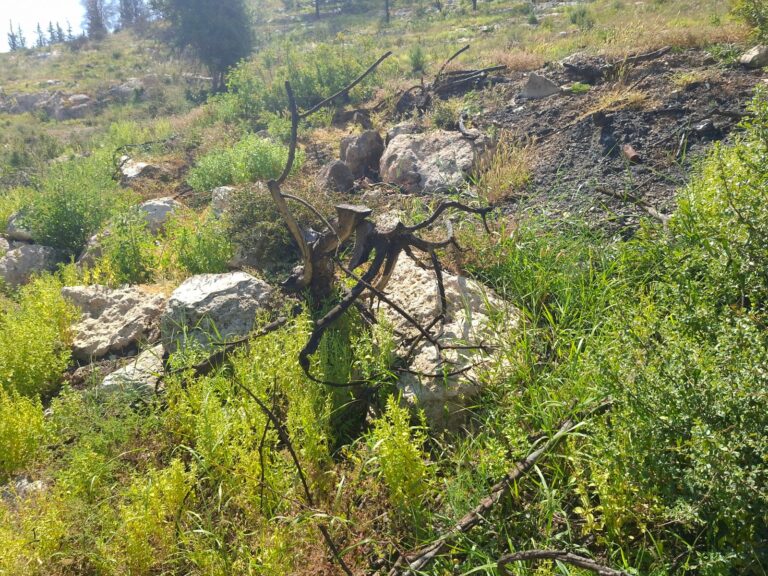
A year after the fire, Nurit Hibsher, head of the KKL-JNF Forest Department in the Central Region, and formerly a ranger of Ayalon Canada Park and Ben Shemen Forest for five years, sits on a KKL-JNF bench, still blackened and slightly peeled, in a grove of olive trees. "Six ancient olive trees burned here," she tells Davar, "and you can see the renewal of this tree that was completely scorched. New branches have grown from beneath the trunk, but we lost the impressive main trunk, a tree of hundreds of years old."
Hibsher, 44, from Ra’anana, has worked at KKL-JNF since 2012. The region under her professional responsibility stretches from Yokneam to Beit Guvrin, and she is currently transitioning to a position at the national headquarters.
The terrible days of 2025
The fires broke out in two main locations a week apart. In the Eshtaol Forest, approximately 6,000 dunams burned on Holocaust Remembrance Day, and in Ayalon Canada Park, another 6,000 dunams burned on Memorial Day for Israel's Fallen Soldiers. "They were truly terrible days. There were strong winds exceeding 60 km/h, extreme dryness, and temperatures over 40°C. Despite massive firefighting efforts, the fire simply leaped over Highway 1 in three places, and that is a very wide highway. After the fire, there was another wave of dehydration; trees in the vicinity of the blaze were damaged by the dryness. Fortunately, we had quite a bit of rain this year."
")
"During the first fire, I was in our offices in Eshtaol, not far from the fire, it was really painful,” says Hubsher. “I was in our command vehicle, and we directed our fire trucks as well as those of the Fire and Rescue Services." KKL-JNF maintains fire-fighting mobile units in the forests that provide an initial response to fires, also handling small blazes that break out on a daily basis during the summer. " We know the terrain, so we know how to reach the spot and also how to guide the Fire and Rescue Services' trucks. Many fires that break out in the summer never make the headlines because we handle them on the spot."

"A week later, when the fire moved to Ayalon Canada Park, it was already harder. We spoke with the forest ranger of the area, and he said, "There is no park. The park is gone." It was also a surprise because it’s not a dense forest, but the winds and the dryness simply overwhelmed it."
Climate change has created ongoing distress in the forest. "In the past decade, the winters in the forest have been much less cold. Even before the fire, all the region's vegetation was under environmental stress, in a state of vulnerability. Even if you see that a plant is green, when examining it physiologically it needs much more water than it currently has, and it is much drier than it was ten years ago. In such a situation, a fire will spread much faster."
When asked how to rehabilitate 13,500 dunams of burnt forest, Hibsher responds: ”A ranger runs long distances, we don't do sprints here. This is a matter of years and decades. In the first stage, we focus on clearing groves, roads, and trees by the sides of the roads, which alone covers a thousand dunams and is not yet finished. After that, there is a large mass of burnt wood inside the forests that needs to be cleared, which is a process of three to four years. You can't rehabilitate an area when there are dry trees around that could collapse at any moment."
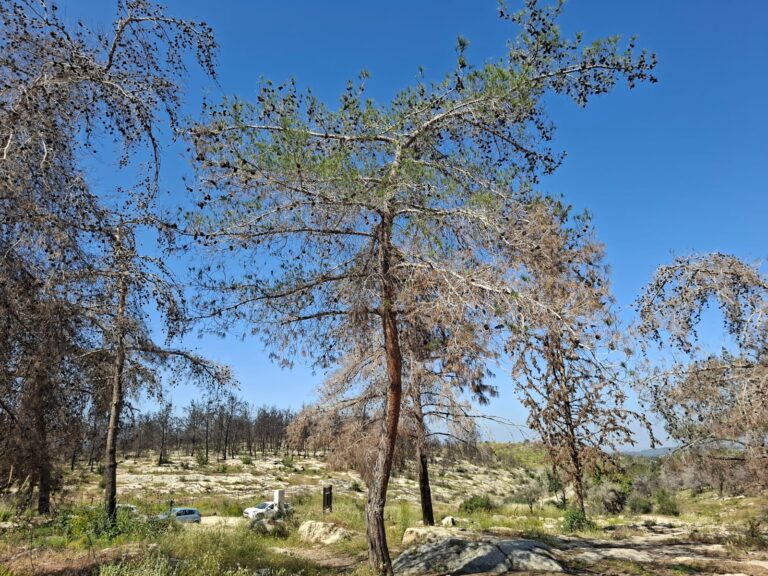
It is also necessary to understand which trees have died and which can be rehabilitated. “For example, some of the trees here on the hill were a bit green at their tops, and a year ago we thought they could still recover. After a year with a fairly good winter, we see that most of them have dried out completely. Meanwhile, natural processes begin on the ground. We monitor the natural growth of trees, shrubs, and grasses, and we won't rush to plant. If there is a scorched recreation area, we’ll want to rehabilitate it and plant there, as well as along walking trails where we want to create shade. But in the heart of the area, we will wait at least five years and see what grows."
When asked if there is an opportunity to grow the forest in a different way after such a fire, Hibsher says, “there is definitely an opportunity here. Along the sides of Highway 1, there were tall trees that facilitated the spread of the fire. If we see high growth there, we will thin it out to promote lower growth. In the forest that naturally grows here after the fire, there is an opportunity for greater biodiversity—not necessarily a dense coniferous forest, but a more open environment with pines alongside other trees, and more shrubs and grasses. This way, it will be more resilient to changes. Some of the pine forests planted in the country collapsed, while others fared very well. Our way of knowing what is best suited to the area is to observe the regeneration: if the seed of a tree germinates and grows, it means it has a strong root in the soil, it reached the water it needs, and it will be our next generation."
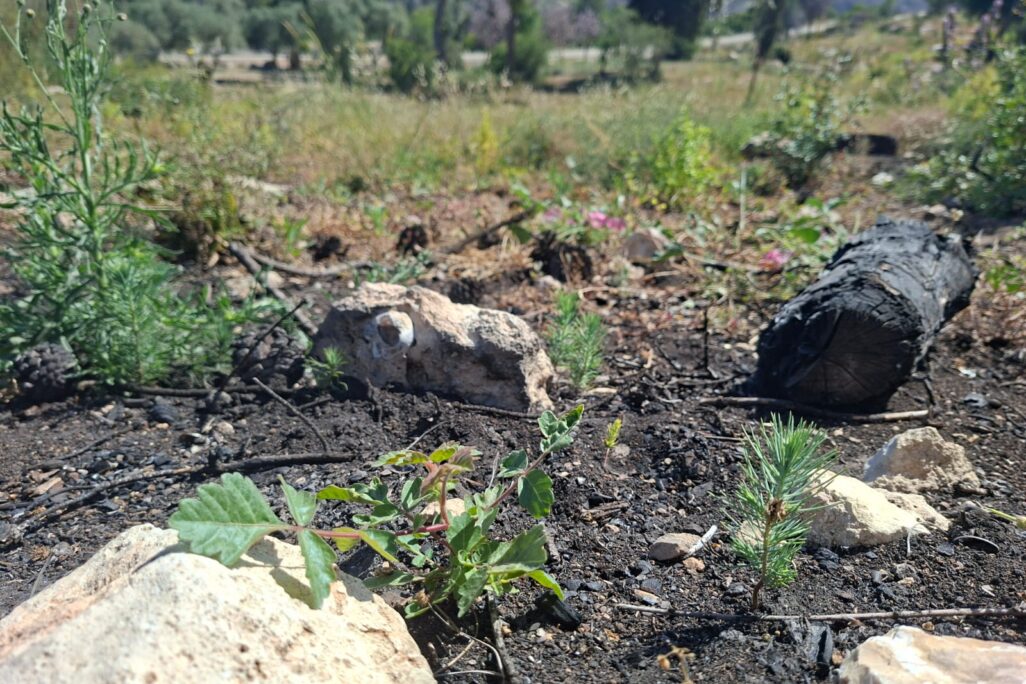
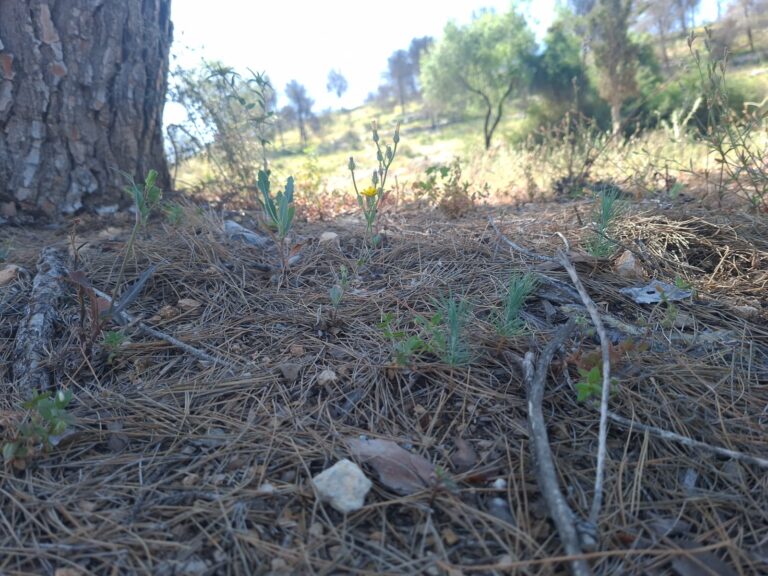
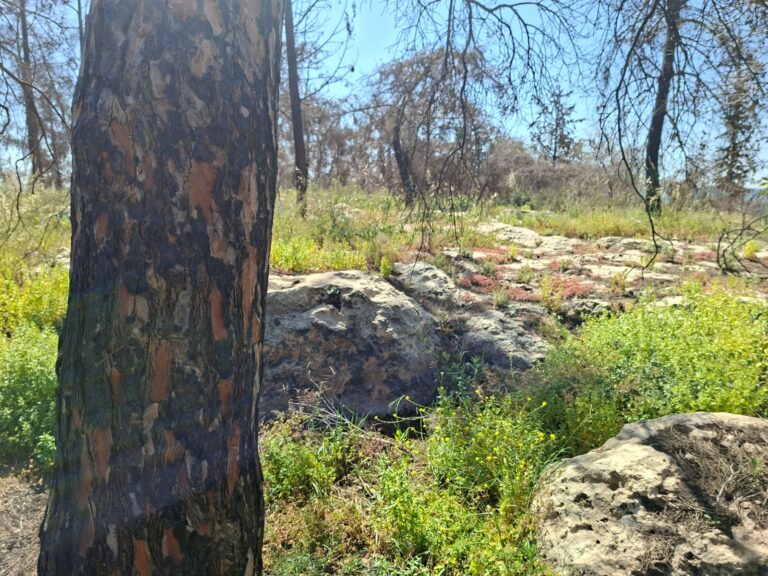
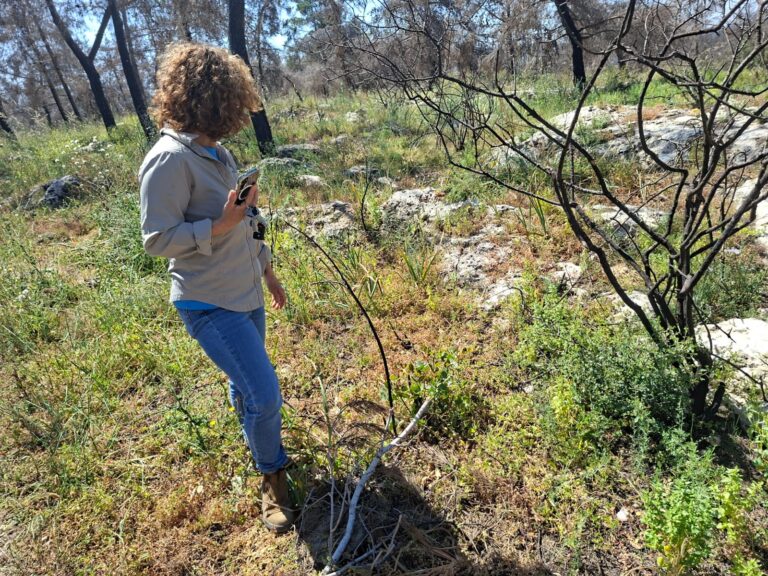
Wandering in the burned forest can be misleading: most of the trees are still standing, with trunks in shades of brown-grey, and one might think they will grow back. But Hibsher reminds us that we must already imagine the forest without them. "Not all the trees here are alive. They could collapse at any moment, and they will be removed in the coming years." But from a small climb to the hill near a camping ground, one can see the natural renewal processes with their own eyes: "Look at the pine seedlings here: one, two, three…" After a brief search, dozens of small pine saplings are revealed, some of which will grow to become the next generation of the Ayalon Canada Park.
A scorched pine does not come back to life, but the new pines growing around it enjoy a lot of sunlight. Other trees have different tactics. "Look at the Mastic Leaf Terebinth (Pistacia lentiscus), it was completely burned, but it is a plant that renews itself. It produces shoots, new branches at the base of the trunk, and recovers. There are also Palestine Terebinths (Pistacia palaestina) and carob trees here that sprouted after the fire, like the olive tree in the camping ground. There are also grasses that grew in this soil, which is still full of ash."
Forests for visitors and forests for conservation
Hibsher grew up in Tel Aviv, but she loved nature and hiked frequently. "I loved trees and flowers, and I was in a Nahal group of the Society for the Protection of Nature. I did a bachelor's degree in agronomy, and then a master's degree in forest ecology, and we did research on forest restoration with KKL-JNF in the Biriya Forest, which burned in the Second Lebanon War and unfortunately, burned again during the last war. It was there that I realized I had found my place. I love the opportunity to influence and shape the landscape for the public's benefit. When I was a ranger here, I saw how much people love this forest and Ben Shemen forest, arriving by the thousands every Saturday."
"The forest ranger is the manager of their forest, ensuring that forestry work is carried out properly: thinning, pruning, and planting. There are places where we will invest in fire protection: in pruning and thinning, as well as in cooperation with cattle, sheep, and goats herders. A goat that grazes on the grass around the trees creates a separation between a fire that starts in the vegetation and the trees themselves."
Sometimes the different objectives clash: "In the 1960s and 70s, KKL-JNF shifted its primary focus from planting and land reclamation to making the forests accessible to the public: many roads, recreation areas, and picnic sites were opened, and the public responded positively. By the 2000s, we realized that perhaps we had leaned too far in favor of serving visitors, and today we are balancing the different goals."
Ayalon Canada Park is currently closed to visitors for rehabilitation and to protect visitors from falling trees. Eshtaol Forest is expected to open in the coming months. The last winter was rainy, and a few more winters like this will assist in the forest’s development. Hibsher is optimistic: "There is no need to worry about what will grow here. I know that it will grow."