
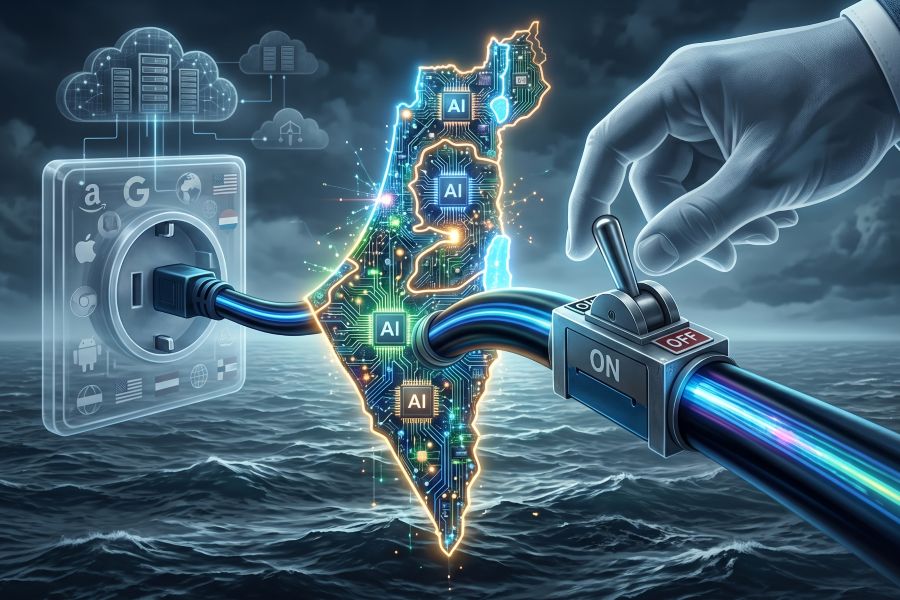
The strength of the private tech sector does not automatically translate into state capabilities. What is missing is government coordination, long-term infrastructure investment, and a conception of artificial intelligence as national infrastructure,” Hadas Lorber told Davar. Lorber, head of the Technology Partnerships Initiative at the Institute for National Security Studies (INSS) and former head of a division at the National Security Council, refers to the race to close widening gaps in the state’s ability to remain independent and sovereign in the age of artificial intelligence—a process that Israel is only beginning to initiate, and with a lag compared to many of its neighbors and other developed countries around the world.
In October last year, the recommendations of the National Committee for Accelerating Artificial Intelligence, headed by Prof. Yaakov Nagel, were placed on the government’s table. A month earlier, the government had decided to establish a National Artificial Intelligence Headquarters within the Prime Minister’s Office.
Following these developments, Hadas Lorber published a report in February presenting a broader framework than that of the Nagel Committee. The report goes beyond issues of international competition and the protection of sensitive data, and addresses a comprehensive concept of “digital sovereignty,” which requires a far-reaching national strategy.
An essential infrastructure: “like electricity or water”
In the Nagel Committee, they indeed understood artificial intelligence as a “national security shaper”—a factor expected to significantly influence Israel’s strategic capabilities. But Hadas Lorber takes this one step further: in her view, it is an existential infrastructure for the state, “like electricity or water,” and local control over this infrastructure “is equivalent to full security sovereignty,” much like control over physical territory.
In other words, the extent of control over all components of artificial intelligence, the so-called “AI stack”, from chips and electricity, through server farms, to data and advanced algorithms known as language models, will define the real scope of the State of Israel’s sovereignty in the 21st century.
")
For an entire generation, Israel built a high-tech powerhouse based almost entirely on minds and software, while relying on infrastructure located elsewhere. It is true that Intel, one of the semiconductor manufacturing giants, is a major employer in Israel, but even there Israeli employees are mainly engaged in engineering and programming roles, while the chips themselves, like most of the “hardware” on which the entire digital world depends, are manufactured abroad.
The Israeli paradox: first in talent, lagging in infrastructure
The annual AI Index of Stanford University illustrates the paradox described by Hadas Lorber. The index ranked Israel first in the world in “AI talent density” in 2026, and in the two years prior as well, despite a brain drain since 2023.
However, the same report also lists the countries with the highest number of data centers, and Israel does not appear on the list at all. None of the 500 supercomputers in the world are located in Israel.
Similarly, in the British Global AI Index by “Tortoise,” Israeli talent ranks seventh out of 83 countries, but Israel is only 26th in infrastructure and 65th in “operating environment.”
In an echo of the Zionist insight that a people relying only on its intellect and without sovereignty over territory is not master of its own fate, experts in technological development have begun warning that a state without clear control over its digital infrastructure is a state without technological sovereignty.
Every strategic file stored by a local institution in the “cloud,” and every life-and-death analysis carried out using artificial intelligence, whether medical imaging or military intelligence, may be located on a server in Virginia or Ireland, under the control of a foreign company subject to a foreign government.
“Computing and data infrastructures are a core national resource,” says Hadas Lorber, “like energy, water, and transportation.”
The auditor’s warning and the national plan
The term spreading around the world is “digital sovereignty” (or “sovereign AI”), and many of Israel’s neighbors, from Morocco to the United Arab Emirates, are already investing billions in national strategies to secure this critical form of sovereignty for themselves.
In this race, Israel is falling behind. Towards the end of 2024, State Comptroller Matanyahu Englman warned in a special report that “Israel’s scientific and technological leadership is one of the pillars of its national security, but existing computing infrastructures are limited and insufficient for advancing research and industry.”
The auditor continued sharply: “The State of Israel and the government are about a decade behind what is desirable in the field of artificial intelligence, both in terms of budget and in government applications. There is no long-term national strategy in Israel, and therefore without broad and intensive government action, the trend of Israel’s weakening may continue.”
Even the Nagel Committee, whose recommendations were published a year later, identified that the core challenge is that in recent years “Israel is in an inherent disadvantage and relative decline compared to foreign states and actors,” mainly due to the lack of centralized management and a relevant budget.
To address this, the committee proposed the urgent establishment of a “strong, lean, and efficient dedicated national headquarters” under the direct authority of the Prime Minister, which would lead a unified strategy. Implementing its recommendations includes an unprecedented investment of approximately 25 billion shekels over five years, the construction of a state-owned “supercomputer” to ensure computational independence, and the establishment of a national research institute aimed at bringing back talent from abroad and doubling the number of experts in academia.
“The Disconnection Test”: Lessons from the Microsoft case
Warnings about the lack of digital sovereignty have also been heard over the past two years in meetings of the Knesset Subcommittee on Artificial Intelligence and Advanced Technologies.
In March 2024, Dr. Ariel Sobelman, then a senior researcher at the Institute for National Security Studies (INSS) and currently an advisor to the National Artificial Intelligence Headquarters, told the committee: “Israel is the last technologically advanced country that has not initiated a national technology program or passed a national technology law.”
Eyal Cohen, an experienced professional and CEO of the company Cognifiber, told the subcommittee in November 2024:
“As someone who has been accompanying the field of artificial intelligence for 20 years, I look at this and tell you unequivocally—it is existential for us. The State of Israel will not exist as the State of Israel in another five years if we are not in the lead.”
")
Chair of the subcommittee, MK Orit Farkash-Hacohen (National Unity Party), defined the threat as follows: “We cannot afford to see a Microsoft Test 2,” referring to a formative event illustrating the lack of digital sovereignty during the Iron Swords War period.
In September of the previous year, the company Microsoft blocked access by Unit 8200 to its cloud services (“Azure”), following a report in the British Guardian that the IDF had used them to store and process data from a mass surveillance system monitoring Palestinian phone calls.
This occurred after an organised campaign called “No Azure for Apartheid,” led by a group of Microsoft employees alongside pro-Palestinian activists.
Israeli security officials argued that no operational damage was caused, among other reasons due to prior preparedness and data backups. However, the question arises whether this was a quiet warning of a potentially catastrophic pathway—an event comparable to Air France Flight 8969, in which Islamist militants hijacked a passenger aircraft and nearly carried out a plan to blow it up over the Eiffel Tower, an incident that should have served as an urgent wake-up call seven years before the September 11, 2001 attacks.
Persistent dependency: the political pressure on the cloud
On the surface, according to official responses from the IDF and the government, the Microsoft incident had no impact. However, according to MK Orit Farkash-Hacohen, joined in this assessment by Hadas Lorber, it precisely illustrates the “disconnection test”: a strategic risk embedded in Israel’s total dependence on foreign technological infrastructure.
They warn that in a moment of emergency, or under political pressure and boycott, a global tech giant such as Microsoft or Google could simply “pull the switch” and block access to data, computing power, or artificial intelligence models that are critical to the functioning of the state.
“Unlike an F-16,” says Hadas Lorber, “artificial intelligence services are a ‘continuous service’ rather than a one-off asset.” In other words, an F-16 remains in Israel’s possession even if the company that manufactures it, Lockheed Martin, or the United States declares a boycott on Israel, whereas access to state data stored on a foreign company’s infrastructure can be cut off instantly.
The potential ripple effects of such a disconnection are enormous. Israel’s security establishment, led by Unit 8200 and the AI unit “Bina,” has developed deep dependence on foreign cloud services such as Azure for storing and processing intelligence data that feeds airstrike planning and target identification systems. At the same time, government ministries and public bodies are transferring core areas such as finance, health, and transportation to platforms operated by Google and Amazon as part of the “Nimbus” project, a $1.2 billion cloud computing and artificial intelligence contract between the Israeli government and the IDF.
Academic research and national development likewise rely almost entirely on computing power and chips located abroad, controlled by global tech corporations that are typically based in the United States.
Cracks in support: Google, Amazon, and the US government
The growing pressure against partnerships with Israel is not directed only at Microsoft. A coalition of employees from Google and Amazon, together with political activists, demanded in the “No Tech for Apartheid” campaign that the companies cancel the “Nimbus” project, arguing that the technology makes them complicit in “apartheid” against Palestinians.
In the United States as well, a growing minefield is emerging around Israel and cooperation with it, due to historical polarization between the political parties and deep divisions within the Democratic Party. Traditional support for Israel is eroding among moderate Democrats such as Senators Adam Schiff and Mark Kelly, who stated this week that votes on arms sales to Israel will henceforth be examined “on a case-by-case basis.”
The Democratic Party is experiencing internal radicalization, and in recent days even appointed an open Hezbollah supporter to the Board of Governors of the University of Michigan. Although support for Israel still enjoys stable backing within the Republican Party, which currently controls the federal administration, companies such as Google, OpenAI, Anthropic, Microsoft, and Amazon are based in states under strong Democratic control.
In light of this reality, Orit Farkash-Hacohen stressed that Israel needs technological independence also over certain categories of its data, and that incidents such as the Microsoft Azure case should not be able to happen. This, she said, is part of technological sovereignty.
The Nagel Committee, she argued, did not truly address national security or strategic aspects—what is referred to as Israel’s digital technological sovereignty. The Israeli government, she said, must establish rules that ensure operational continuity and technological resilience even in relation to technology companies, with regard to artificial intelligence infrastructures within the country.
The hybrid model: managing dependence
Hadas Lorber argues that the establishment of the AI headquarters is a “positive step, because it creates a coordination hub.” However, she says, “its real value will be measured by its ability to exercise authority, budgets, and inter-ministerial coordination, not just to advise.”
Beyond this, she distances herself from the implicit assumption in the Nagel plan that the path to independence lies in building everything in-house. Between the current reality, where everything depends on foreign infrastructure, and the Nagel Committee’s vision of rebuilding the entire AI ecosystem domestically, Lorber proposes a third way.
Her hybrid approach is based on building local infrastructure for the most sensitive needs, alongside a system of strategic alliances between the state and the private sector, other countries, and international corporations, within a regulatory framework explicitly designed to address the “disconnection test.”

According to her, in practice there is no real alternative. “The State of Israel does not have, and is unlikely to have in the near future, the economic, energy, and technological scale to independently build a full, competitive AI infrastructure that includes computing, chips, and models. On the other hand, full reliance on the global private market exposes it to risks of disconnection, political influence, and lack of control. Therefore, the hybrid model tries to balance: state control over critical layers (sensitive data, core capabilities, regulation), alongside leveraging private and international actors for scale. Yes, it is more complex, but the alternatives are worse.”
Hadas Lorber continues her warning about a series of “pitfalls” that could derail Israel’s path toward digital sovereignty. Chief among them are over-dependence on a single supplier, insufficient energy capacity for infrastructure, regulation that slows innovation, and talent drain.
She emphasizes that when prioritizing resources, it is difficult to give up on computing infrastructure, energy, and high-quality data, but it is possible, carefully, to rely on external actors for chips and general-purpose models, such as the large language models developed by companies like OpenAI and Google.
In her view, the measure of sovereignty is not the structure but the outcome: “enough independence not to be vulnerable.” This means ensuring the ability to carry out critical functions independently, while preserving freedom of action in the face of geopolitical pressure.
New alliances and local models
And what about the troubling trends in relations with the United States? Hadas Lorber acknowledges the political risks, but argues that the United States is “the only partner capable of providing real scale,” and therefore the approach should be “not to avoid dependency, but to manage it,” through diversification of partners and built-in redundancy.
According to her, “there is potential with countries such as the United Arab Emirates,” particularly regarding its energy resources and capital, as well as with Morocco. She emphasizes that “the combination of complementary resources can be highly beneficial.”
Beyond the major commercial AI models, all of which are primarily trained on English-language texts, Hadas Lorber sees long-term strategic importance in developing local models, such as those of the Israeli company AI21 Labs and the open-source project “Dicta.”
According to her, local models could also address civilian needs by including Israel’s minority communities who speak Arabic, Russian, and Amharic, for example, as well as intelligence requirements related to understanding language, culture, and adversaries’ narratives, and protecting against antisemitic and anti-Zionist “poisoning” of global models.
“‘This applies both to civilian services and to security,’ says Hadas Lorber. ‘It requires high-quality data collection, appropriate tokenization, and dedicated training or fine-tuning,’ meaning the selection and processing of data and text in a culturally adapted way that only Israeli institutions fully understand.”
She emphasizes that only with local models will artificial intelligence systems processing local data and texts understand them in the way locals do, rather than as Americans would. “This requires dedicated data and integration between artificial intelligence and intelligence work.”
To the question of whether there are examples of countries that have successfully built a hybrid system of digital sovereignty, Hadas Lorber replies that “there are attempts, mainly in Europe and the Gulf. Countries like France and Germany are promoting a ‘sovereign cloud’ in cooperation with Amazon, Microsoft, and Nebius, under local regulation.”
The United Arab Emirates, she notes, is also cooperating with American companies to build AI infrastructure while trying to maintain regulatory control. However, there is still no perfect model that guarantees complete “non-disconnection”—this is an emerging field.
“Sovereign AI is not only a technological project,” Lorber emphasizes. “It is a multi-layered national-strategic project that requires the adaptation of both civilian and security systems.”