
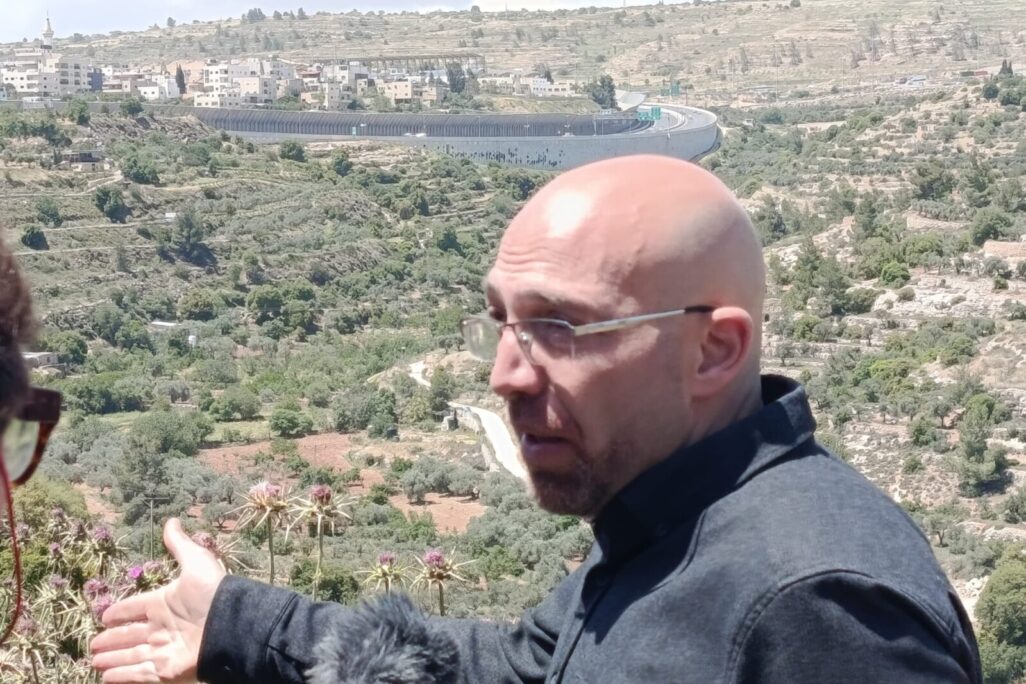
On June 28, 2024, the Israeli government decided to establish the settlement “Bar Kokhba” on agricultural land between Battir and Beit Jala, an area designated as a World Heritage Site by UNESCO in 2014.
For Kamal Mukarker, a resident of Beit Jala, the story began with the construction of the separation wall in the area in August 2015: “My family grows olive trees. I think a million trees were uprooted when they built the separation wall, including trees belonging to my family.”
“I remember that day. I was studying in Germany, and I was told that they were going to take all of my family’s land. I was very angry and very sad. My family fought back and even reached the Supreme Court. Somehow we succeeded, and we lost only a third of our land,” he says, pointing to an area near the separation wall. “It’s only because the settlers there want a beautiful view.”
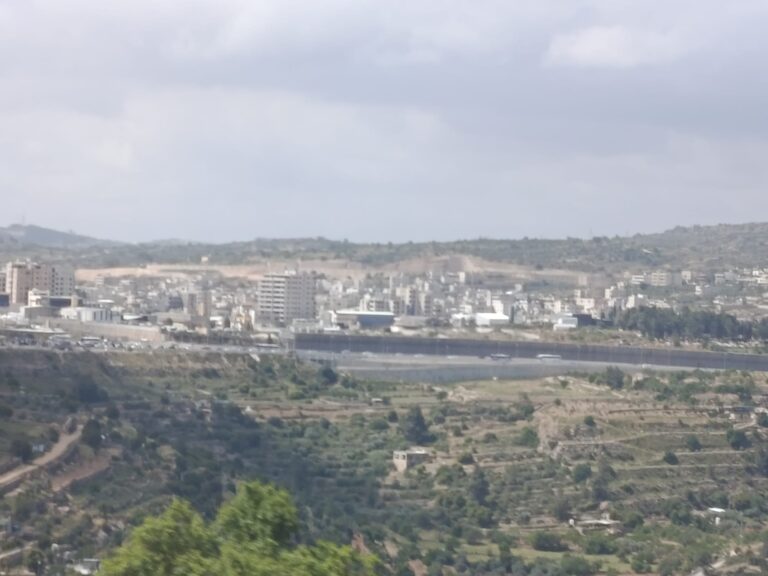
A new report by the NGO Ir Amim, which promotes coexistence between Jews and Arabs, points to government actions aimed at increasing the Jewish population in the Jerusalem area, at the expense of the Palestinian population. Beit Jala has a population of around 17,660 people, whose residents are mostly Christian. The Bar Kokhba settlement consists of around 12 families. According to the report, government actions south, east, and north of Jerusalem are intended to cut it off from the Palestinian area.
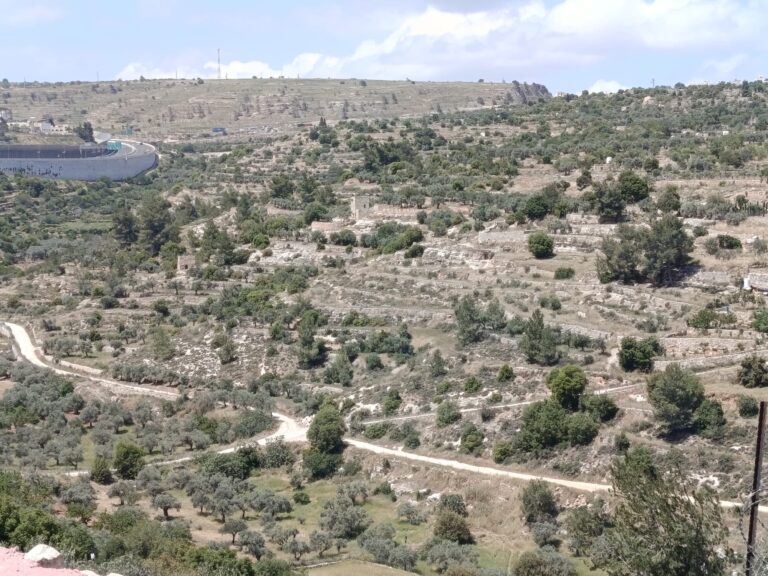
The Jewish expansion also includes the agricultural area known as the “land of vineyards and olives.” The area is famous for its ancient agricultural terraces that have been continuously cultivated for hundreds and even thousands of years, including an ancient Roman irrigation system that is still in use. The area also preserves a cultural landscape of Palestinian villages, vineyards, and olive groves integrated into the mountainous terrain, according to UNESCO.
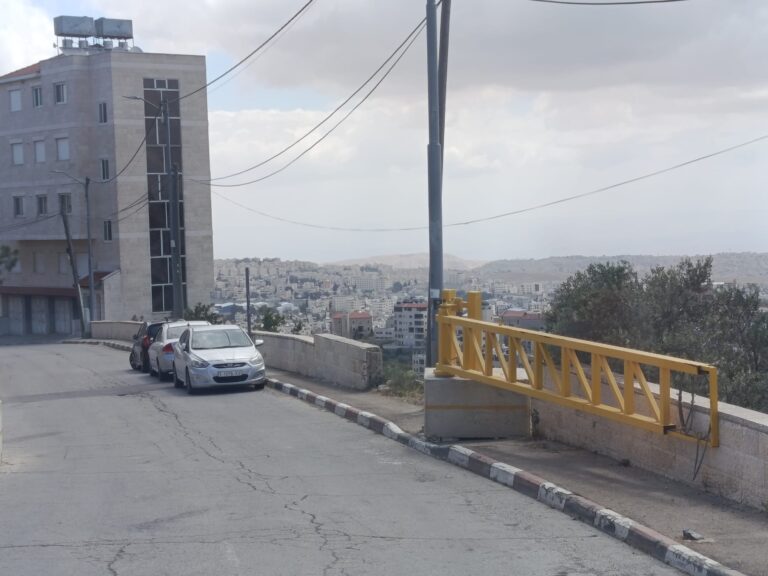
The designation of the area as a World Heritage Site by UNESCO was approved through an expedited process in order to prevent the construction of the separation wall, whose planned route passed through the area and threatened the agricultural and cultural continuity.
“I am afraid to build even a small fence, because they will destroy it”
In front of Mukarker stretches a valley, on whose slopes there are terraces and small orchards. Above them, at a distance, are the houses of the new settlement. According to him, “This land is now under full Israeli control. If I want to build, I need a building permit from Israel. But I will never get one.” He points to the ridge opposite and adds: “This is the ‘Mahrour.’ This is Area C; Israelis think this is Israeli territory, but according to the Oslo Accords it is supposed to be transferred to the Palestinian Authority. But they are planning to build thousands of apartments there. Look what they managed to build in six months. I am afraid to build even a small fence, because they will destroy it.”
According to him, “The biggest problem in the Holy Land is land. A dunam of land costs 700,000 dollars here. It’s insane.” For Mukarker, a former basketball player, tour guide, farmer, and workshop owner, there is no chance of obtaining such a sum.
In addition, Mukarker explains how the situation has changed since the wall was built: “I am not allowed to dig a well on my land. Water is essential here for agriculture. From time to time, organizations such as Caritas Internationalis (an international confederation of Catholic humanitarian aid organizations) help us obtain large water tanks.”
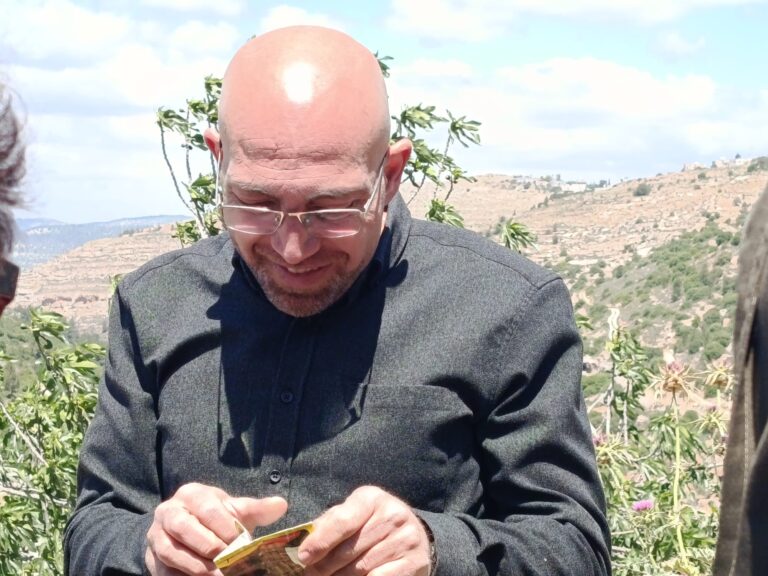
For Mukarker, it is important to emphasize that this is not only about losing land: “It’s not just losing territory — it’s like losing your lungs. This place used to be the breadbasket of the Bethlehem district. Now they want it to become part of Greater Jerusalem.” He adds: “I am a licensed tour guide in Jerusalem, but I cannot enter Jerusalem. It’s not only a matter of livelihood, it is also a religious issue. I was born in Jerusalem, and I am forbidden from reaching the Church of the Holy Sepulchre in the city.”
“There are no natural open spaces in Area A — this is the place to breathe”
According to him, “The idea is to make our lives more difficult, so that we move to live inside the city or leave. But we will hold on.” However, he acknowledges that “people tend to leave. My community [Greek Orthodox] made up 11% of the country’s residents; today we are 1%.”
Mukarker takes a deep breath of the clear mountain air and gazes longingly at the valley below him. “The feeling in Area A is like being in one giant refugee camp. There are no natural open spaces in Area A. People come here to be in nature, even though the land is not theirs. This is the place to breathe. There is room for everyone here.”