


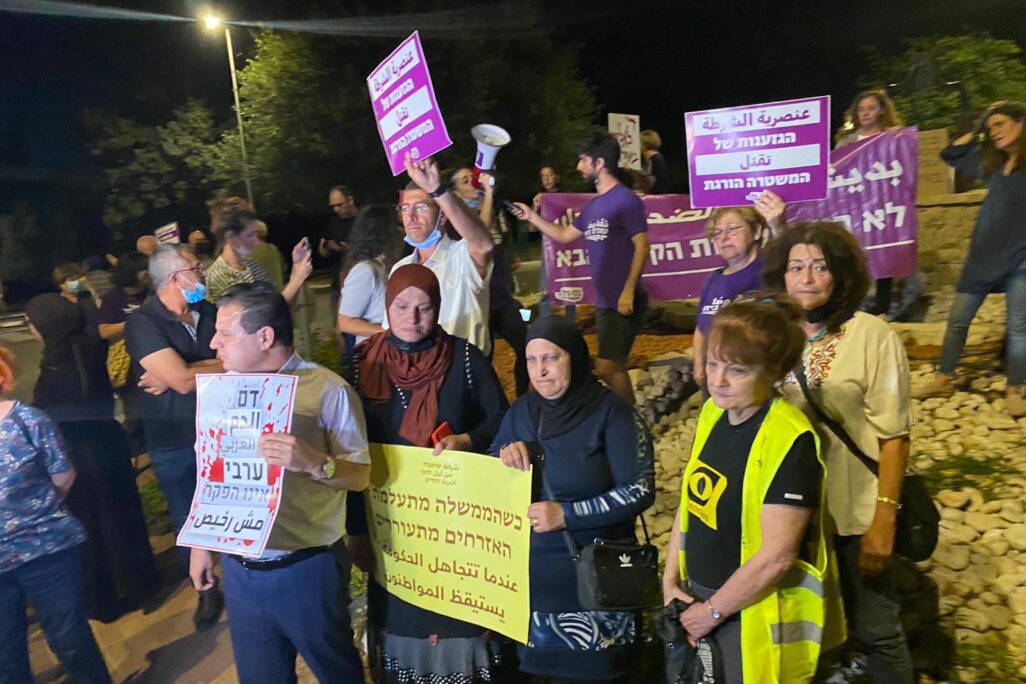
Three out of every four Arab citizens in Israel (75.8%) support voluntary non-security civil service on behalf of the state for Arab high school graduates, both young men and women, according to a survey conducted by the Konrad Adenauer Foundation and presented last week at Tel Aviv University.
Among survey participants, 46.9% expressed strong support for volunteering, while only 23.2% opposed the idea.
The researchers noted that support for the idea increases with age, though even among young people aged 18–34 there is solid backing for it (69.1% support).
In addition, no gender differences were found: 75.3% of men and 77.2% of women expressed support for the idea.
The study was led by Arik Rudnitzky, director of the Konrad Adenauer Program for Jewish-Arab Cooperation at the Moshe Dayan Center for Middle Eastern and African Studies, and was presented at the Tel Aviv University conference held in cooperation with the Kadar Foundation.

The study is based on a telephone survey in Arabic conducted in the last week of April (April 26-May 3) and included 500 respondents (sampling error 4.4%).
The Most Important Issue: Addressing Violence and Crime
A majority of survey participants (71.3%) said that the most important issue today for the Arab public is addressing violence and crime.
Only 8% identified resolving the Palestinian issue as the top priority.
Another 7.4% said that dealing with problems in education, employment, and poverty was the most important issue, while 6.1% said that regulating planning and construction in Arab localities was the most pressing concern.
Many within the Arab public (76.9% of survey participants) reported a decline in their sense of personal security.
The primary reason cited was the high level of violence in Arab localities (51.8%).
Additional concerns included the possibility of a new war breaking out in the region (21.8%), economic hardship (8.6%), and the situation of Palestinians in Gaza (7.4%).
At the same time, a majority of respondents (68.3%) said that their overall economic situation is good.
Identity and Belonging
The survey found that the most prominent component of Arab citizens’ personal identity is their Arab identity (33.3%).
Other components mentioned were Israeli citizenship (27.7%), religious affiliation (24.5%), and Palestinian identity (13.5%).
Among Muslims, 35.4% said that Arab identity was the dominant one, while only 13.7% identified Palestinian identity as dominant.
Among Christians, 37.8% identified Israeli identity as dominant, 33.4% identified Arab identity, and 24.9% identified Palestinian identity.
Among Druze respondents, the most prominent identity was Israeli identity (64.8%), while Palestinian identity was not mentioned as a dominant identity.
About half of the survey participants (53.3%) said that their sense of belonging to the state is generally strong. In contrast, 44.5% reported that their sense of belonging to the state is weak.
Responses to this question revealed differences according to socio-demographic variables (religion, age, and education level) as well as political variables. For example, the proportion of Druze respondents who reported a strong sense of belonging to the state (81.7%) was significantly higher than among Muslims (50.5%) and Christians (53.3%).
No major differences were found between age groups, though it can be said that older age groups tend to report a somewhat stronger sense of belonging to the state than younger groups. In general, the sense of belonging to the state tends to weaken as education levels rise.
A multi-year view of the data shows that the importance of the religious component in identity is fluctuating.
The Palestinian component, which dropped to 8% after October 2023 (down from 16.5% in May 2023), is strengthening again but still remains the least significant component.
In practice, Israeli citizenship and Arab identity are the more prominent elements, competing with one another in their relative importance over the years.
Belief in Arab-Jewish Political Partnership
If Knesset elections were held today, expected voter turnout in Arab society would stand at 53%, similar to the turnout recorded in the elections for the 25th Knesset (53.2%) held in November 2022.
Under this scenario, Hadash-Ta'al (projected 5.3 seats) and Ra'am (projected 4.6 seats) would be expected to pass the electoral threshold, while Balad would not (projected 1.8 seats).
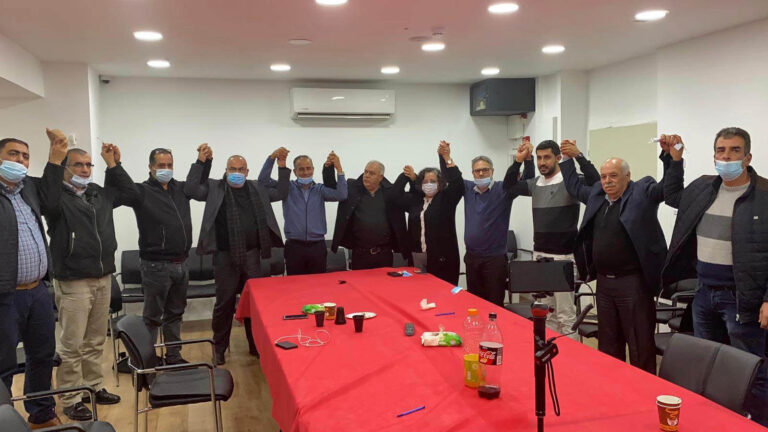
By contrast, if the Joint List were to run as a unified alliance of the four Arab parties, Hadash, Ta'al, Ra'am, and Balad, expected voter turnout in Arab society would jump to 67%, the highest level measured.
In that scenario, the Joint List could win 16.3 seats, meaning more than the combined total the Arab parties are projected to receive if they run separately.
A large majority (77.2%) support the participation of an Arab party in the government formed after the next elections, 43.3% support joining any government that is formed, while 33.9% support joining a center-left government.
A breakdown by voting intention shows that support for entering government is highest among voters for Ra'am and Jewish parties (over 90%), while among Balad voters and those who do not intend to vote, support is lowest — 67% and 63% respectively.
A multi-year view indicates that since May 2023 there has been a steady, moderate increase in the share of Arab voters who support an Arab party joining the government.
According to Dr. Arik Rudnitzky, Arab politics is moving between two poles: running in a joint electoral list for the Knesset and joining the government.
“In the case of Arab politics, these things do not go together. Running in a joint list, and after the elections allowing those who want to join the government to do so, and those who do not want to, not joining the government, could be a solution. This is a maximal utilization of the electorate, and a maximal utilization of political power.”
A majority in the Arab public (59.4%) believe that the current state of Arab-Jewish relations is not good. The survey also found that the higher the respondents’ level of education, the more likely they were to say that Arab-Jewish relations are in a poor state.
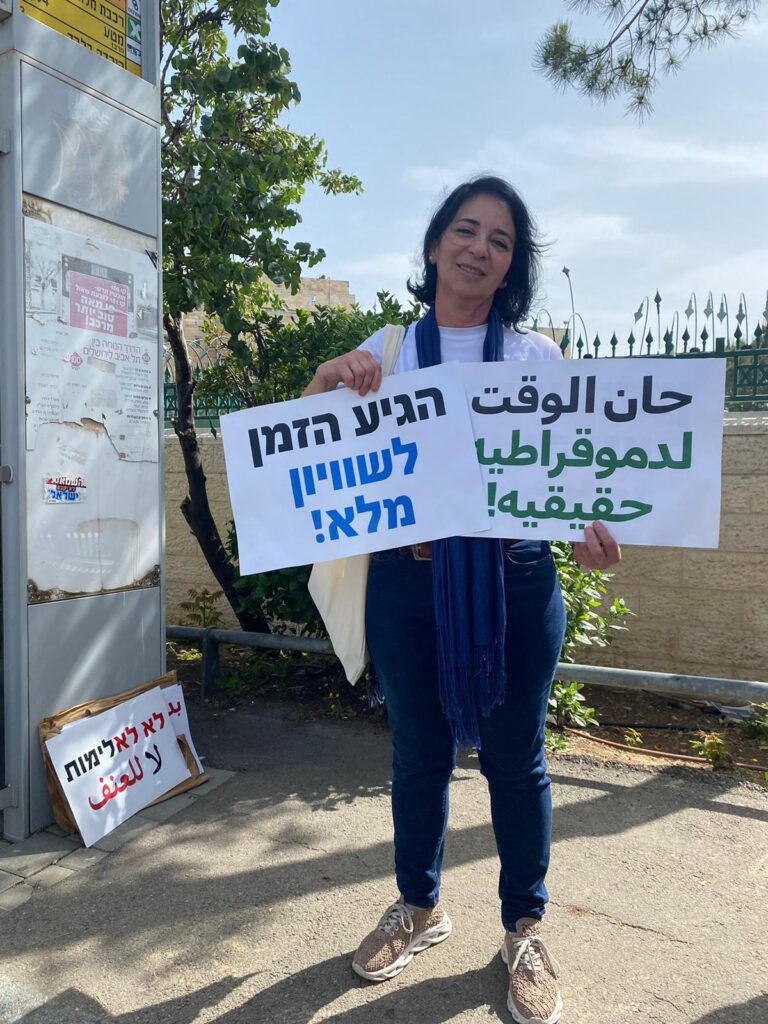
Nevertheless, a majority of survey participants (63.7%) said that they believe in Arab-Jewish political partnership.
Among young people, support for Arab-Jewish political partnership stood at 59.3%.
A party-based analysis found that only among supporters of Balad did belief in political partnership fall below 50% (41.5%).
Meanwhile, 39.7% believe that there is genuine support within the Jewish public for such political cooperation. In the previous survey (November 2025), 56.9% believed that the Jewish public supported political cooperation.
Only among supporters of Ra'am, which participated in the Bennett-Lapid government, did distrust regarding the Jewish public’s willingness for partnership fall below 50% (49.7%).
According to the researchers, this distrust is explained in part by statements from leaders of Jewish parties rejecting or ruling out such cooperation.
“Acute Problems That Require an Immediate Government Response”
According to Dr. Arik Rudnitzky, “Against the backdrop of a prolonged multi-front war, many in the broader Israeli public are unaware of the changes taking place in the attitudes of Arab society. It is difficult to overstate the importance of these findings: Arab citizens are presenting a roadmap for rebuilding Israeli society through integration and influence, not only on the political level, but also on the social level.
The broad support for an Arab party joining the government is not a new finding. What is interesting, however, is that this support did not decline after the war, and even increased to some extent.”
“At the same time, the new finding is the principled support for the integration of Arab high school graduates into non-security civil service provided by the state. For Arab citizens, this is not only a path toward deeper integration into broader Israeli society, but also an opportunity for young Arabs to gradually build their life trajectory after finishing high school, similar to the mainstream path followed by young people in Israeli society.
“The survey also points to acute problems that require an immediate response from the government, foremost among them addressing crime and violence, as well as improving protective infrastructure in Arab localities for emergencies and wartime situations. In the absence of adequate protection, anxiety within Arab society over the possibility of renewed war in the region continues to rise.
“The survey findings are especially significant this year, as Israel’s citizens, Jews and Arabs alike, engage in political soul-searching ahead of the upcoming Knesset elections,” said Dr. Arik Rudnitzky.