


When Israel’s leaders initiated the events marking Jerusalem Day, they did so to symbolize the unity of the city. Yet in recent years, the traditional route of the Flag March has instead become a symbol of friction and division.
Anyone walking through the Old City of Jerusalem on this day encounters a depressing sight: rows of shops and businesses owned by Muslims and Christians — all closed.
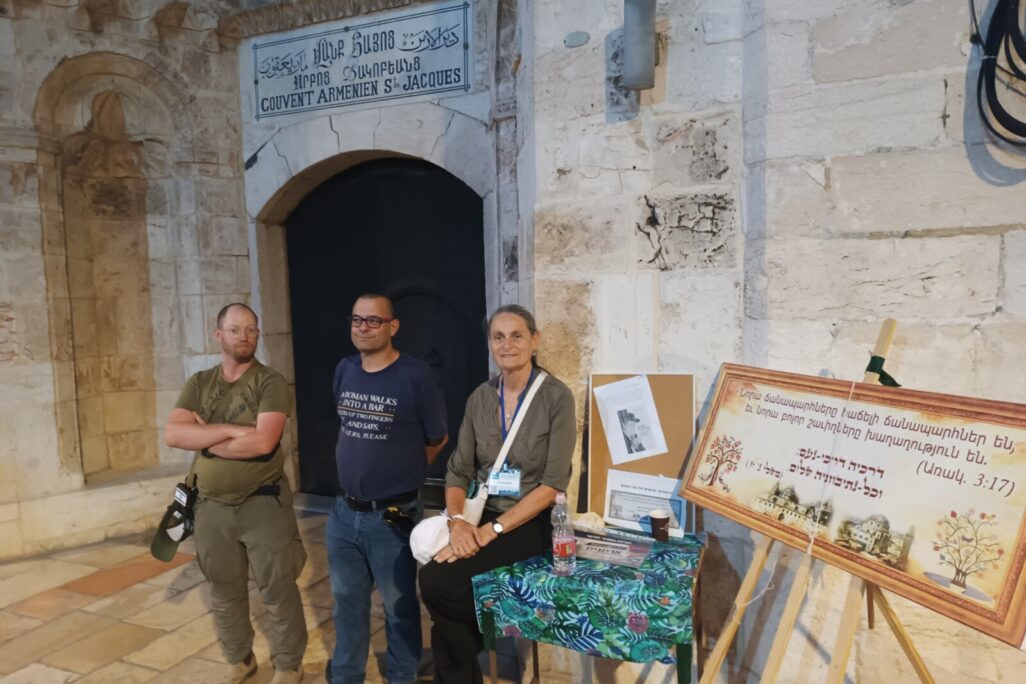
For me, this has become a personal tradition. On Jerusalem Day, I stand in a protective presence on Armenian Patriarchate Street together with Yisca Harani, director of the Center for Data on Freedom of Religion, alongside other volunteers.
We stand at the entrance to the Armenian Monastery, one of the locations most vulnerable to attacks against Christians in the Holy Land. It lies along the main route taken by marchers walking from Jaffa Gate to the Jewish Quarter and the Western Wall.
Reports published by the Center for Data on Freedom of Religion make this clear. According to the latest reports, and especially the report covering the first quarter of 2026, roughly two-thirds of the documented incidents of harassment against Christians in the Old City of Jerusalem occurred on this very street.
For reasons that remain unclear, this striking and alarming data did not lead police commanders to station a meaningful police force along the particularly vulnerable section of the street opposite the entrance to the Armenian Monastery during the Flag March, despite the heightened security deployment throughout the Old City.
The result was predictable: during the few hours in which marchers passed through, countless spitting incidents were documented.
As part of this protective presence, I found myself moving back and forth between my position at the entrance to the Armenian Monastery and the surveillance feeds from cameras installed by residents of the Armenian Quarter in a dedicated control center.
One volunteer would identify a spitting incident, send me the exact time and a description, and I would immediately hurry to the camera control room to locate the footage of the event.
I then passed the recorded videos to Yisca Harani, who filed police complaints. Complaints that will likely be closed due to the inability to identify the suspects.
Had a police officer been stationed there, it would have been possible to detain the perpetrator immediately, show him the clear evidence from the camera control center, and arrest him on the spot. That would have sent a deterrent message to the offenders and a reassuring message to the victims. But the police, apparently, have other priorities.
Attacks on Christians in Israel Give Antisemites Ammunition
The aggression directed at non-Jews, even if carried out by only a marginal minority among the marchers, demonstrated that for many, this day has become one of excluding other religions and asserting Jewish supremacy.
I am deeply concerned about the future of Jerusalem as a city shared by three religions, and anyone troubled by harm to innocent people and to the city’s interfaith fabric should be concerned as well.
It is also troubling in relation to the future of diaspora Jews, minorities in their own countries who are vulnerable to antisemitism, because what happens here directly affects what happens there.
These acts of harassment are not merely criminal offenses. They represent a profound moral crisis. They begin with education at home, in schools, and within the broader political climate. When such acts are ignored, a dangerous message is sent to the world: that we, as a majority, permit harm against religious minorities, while Jews as minorities suffer similar attacks abroad.
Harassment of Christians in Jerusalem weakens our moral argument as a people who themselves endured persecution, and gives ammunition to antisemites.
The day before the Flag March, the Knesset Committee for Immigration, Absorption and Diaspora Affairs, chaired by MK Gilad Kariv, held an important discussion on the harassment of Christian clergy and pilgrims in the Old City of Jerusalem and its impact on antisemitism around the world and on interfaith dialogue. That discussion was essential.
The Center for Data on Freedom of Religion is doing sacred work: systematic collection of information, documentation, and continuous pressure for action. Without them, we would know less and ignore more. But documentation alone is not enough.
What is needed is determined enforcement, educational change, and political leadership willing to say clearly: harming someone because they wear a cross or a monk’s robe is a desecration of God’s name.
My hope is that by the next Flag March, the route will be changed so that marchers no longer pass through Damascus Gate and the Muslim, Christian, and Armenian Quarters.
If, however, it is decided to continue holding the march in its current format, then a significant police presence must be deployed at the entrance to the Armenian Monastery and at other friction points in order to prevent harm to religious institutions and to the non-Jewish residents of the Old City of Jerusalem.