


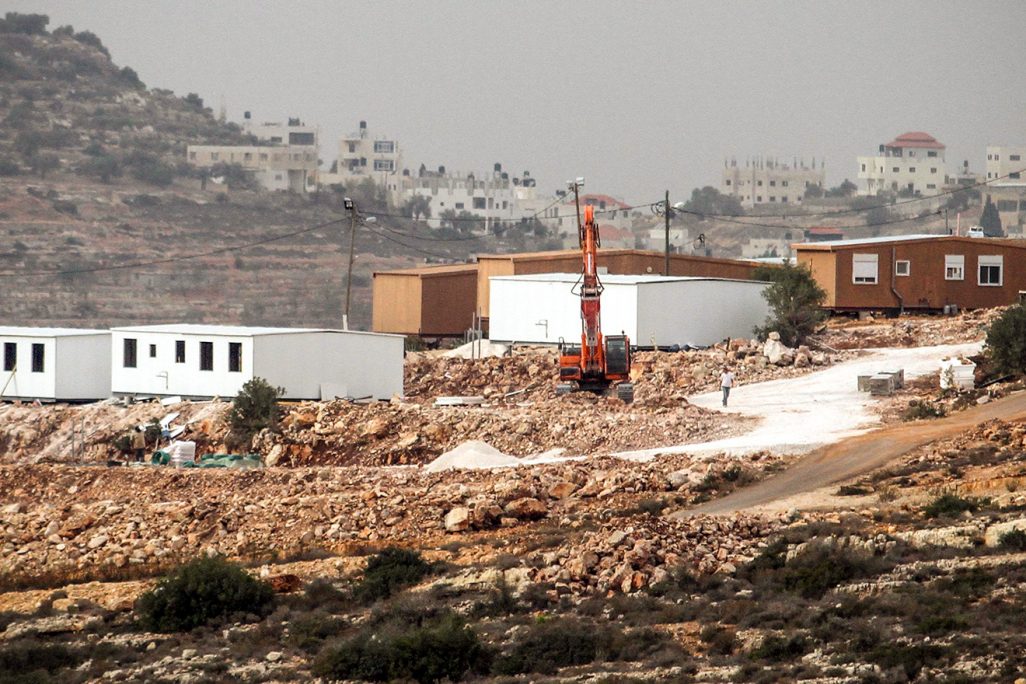
The Finance Committee debated earlier this week for over ten hours a over proposal by MK Zvi Sukkot and Finance Minister Bezalel Smotrich (Religious Zionism) for tax benefits for settlements in the West Bank and on the Lebanese border. The stormy debate ended without agreements.
The bill to amend the Income Tax Ordinance (Tax Benefits for a Threatened Settlement in the Area) encountered legal difficulties due to the challenge of defining the essential difference between the settlements in the West Bank, to which the tax benefit proposal applies, and other settlements. The initial proposal to define them as a 'threatened settlement' was disqualified because there are many settlements at security risk that are not in the West Bank. Subsequently, it was proposed that the definition would be 'settlements where there is an obligation to protect school transport from gunfire' – a condition that focuses the proposal on parts of the West Bank. However, the Knesset's legal counsel expressed opposition to this criterion.
Attracting strong populations to the periphery
The new proposal is relevant to settlements ranked in cluster 6 or lower on the peripherality index (an index calculated by the Central Bureau of Statistics, reflecting the degree of peripherality of a local authority in Israel in terms of its geographic location relative to centers of economic activity), and on the socio-economic index.
According to the proposal, the law will take effect retroactively from January 2026 until the end of 2027. The Finance Minister will be authorized, subject to the approval of the Finance Committee, to extend its validity by order for up to two additional years. A clause that would have allowed him to include additional settlements for the benefit at his discretion was removed from the proposal.
Settlements in the West Bank located at a distance of 2 km from the security wall, the proposal states, will enjoy 25 tax credit points – up to about 6,000 NIS a month, or 72.6 thousand NIS a year. This benefit is intended to attract strong populations to the periphery and ease the burden on high-income earners living in the West Bank, even though many of them are located a reasonable driving distance from high-income employment hubs in the center and Jerusalem.
The consequences of rejecting the law will also apply to the confrontation line in the North
During the discussions in recent days, it was decided to also add the confrontation line settlements in the north to the proposal. The decision ties their fate to the fate of the West Bank settlements, so that the consequences of rejecting the law will also apply to the confrontation line.
According to the new bill, only settlements located at a distance of 0-2 km from the northern border will be eligible for the benefit, despite promises to include those located up to 9 km away. Finance Committee Chairman Hanoch Milwidsky asked to expand the range of benefits to 9 km from the border, and to add Ma'ale Adumim and Ariel to the list of eligible cities. However, Prime Minister Benjamin Netanyahu intervened in favor of Smotrich's original phrasing (0-2 km only).
It was also decided, with Netanyahu's intervention, to add a clause to the proposal conditioning eligibility for the benefit on settlements whose establishment was legally approved. This means that cities located beyond the Green Line, such as Ariel and Ma'ale Adumim, will not be included in the new law, despite Milwidsky's request.
According to the proposed amendment, confrontation line residents eligible for the benefit will receive a 4% addition to their tax credit, as long as the credit does not exceed 18% of the employee's income with a ceiling of about 44,000 shekels. According to the Tax Authority's assessment, the cost of the proposal is about 130 million shekels a year in the West Bank and 25 million shekel in the north.
"The confrontation line serves as the state's flak jacket"
Moshe Davidovich, head of the Mateh Asher Regional Council, said in response: "The confrontation line is currently the area that serves as the state's flak jacket; the confrontation line is currently the only area in chaos, where residents fight daily to survive there. While you sit here, and I am here with the heads of the authorities, people have been killed on the confrontation line. The Finance Minister proposed including the confrontation line, but didn't say a single word about it being 0-2 [km] only. I am not willing for us to be taken hostage for a proposal that is opposed by the Attorney General. Either we are all in or you leave us all out of the decision. We are no one's punching bag and no one's fig leaf."
Finance Committee member Naor Shiri (Yesh Atid) said: "The Finance Minister is cynically and despicably using the residents of the north in order to hand out money directly to his voters."
Mayor of Ma'ale Adumim, Guy Ifrah: "Today, the residents of Ma'ale Adumim and the residents of Ariel will know that they are not doing enough settlement, because the Prime Minister, whom I support and love, decided that the residents of these cities do not interest him enough. It hurts me very much that this is the decision here."
Following the discussions, Milwidsky announced: "I fought and will continue to fight so that all confrontation line settlements will be included, both in Judea and Samaria and in the north. This is a top-tier security and national interest."