


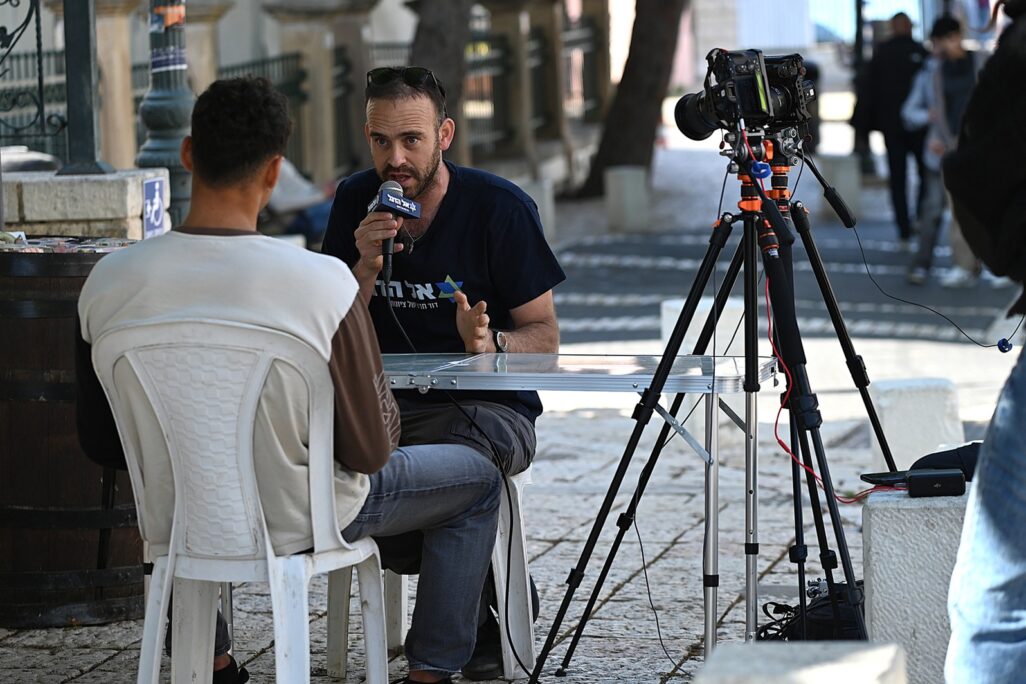
In the center of the pedestrian mall in Zikhron Ya'akov stands a folding table. Two cameras are set up opposite it, with plastic chairs on either side. On one sits Matan Yaffe (42), leader of the 'El HaDegel' (To the Flag) movement. Passersby are invited to sit on the other to talk politics. The conversations that develop are relatively long and continue consecutively over several hours. Yaffe responds eloquently and directly to the participants, who seek to challenge his worldview regarding the state of Israeli politics. The result is a series of tight videos from dozens of locations across the country, which have gained wide circulation. An attempt to establish a new ideological movement.
This phenomenon does not grow in a vacuum. In the mandate polls ahead of the upcoming elections, a dramatic figure is hidden: between 15% and 20% of voters still do not know who they will vote for, according to data from the "HaMadad" website and Kan public broadcaster pollster Dudi Hassid. In a 'Maariv' poll conducted last summer, a party of discharged soldiers and reservists wins 13 mandates. These and other figures indicate that between the two blocs lies a voting public that cannot find a political home, even though it has the power to decide the elections. Movements like El HaDegel are interested in entering this void.
In Bnei Brak, in Zikhron Ya'akov, and in Athens
The 'El HaDegel' movement announced its intention to enter the political arena a year and a half ago, but has not yet established a party or joined an existing one. Alongside Yaffe, David Sheraz (41) leads the economic field in the movement. Yaffe's main public exposure comes from the video project called "Explain it to Me," which is based on a simple format: open political conversations in the public space with voters.
")
The videos from the project, which are filmed in Tel Aviv, on academic campuses, in periphery cities, and even in Athens, accumulate tens and sometimes hundreds of thousands of views on Instagram and Facebook. According to him, the initiative was born out of frustration with the political and media discourse: "I got tired of talking to politicians and the media," he says. "So I went to set up a table in Bnei Brak, and asked Haredim to explain to me why they don't enlist. I talked to them for three hours."
When asked if these interactions ended in violence, Yeffe says, ”At the very, very end, someone came and went wild, but we didn't include that in the video. I have two principles: the first is that I don't play the bloc game, and the second is that I'm not a populist, and the only video I didn't upload from 'Explain it to Me' is the part where a Haredi in Bnei Brak spat on me and flipped a table on me. Various people asked me to upload it and I refused. The flip side of populism is someone who says what sounds good even though he knows it won't happen."
According to Yaffe, this is not an election campaign. "The goal is connecting with the people, doing it through genuine encounters with the public, this is an event of substance. Even as an elected official, I intend to continue with this platform to stay connected to the substance."
From a demand for resignation to a political movement
Yaffe often speaks in terms of values and vision, as he also did in the long conversations he held with Prof. Yaron Zelekha and Dr. Einat Wilf, both of whom are potential political rivals or partners in the upcoming elections. The "El HaDegel" movement, which is actually an evolution of an earlier organization called "Tikun 2024", began its path by demanding that ministers and Knesset members take responsibility and resign, as a continuation of the values-based line demonstrated at the beginning of the war.
According to him, upon concluding his first round of reserve duty in January 2024, he and his friends were surprised to discover that "our leaders have returned to the discourse of October 6." As people who returned from prolonged service where they were exposed to smaller gaps than imagined between parts of society, they founded "Tikun 2024". The movement held contacts with a series of politicians from the coalition and the opposition in order to harness the spirit of the days after October 7 to establish a state commission of inquiry and an agreed-upon dissolution of the Knesset, ahead of the establishment of a broad Zionist government that would rely on the three major parties.
After several months, the members of the initiative realized that the elected officials are in no rush to give up their power, and that sometimes they will prefer to harm their political rivals even at the cost of harming the entire public. "We looked left and right, we saw that they are unable to get out of October 6, and we did the only thing we know how to do: say 'Follow me'."
At the beginning of the journey, the membership of distinct right-wingers in "Tikun 2024" aroused suspicion on the left. Publicist Ido Dembin, former CEO of the "Molad" institute, even claimed in an opinion column in Haaretz that this is an organization that, like "Im Tirtzu", starts with a discourse of unity and Zionism, but is expected to reveal itself as an extreme right-wing organization.
"We seek to break this discourse of right and left," responds Yaffe, who is indeed hard to clearly assign to one of the camps. "Our goal is the existence of the Jewish people in its land, and that means our goal is not the Greater Land of Israel, not a Halachic state, and also not a beacon of universalism and liberalism. All of these are personal aspirations and everyone is entitled to them, but that is not the goal of Zionism."
Alongside Yaffe, several key activists stand out in the leadership of "El HaDegel": Eli Meiri, a lieutenant colonel in the reserves and former principal of two schools and of the education department in Tiberias, who leads the field operations; Attorney Yitzhak Glick, a real estate entrepreneur from the West Bank and a major in the reserves, who is in charge of the legal and government areas; and Golan Rise, a documentary director and strategist serving as the movement's CEO, which perhaps indicates the importance attributed to branding the message. They are joined by Reut Frenkel, who leads the partnerships field, and Lilach Chaim-Idelberg, who coordinates the research and strategy activity.
"If we don't stop the polarization, I really wish us luck"
"You see the leaders of this nation and you say, 'I really don't like them, but I like the other side even less.' And I think that suddenly people see that it's possible to hold a position and a path, which I think is missing today in Israeli politics," Yaffe describes his feelings.
When asked what practically Yeffe’s group is proposing he responds, “I think I come in very matter-of-factly and without a position; I am capable of both condemning the fact that in the Prime Minister's Office advisors worked with Qatar, that is a terrible thing and totally immoral and un-Zionist, and also condemning the Military Advocate General, because my objective function is not to topple the government at any cost. I think the Israeli public is asking for someone who arrives, looks at the situation, and says what he agrees with and what he doesn't."
In "El HaDegel", they do not rule out sitting in a government with Netanyahu, but insist that they are not affiliated with the current government, clarifying that this is only on the condition that such a government also includes parties currently sitting in the opposition. "Our basic concept is on the question of what serves the State of Israel, regardless of right or left," Sheraz explains. "If taking territory from the enemy helps us defeat them, then that is in our toolbox. If a peace agreement with Lebanon serves us, excellent; if putting an Iron Dome in the Emirates serves us, then so be it. We are not constricted to the molds of left or right”.
"We don’t divide ourselves along this idiotic fault line of Bibi vs. Anyone But Bibi. We talk about Zionist vs. Non-Zionist, and we will force a broad Zionist unity government," Yaffe declares. "What we need right now is a government where there is no conflict of interest between itself and the state. And if the choice is between a government that acts contrary to the country's needs or heading to another round of elections, we will go to elections."
"The desire to break the blocs isn't because we don't connect with the opinions of either side," explains one of the movement's regional coordinators. "It’s because we know that even if an 'Anyone But Bibi' government is elected, good luck with Haredi enlistment and handling the Hilltop Youth when they have no representatives in the government. And right after that, a government would be elected that will make us look back at the current government the way we look back at Menachem Begin. That’s the polarization—it escalates itself, and if we don't stop it, we really are in trouble."
Yaffe continues, speaking about if they would collaborate with groups critical of Israel. “As a concept, we don't boycott, but there are people who commit un-Zionist acts. I think Brothers in Arms, like many other organizations, did wonderful things on October 8th that deserve the Israel Prize—in rescuing people, in sourcing equipment, in many vital things they did when the state just wasn't there. But in the world of October 6th, they carry a heavy weight for dragging things that were once sacred cows into a dispute that helped divide the nation. For that, they must take responsibility and recognize the danger and mistake in it. Leaders aren't expected to never make mistakes, but to take responsibility for them. As an organization, they haven't taken responsibility and they continue to justify this action, which endangers the existence of the Jewish people in their land, so as an organization there's a real problem here. But as individuals who were part of it and are willing to say it was a mistake and express regret? Absolutely, there is a path to repentance for everyone; that’s part of Judaism."
"When you talk about establishing a neighborhood for police officers in Khan Younis," Yaffe says, referencing statements made by Minister Itamar Ben-Gvir during the fighting in Gaza, "you end up signing a surrender deal with Hamas. Because if you come and fight for the existence of the Jewish people in their land, you can do the diplomatic work globally to establish the justice of your path, that we deserve a life of prosperity and security. But the moment you layer your own private fantasies on top of that, which don't even represent the entire Israeli public, everyone around looks and says, 'Whoa, this is no longer about defending the existence of the Jewish people in their land, this is about fulfilling all kinds of personal visions,' and that is not Zionism."
Despite these statements, when MK Limor Son Har-Melech arrived in the Gaza Strip on Tu BiShvat under the cover of her parliamentary immunity to plant trees, Yaffe was also present. However, his central question to her was: "Why is there no decisive victory?"
"A Deep Failure of Politicians"
Yaffe, born in Jerusalem and raised in Mevaseret Zion, is a combat officer in the Commando Brigade reserves, a social entrepreneur, and makes sure to emphasize that he never planned on being a politician. In 2013, he co-founded and headed the "Desert Stars" non-profit for leadership in Bedouin society alongside Dr. Muhammad Al-Nabari. Together with Sheraz and Rabbi David Leybel, he rehabilitated the "Achvat Torah" organization to integrate Haredim into the workforce. He is a graduate of the Wexner Foundation Fellows program at Harvard University (the same institution he later sued over antisemitism) and has served hundreds of days of reserve duty during the current war. He lives in the community of Srigim with his wife Aviv and their five children.
Yaffe established the Desert Stars academy after Bedouin youth attempted to rob him. "The State of Israel never missed an opportunity to miss an opportunity with the Bedouin population," Yaffe says. "This is a population that served, that built the country, that partnered in developing the Negev, and time after time, we just screwed up something else, causing them a loss of hope on one hand, while offering zero prospects for the future on the other. They went and studied at universities outside of Israel, picked up all kinds of radical ideas there, and brought them home."
Regarding internal security, Yaffe adds: "Ben-Gvir talks about how they won't let him manage, but there has never been a minister with as much authority as he has right now, and you have 180,000 illegal weapons in the Arab sector. I have yet to see the High Court judge, the bureaucrat, or the 'Deep State' that said 'don't confiscate the illegal weapons.' There is a deep, deep failure of populist politicians here who are busy posting tweets instead of solving the problem."
Leaning Right Economically: Less State, More Market
Sheraz, who coordinates the economic front for "El HaDegel," is a businessman and entrepreneur who has founded five companies. One of them is VENN, which he co-founded with two of his friends from Sayeret Matkal who serve as co-CEOs. The company, which currently operates primarily abroad, was established to create young communities in rental residential complexes. Early on in Israel, the company faced criticism claiming it drove up housing prices and gentrification. It has since shifted its model, turning primarily into a technological platform for managing and strengthening internal resident communities.
"It’s a model that connects to my overall economic worldview—a free market concept, with responsibility to all the people who actually create the value," Sheraz says. "Therefore, it also connects very deeply to the worlds of decentralized economics and decentralized currencies (crypto), which I am a part of. Because ultimately, the question is how value is distributed properly among everyone who creates it."
"The economic platform of 'El HaDegel' is reducing state intervention, a free market, increasing competition, and removing barriers and bureaucracies. The State of Israel today sits on Ottoman and British infrastructure, later mixed with socialist elements, and we have a lot of those remnants left over. It happens through all sorts of agreements and mechanisms that protect egg farmers, tomatoes, and a thousand and one other things here, creating a reality where the consumer at the end of the line simply lacks a competitive market, and that’s a problem. So these things need to be fundamentally fixed and dismantled one by one."
")
"Agriculture in our eyes is an important Zionist value for the State of Israel, both in terms of our ability to rely to a certain degree on self-production, and in the ability to hold onto land, protect borders, and ultimately be connected to this soil. If there are farmers who need support, we will gladly support them, but directly and without middlemen along the way skimming a cut."
Sheraz presents a similar view toward teachers' unions: "The teachers' unions currently constitute a significant barrier to fixing the education system. Ultimately, it doesn't serve the teachers and it doesn't serve our children's education; the power there is disproportionate."
"In fact, the education system today is highly distorted. There are four different education systems. El HaDegel’s core curriculum package dictates a Zionist, democratic, Jewish identity, which defines what it means to be a citizen in the State of Israel. Regarding minorities, there are obviously adjustments, but they too need to understand that this is the national home of the Jewish people, that this is a Zionist state. The Haredi community also needs to receive this package. Just as an American citizen salutes the flag and sings the anthem, the exact same should apply in the State of Israel."
"We intentionally built this core curriculum package to be as lean as possible," Sheraz concludes, sketching out the boundaries of the state's role: "Just like most of the other centralized state systems, they need to stop being the employer and stop being the operator, and instead become a body that outlines policy and enforces it."
"Joining an Existing Party is an Absurdity to Me"
"The first thing we did was create a set of bylaws, stating that after every term, one-third of the leadership rotates out," Yaffe explains. "And this is essential because it tells you that nobody here enters politics to retire as a Member of Knesset. We come to do the work because we understand that the moment we started, the hourglass flipped."
")
He continues to critique the current system: "Right now, there is a conflict of interest between elected officials and the State of Israel. Our objective function is not to serve a political base, but to serve the State of Israel. Today, the attempt to serve the base births all kinds of anomalies, like the death penalty law for terrorists, whose entire purpose as far as Ben-Gvir is concerned is to clash with the judicial system. He isn't thinking about the State of Israel and the country's security; he is thinking about his base. That is the difference between a politician and a leader."
When asked what immunize him from turning into a politician, Yeffe replies, ”First of all, the fact that I am an entrepreneur. When an entrepreneur enters a system, he doesn't ask how to study it and adapt himself to it, but how to dismantle it and make it better. We aren't establishing a political movement; we are establishing a political startup. But I don't even rely on this DNA of mine, which is why we wrote bylaws with legal advisors ensuring that we don't accidentally become politicians. Within that, term limits are dramatic. Today, an elected Knesset member asks himself how he will get elected next time, so he doesn't do what’s right for the country, but what’s right for him, whatever makes him look good."
"Joining an existing party is an absurdity to me; it's something that will never happen. We are coming to replace the people of October 6th who brought October 7th upon us; we are not entering the bloc game."
When speaking about joining frameworks that come from outside the political system, that speak with similar messages and ideologies, Yeffe is more open to collaboration. “Absolutely, one of our goals is to create connections, to create something new. We aren't saying that only we know how and only we can. Even myself as the leader of El HaDegel—if someone comes along today who carries this voice we bring better than I do, and has more public recognition, it will take me exactly 4 seconds to step aside. I am not the story here."
"We are talking to everyone, including those in the genre of the newcomers whom I've invited to come and talk to me in front of cameras. I think there is value to this discourse when the public sees it. If you have a path and a truth, you have no problem holding a conversation in front of cameras, and we also upload all the full 'Explain it to Me' meetings to YouTube."
"If an existing party offers me the number 2 spot, I'm not going. Second, the difference between us and the other newcomers is that we are a group; they are usually one person, some star who is the list. We are an organization of people; we are building a team here, not building up a star whose goal is to get into a party."
Yeffe talks about ‘breaking the bloc map’ of the political system in Isreal. When asked if the governemnet is either a narrow right-wing coalition under Netanyahu, or a narrow ‘Anyone But Bibi’ bloc”, and they are the deciding factor, who do they join, Yeffe responds, “If Netanyahu can form a narrow government without us, he will do it, and if Bennett can form a left-Arab government without us, he will do it. But if we are in a situation where we are in the middle, we will not be the ones to give the kosher stamp to any government of this kind."