
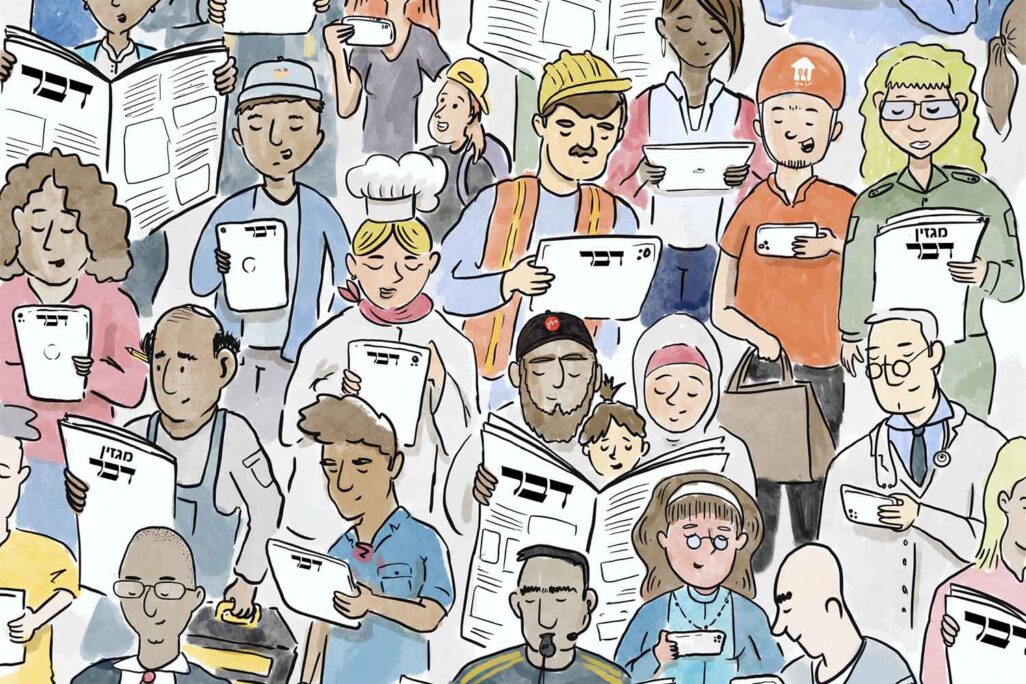
Ten years ago, on the morning of June 7, 2016, the news website Davar Rishon went live, later becoming Davar. The resources were modest, but the goal was ambitious: to revive a significant institution—a newspaper seeking to connect current events with the deeper values and ideas of Zionism, equality, and social justice.
A newspaper that aims to point toward the possibility of a better society, through labor unions, a just economy, social struggles, and solidarity.
The Histadrut, which leads unionization efforts across the economy and social struggles, chose to relaunch the newspaper it had published for 70 years, in order to bring a different voice into the public and media discourse. A voice advocating public investment and the expansion of social services, rather than chronic budget cuts; a voice promoting unionization, rights, and workers’ welfare, rather than ongoing attempts to undermine organized labor.
The voice of the workers, as the first editor, Berl Katznelson, wrote: “Not a newspaper for workers, but the workers’ newspaper.”
***
Since then, much has happened. At times, it feels like everything has happened. Five election cycles. A global pandemic. Deep polarization over changes to governing systems. The atrocities of October 7, the hostages, the wars in Gaza, Lebanon, Iran, and Yemen. A struggle over the democratic character of Israel, and a public sphere that is becoming increasingly violent. Russia’s invasion of Ukraine. A U.S. president reshaping the rules by which the world operates. Across the Western world, forces are emerging that challenge the existing global order.
In the midst of all these storms, Davar’s compass has had to be recalibrated again and again. Time and again, it has sought to find a way to tell the Israeli story, and to identify within it better and more just possibilities.
To expand into new areas of coverage, to find the right language, the right analysis, the right sources and the right hard questions.
To keep finding the people of the moment: the doctors, the soldiers, the families of the hostages; those who led labor organizing, fought discrimination, or initiated action for the public good; and those whose homes were hit by rockets, whose loved ones were murdered in criminal conflicts, who were fired from their jobs, or who fell victim to rigid and unresponsive systems. Residents of the Gaza border region and the North, evacuees from Tel Aviv, and those waiting for their relatives in Ethiopia.
To enter fields such as the state budget, constitutional law, public health, Shiite Islam, and the global dollar system. To understand the map of Gaza, Lebanon, Ukraine, Syria, and the Strait of Hormuz.
To give voice to the oppressed, the exploited, the marginalized, and the poor. To look directly at painful places. To critique, without fear, the centers of political and economic power. Not to become accustomed to injustice.
And to try to connect the difficult and demanding day-to-day reality with a vision that can still be pursued and acted upon.
***
These are significant tasks for a small newspaper. The path is long and at times difficult, but throughout this turbulent decade, Davar’s voice has been heard in the Israeli public sphere.
Thanks to the trust we have received from our readers, from the Histadrut and its members, and out of a belief that Israel can be better, we choose to continue the challenge of Davar.