


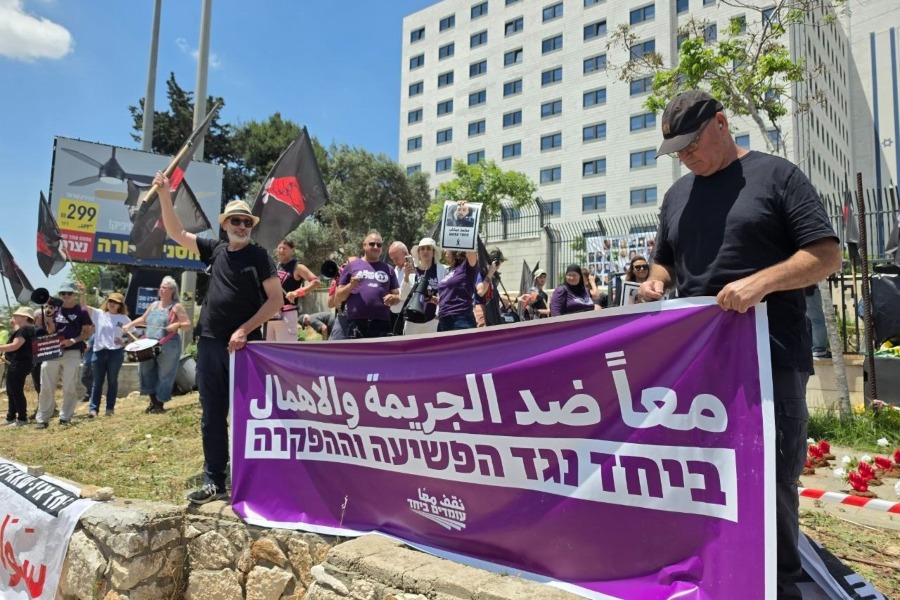
National attention and media discourse are currently focused on the security arena, but on the domestic front, the escalating crime in Arab society in Israel has not paused for a moment.
One of the most troubling issues in the public sphere in recent years continues to generate disturbing reports almost daily of shootings, extortion, armed violence, blood feuds, and organized crime, along with a growing sense of lost control and weakened governance.
Naturally, most criticism is directed at law enforcement authorities as the primary actors responsible for restoring security to the streets. However, the reality is far more complex. Crime does not emerge in a vacuum; rather, it is a multi-systemic phenomenon resulting from a combination of social, economic, cultural, and educational factors that lie at the heart of the marginalization processes experienced by Arab society in Israel.
Another source of influence, deep and highly powerful, that often seems not to receive the attention it deserves in public discourse or among decision-makers and policymakers is Muslim religious leaders.
In Arab Muslim society, which is characterized by a close-knit communal fabric, a deep connection to tradition, and strong intergenerational continuity, religion occupies a central place in both personal and collective identity. This is a collectivist society in which family, tradition, and religion play a significant role in shaping values, norms, and patterns of behavior.
In such a reality, religious figures have direct access to and influence over the formation of public consciousness, not only on the level of values, but also in practical matters. The words of an imam in a mosque or a respected sheikh are not viewed merely as moral recommendations; they are seen as carrying spiritual authority and, at times, even a binding force.
A Moral and Ethical Obligation
The power of religion stems from its ability to connect individuals both to God and to a broader moral and spiritual framework, linking everyday behavior to a system of laws and values. When a person believes that a particular action contradicts a religious commandment or the values of Islam, they fear not only the law or the police, but also moral, social, and sometimes even divine judgment.
For this reason, statements made in the name of religion possess enormous power to encourage or discourage certain behaviors. Although the influence of religious leaders is not based on formal enforcement powers, but rather on educational and communal authority, in many cases the public places greater trust in an imam or preacher than in official state institutions.
When religious leaders choose to speak out clearly against violence and the taking of human life, their message may resonate more deeply and have a particularly strong impact on young people who are searching for identity, belonging, and sources of authority.
Here lies precisely the great responsibility. As part of the fight against crime, in this time of emergency, Muslim religious leaders carry a moral and ethical duty to engage deeply with the problem of violence.
In mosques, religious lessons, and social gatherings, action must be taken through education, preaching, and community guidance, while emphasizing central values in Islam: the sanctity of human life, justice, social responsibility, respect for others, and the prohibition on harming the vulnerable.
When a religious leader succeeds in connecting these principles to the everyday reality on the streets of Arab society, and consistently reinforces them, they may reduce the social legitimacy of crime and strengthen the sense of communal responsibility.
Effective Mobilization of Religious Leadership
Alongside the responsibility placed on religious leaders, the state also has a fundamental role in shaping and directing this influence. The effective mobilization of religious leadership cannot rely solely on local initiatives, but rather requires an institutionalized and sustained effort as part of a systemic response.
The state should work to integrate religious leaders into prevention programs, train them as mediators and conflict-resolution figures, support educational activities, and create structured mechanisms of cooperation with local authorities and law enforcement agencies.
The role of religious leaders is not limited to moral preaching. In many traditional societies in the Middle East, religious figures also play an important role in conflict resolution and in preventing escalation.
The institution of “sulha” (reconciliation) is still considered a significant mechanism for resolving disputes between families, clans, and communities. At times, early intervention by an imam or a sheikh can prevent a situation from deteriorating into armed violence or interrupt an ongoing conflict before it enters cycles of revenge and criminality.
Their influence also stems from their deep familiarity with local culture, with ‘urf’, the local social tradition, and with the religious and emotional language that speaks directly to the heart of the community.
Precisely because religion hovers above the social structure of this community and provides it with meaning, religious leaders are expected to be active participants in the struggle over the character of Arab society in Israel.
Not to stand on the sidelines, but to lower tensions, reduce incitement, strengthen hope, and offer young people an alternative horizon to that offered by crime.
Ultimately, the fight against violence and crime cannot rely solely on increasing forces on the ground, targeted operations, and indictments. It is, first and foremost, a struggle over values, education, authority, and identity.
In this struggle, Muslim religious leaders hold real power—and they are now required to place it at the forefront and act in a visible, consistent manner, without fear or hesitation.
Dr. Avner Saar is an Islamic studies scholar and an expert in analyzing components of conflict resolution in the Middle East.