


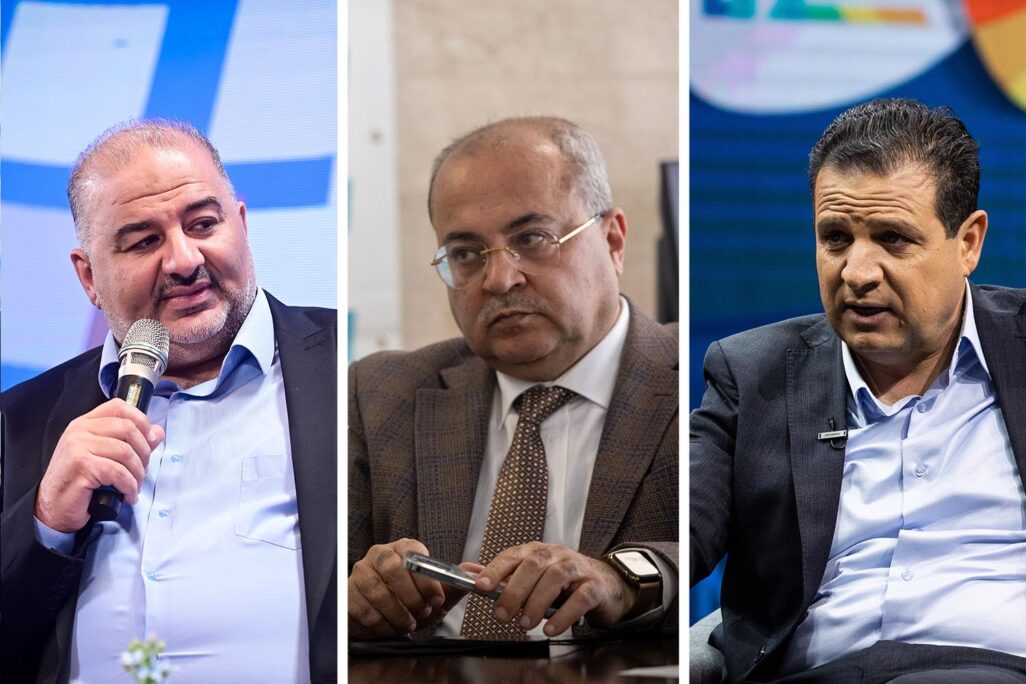
At least three Arab parties – Hadash, Ta'al, and Balad will run together as part of a Joint List, following the signing of the “Sakhnin Declaration” on 22nd of January of this year. The key question is whether Ra'am, which was one of the four signatories to the declaration, will also join the list. There are concerns within the party that if it runs as part of a technical alliance and later splits from it to join a government coalition, it will face condemnation and defamation from its partners on the list.
Ta'al Chairman MK Ahmad Tibi tells Davar that negotiations are progressing, but disputes remain. “We received the idea of a technical list, and then new issues emerged during the last meeting, which is why all sorts of statements in a different direction were made,” Tibi said, referring to the concern of Ra'am Chairman Mansour Abbas regarding the condemnation that would come from the Joint List if he were to split from it after the elections.
Alongside the uncertainty regarding Ra'am, the four parties that signed the declaration will face an additional challenge: a new Jewish-Arab party. The party, named ‘A Place for All of Us’ (Makom LeKhulanu), will be led by Rula Daood and Alon-Lee Green, who announced its establishment on Tuesday. Daood and Green are the leaders of the social movement ‘Standing Together’ (Omdim Beyachad), and the new party's website features the purple color identified with Standing Together.
The option for Ra'am to split after the elections has already been agreed upon
Professor Mustafa Kabha of the Reconciliation Committee, which is discussing the formation of the Joint List, stated that a decision regarding the nature and composition of the list will be made by the end of June. According to him, the actual establishment of the list has already been agreed upon, and what remains now is to determine the order of candidates and its leadership. Kabha added that the option for Ra'am to split from the list after the elections has already been agreed upon by the parties.
MK Tibi says, “I still think that the Joint List is the first, second, and third demand of the Arab public.” He warns: “Without a Joint List, Netanyahu's bloc will gain another two to three seats.”
“Our friends in the previous Joint List cooperated with Likud and with Shas.”
Shortly after Tibi’s remarks, Ra'am Chairman Mansour Abbas claimed that elements within the Arab society are damaging his party's reputation and the names of its MKs due to its willingness to join a government, even if it is a right-wing government.
In response to Davar's question regarding the unification issue, Abbas states that fundamental questions still remain concerning the political conduct of the other Arab parties. According to him, Hadash, Balad, and Ta'al, which formed the previous tripartite Joint List and intend to re-establish it, have cooperated in the past with Likud and Shas. He remarked, “We saw them sitting with Yariv Levin, Yoav Kisch, Ahmad Tibi, Sami Abu Shehadeh, and Aida Touma-Sliman, coordinating moves.”
Abbas claims that this cooperation ultimately led to the dissolution of the Knesset and the government. “It took them a year until they finally succeeded in eliminating the Knesset and dissolving the government," he says. "This is the fundamental question we are trying to raise: what will happen when a new government is formed? Will you go back to joining the right-wing opposition camp and cooperate to dissolve the Knesset and topple the government? It has become a sort of habit to dissolve every Knesset and break up every government. There is no purpose to this kind of politics.”
On the other hand, sources in Hadash, Ta'al told Davar that “Abbas cannot be surprised that people are talking about him, given that he entered a government with Bennett.”