



Every era is accompanied by a buzzword meant to encapsulate its most fundamental economic issue. In the Israel of 2026, that buzzword is "Israel's Trilemma." While this term hasn't yet become a household name, it is already steering the economic debate surrounding state budgets for the coming years. It pops up in presentations by Bank of Israel Governor Amir Yaron, as well as those by the Acting Director of the Budgets Department at the Ministry of Finance, Tamar Levi-Boneh. Esoteric as it may sound, this debate is shaping the future of the State of Israel.
So, What Is the Trilemma?
Linguistically, a trilemma is a problem with three alternatives from which one must choose. In this case, it consists of three distinct components:
- Public debt
- Standard of living
- The defense budget
The logic of the trilemma is simple: you can't have it all. If you want low debt and a high defense budget, you must raise taxes or cut public services. If you want the standard of living and the defense budget to rise, you are forced to expand the deficit and national debt. And if you want to safeguard the national debt without harming the standard of living, you have to ease up on defense spending.
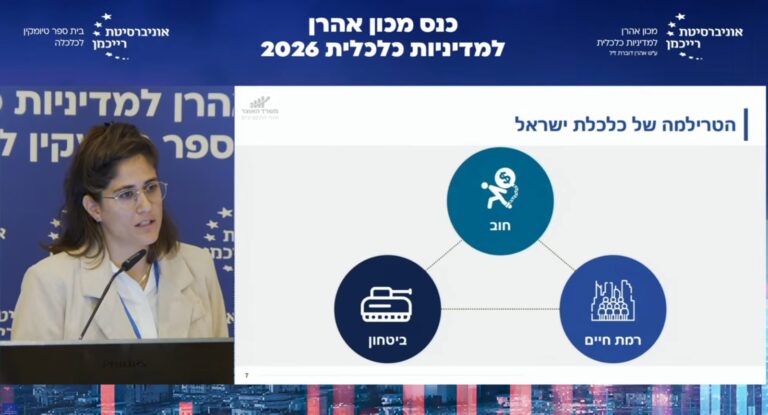
This is a new situation. One of the most consistent trends over recent decades was the shrinking weight of the defense budget, alongside drops in public debt and Israel's civilian spending. Since October 7, followed by the campaigns in Lebanon and Iran, security requirements have surged. Yet, following decades of conservative fiscal policy, civilian spending is already at rock bottom compared to Western nations. And thus, a trilemma was born. Allegedly.
The Trilemma Is Actually a Monolemma
Before diving into the depths of this problematic framing, a brief political analysis is in order: the sole purpose of the trilemma discourse is to provide a counterweight to the demands of the defense establishment. One can reach this conclusion simply by listening to the speeches, or through basic logic: public expenditure in Israel is at rock bottom with nowhere lower to go, and the Treasury and the Bank of Israel will never concede that national debt can be expanded.
In practice, given the absence of any real economic opposition, the only battlefield over the 2027 budget will be defense spending. Consequently, the trilemma is actually a monolemma—a dilemma with only one viable option (a real concept, even if a rarely used one).
And for those for whom logic isn't enough, Tamar Levi-Boneh explained at a conference held in late May at the College of Management: "The defense budget has spun out of control. We have entered a trauma economy. The next government will have to decide whether it continues with defense budgets of such insatiable volumes that almost completely ignore the Budget Law."
So, is the defense budget too big? Perhaps. The defense budget's share of GDP has indeed doubled. However, it remains a far cry from its relative size throughout most of Israel's existence up until the 1990s. While a methodology for defining the defense budget must be established, it is difficult to see on what basis Levi-Boneh determines it is too large. Is it relative to the security reference scenario? The status of ammunition stockpiles? The imperative to reduce dependency and develop local defense manufacturing? The next campaign against Iran? Or is it measured solely through a single metric—the defense budget's weight relative to GDP?
Israel is a threatened nation. One could just as easily argue, from the opposing view, that over the past few decades, the defense budget was actually too small.
Therefore, a serious, professional discourse must take place regarding the actual resources (not just the cash) that Israel must allocate to defend itself. In such a discussion, by the way, reserve duty days, which directly harm economic activity and the labor market, present a far larger problem than money. The other equations are equally complex. Good interceptors save buildings from being ruined. A strong military can avert protracted wars. A defense industry generates revenue; it doesn't just drain it. This does not imply handing out a blank check, but rather that we must foster a rational, multidimensional economic dialogue.
The Trilemma Is Actually an Ideology
This brings us to the deeper flaw embedded in the trilemma concept: its inherent ideological assumption. The trilemma is framed as a zero-sum game. On the surface, it looks like flawless logic—three interconnected numbers that must be balanced against each other. That might hold true from an accounting standpoint, but a national economy does not function that way.
The State of Israel is not a household that needs to balance its income and expenses, nor is it a business trying to balance its books. Forcing it into this rigid box stems from a neoliberal doctrine. This view fails to see the state as a proactive engine that pursues goals and shapes the rules of the game, treating it instead as just another market player that must bend to market conditions.
The debt burden, the sheer volume of expenditure dedicated to interest payments, is certainly a factor to consider, but it is merely one of many. A country's success hinges on its capacity to deliver quality services to its citizens, steer an economy capable of global competition, drive technological innovation, and more. This is the true guarantee, both economic and intrinsic, for its long-term survival and prosperity.
Israel could, for instance, decide to transform the Upper Galileee into a technological hub. It could establish conditions that generate high-quality jobs in the region, boost regional tax revenues, and minimize transfer payments. Spend money to make money. It could build a high-quality transportation grid. It could invest heavily in artificial intelligence infrastructure to amplify domestic labor productivity. It could train more doctors to shorten wait times and prevent unnecessary mortality.
The state's objective is not to net out a balance sheet, but to reinforce its economic, social, cultural, and security resilience—of which the debt structure is merely a single component. This is a bean-counter mindset, perhaps fit for treasury clerks, but one cannot pretend to pilot a nation's economy using it.
"Growth is the scoundrel's refuge," Levi-Boneh remarked at that same conference, "because people claim that growth will deliver the solution to debt and interest problems. Without deep structural steps, you won’t see growth. Growth is low, and what we see in the stock market is just expectations and hopes."
But growth is not a scoundrel's refuge—it is the ultimate strategy for lifting the standard of living in Israel. It underpins education, healthcare, and welfare; it is the very vehicle that allows the state to stride forward. The discourse meant to guide the Israeli economy through these intricate times cannot be managed through the simple lens of a checking account ledger.