


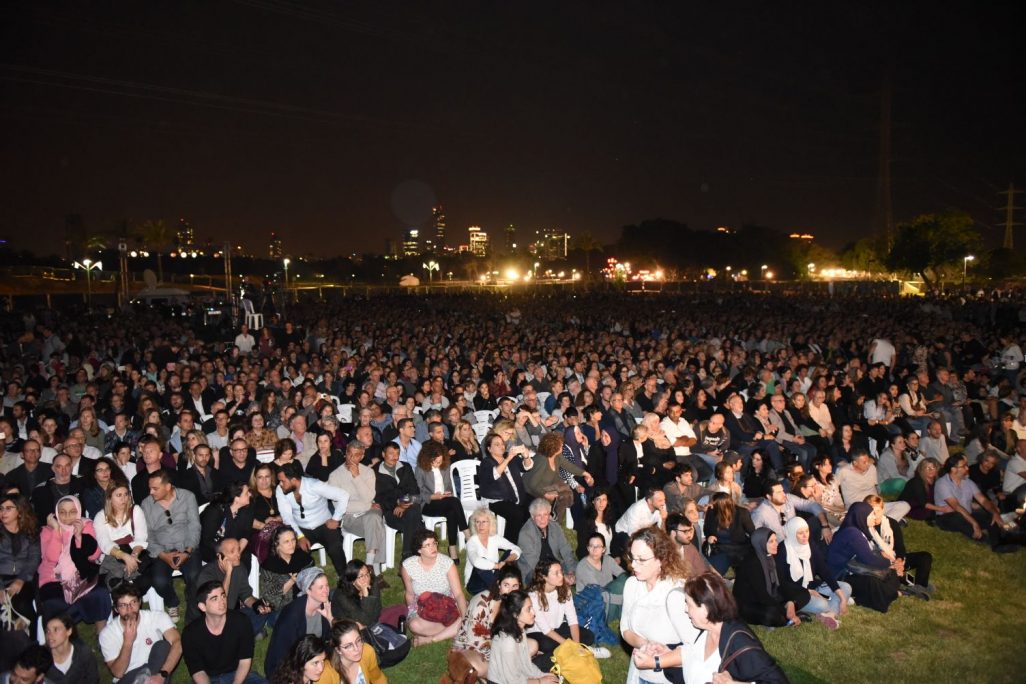
The District Court decided this week to overturn the disqualification of the Israeli-Palestinian Bereaved Families Forum's program, ‘Dialogue Meetings: From Pain to Hope,’ from the database of approved programs. This is the second time in the last two years that the District Court has made such a decision, striking down an attempt by the Ministry of Education to prevent the Forum from operating in schools. The court also ruled that the Ministry of Education must pay the Families Forum 20,000 shekels in legal fees.
In the ruling, Judge Avraham Rubin stated that part of the education system's role is to engage with complex and controversial issues. He thereby rejected the Ministry of Education's claim, according to which the program is unsuitable for students due to its reference to “sensitive events in Israeli public life in a manner that is not adapted to the target audience.” The judgment further stated that the program focuses on the pain of bereavement and the possibility of dialogue, rather than on the rejection of IDF service or the legitimacy of the State of Israel.
Minister of Education Yoav Kisch criticized the decision. “The court is seeking to force the Ministry of Education to admit an organization of terrorists' families into our children's classrooms,” he said. “The decision to compel the Ministry of Education to allow the Palestinian Bereaved Families Forum to enter schools is scandalous and despicable.”
The petition against the disqualification was filed by the Association for Civil Rights in Israel, alongside the Families Forum itself. Joining the Ministry of Education's position as respondents were the 'B'Tsalmo' organization, the 'Choosing Life (L’fror B’chaim)' Forum, and bereaved parents, including Talik Guili, the mother of the late Master Sergeant Ran Guili, who fell on October 7th and whose body was abducted by Hamas; and Herzl and Merav Hajaj, the parents of Lieutenant Shir Hajaj, who was murdered in the ramming attack at the Armon Hanatziv promenade in 2017.
The Bereaved Families Forum is an association that brings together Israeli and Palestinian parents whose children were killed as a result of the Israeli-Palestinian conflict. Its activity in the Israeli education system includes meetings between high school students and both a Palestinian bereaved parent and an Israeli bereaved parent, and has been conducted for about twenty years in schools that choose to do so. Since the 2022-2023 academic year, the Forum has operated within the framework of the Gefen program database.
The Gefen program database is the budgetary program for schools' external activities. Each school principal can choose an activity from an approved database of programs, using a dedicated budget allocated by the Ministry of Education. The database includes thousands of programs from organizations and non-profit organizations that were accepted into it through a tender process. Part of the admission requirements for Gefen is a commitment that the activity aligns with the goals of state education, as defined by law.
Kisch claims that Judge Rubin is in a conflict of interest
According to Kisch, the Forum's victory in the petition was a foregone conclusion, since the judge presiding over the case, Avraham Rubin, was in a conflict of interest. Rubin himself testified to the conflict of interest and had even recused himself from ruling on the matter in the previous petition on the subject.
The conflict of interest in question is that Rubin's wife serves as a board member at a school in Jerusalem, which hosted a support event for the Families Forum. The Forum regularly conducts workshops at that same school. The decision to recuse Rubin in the previous petition was made following a request filed by Kisch and the 'B'Tsalmo' organization. With the second petition this past January, an appeal was filed against the conflict of interest decision, and Supreme Court President Yitzhak Amit ruled that Rubin could preside over the trial.
CEO of the Families Forum: We will continue to enter schools with our heads held high
Ayelet Harel, co-CEO of the Families Forum, who lost her brother in the First Lebanon War, defined the ruling as “a victory for the rule of law, for freedom of expression, and for those who believe in education for peace, dialogue, and hope.” According to her, the stories of bereaved families do not pose a threat to students, but rather 'an educational opportunity for listening, reflection, and choosing life. We will continue to enter schools with our heads held high.”
The Association for Civil Rights in Israel: “It is permissible to say ‘occupation' and to criticize IDF activity in the West Bank; students are not a captive audience, and the pain of bereavement experienced by Palestinians is in no way different from the Israeli one. The education system is not an arena for re-education that conforms to the nationalist, racist, and narrow-minded worldview of Minister Kisch.”
The court: The Ministry of Education lacks a factual basis
The petitions and the subsequent legal discussion are quite similar to the previous petition. In response to the petition, the Ministry of Education argued that in the Forum's meetings, “statements are heard that portray IDF soldiers as harming innocents.” The ministry claimed that parts of the program undermine the legitimacy of the military and the state. Similar claims were presented in the first petition, where it was additionally claimed that some of the casualties from among the Palestinian families were Hamas terrorists.
As in the first petition, the court ruled that the Ministry of Education did not prove its claims. In the current ruling, it was stated that: “The respondents did not have a proper factual basis before them that would allow them to make an informed decision on the matter.”