


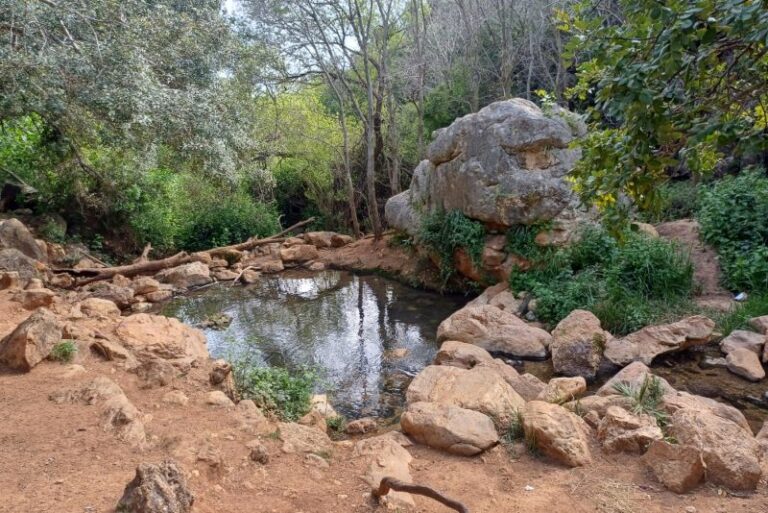
Anyone hiking in Nahal Tzalmon National Park will encounter breathtaking scenery, peaceful surroundings, and ancient flour mills. But one thing stands out by its absence: the stream itself.
Descending from the upper parking area at the entrance to the reserve, visitors will not find even a trickle of water flowing through the channel. Only after walking about 300 meters does a small flow appear, but even that is expected to disappear completely in the near future. The natural spring that once fed Nahal Tzalmon has almost entirely diminished over the past two decades, leaving behind a broad and largely dry riverbed.
Further downstream along Nahal Tzalmon, however, the picture has changed dramatically over the past year. A few kilometers east of the nature reserve, near Kibbutz Ginosar, the morning silence is broken by the constant sound of running water. Along the stream, now green and lined with vegetation, early risers stroll beside the flowing channel. “For years it didn’t flow at all, not even in winter,” one walker tells her companions.
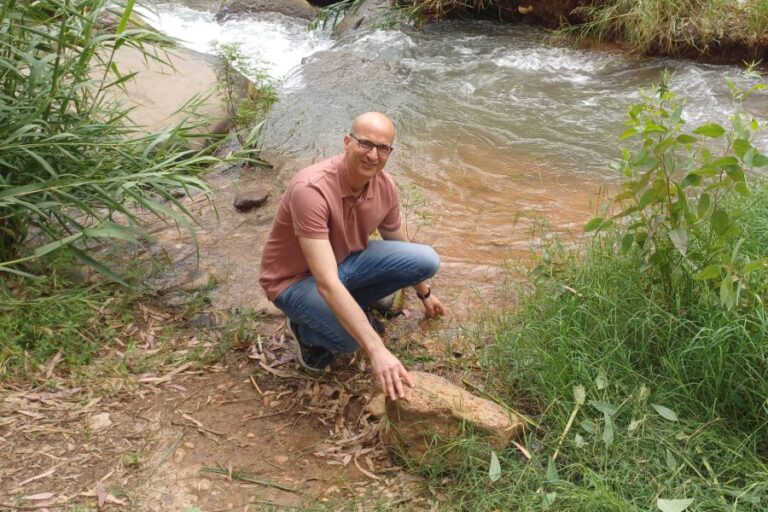
At the entrance to the kibbutz, beside a favorite sitting spot overlooking the water, stands Raviv Levy, a veteran water engineer and manager of Israel’s Water Innovation Community. “This is essentially the only pipeline in the world that a country has built specifically to return water to a river and a lake,” he says with restrained excitement, watching the stream flow past. “And the amazing part is that the ecological restoration of the stream is only a small part of the benefits.”
Levy has known the stream for many years. “I was born in Eilon in the Western Galilee. When my wife and I, she’s also from the north, were looking for a home, we came to Masad, which sits upstream along the stream. That was twenty years ago,” Levy recalls. “Since then, and until two months ago, I had never had the chance to see the stream flowing continuously.”
Bringing Water to the Kinneret, and Reviving the Stream
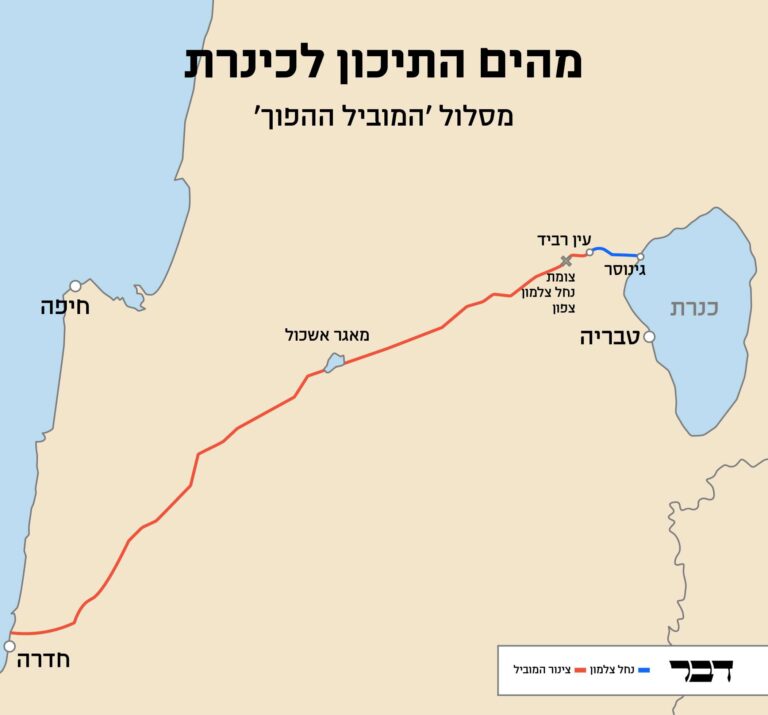
The restoration of Nahal Tzalmon is part of a much larger project known as the “Reverse National Water Carrier.” The project, led by Israel Water Authority and implemented by Mekorot, connects the Galilee to Israel’s national water system by transporting desalinated water from the Mediterranean Sea to the Sea of Galilee.
The water travels through pipelines from the area of Hadera and is discharged into Nahal Tzalmon. Thanks to the project, the stream has resumed flowing, carrying the water onward into the Kinneret. In effect, the system creates a route that reverses the direction of the traditional National Water Carrier, which historically pumps water from the Kinneret and transports it south toward the Tel Aviv metropolitan area and other parts of the country.
“When the state was founded, it had a very advanced vision, to bring water from where there is plenty of it, in the north, to the center and the Negev, where there is none,” explains Levy. “Today, thanks to desalination, the north is precisely the place that lacks a system that supports its rivers and springs. This is very important for us, residents of the eastern Galilee, who until now have essentially lived on rainfall and springs. Paradoxically, we were the ones without what is called ‘climate water security’ in cases of drought.”
“Therefore, Mekorot decided that water should also be returned to the Kinneret,” he says, “in order to store surplus desalinated water, and along the way revive both the Kinneret and the stream.”
Although the water could have been discharged directly into the Sea of Galilee, Mekorot chose instead to route it through the dry stream that leads into it. “There were those who said it was a shame, because some water would be wasted and evaporate. But ecological responsibility, and even aesthetics, is also part of the state’s responsibility,”
About 2 kilometers from the interchange, the clear stream begins to flow.
Higher than Kibbutz Ginosar but lower than the national park area, sometimes referred to as “Upper Tzalmon”, lies the middle section of Nahal Tzalmon, which runs from the Tzalmon Interchange near Kibbutz Ravid down toward Ginosar.
At the beginning of the route, hikers are greeted by a small directional sign reading: “To the stream’s flow.” Unlike the well-maintained and popular national park section, this route is wilder and somewhat neglected. Over its first two kilometers there are indeed beautiful views, but also muddy ground, swarms of flies, and the main companions along the way are a considerable number of cows. As in the national park, the stream here is still not flowing.
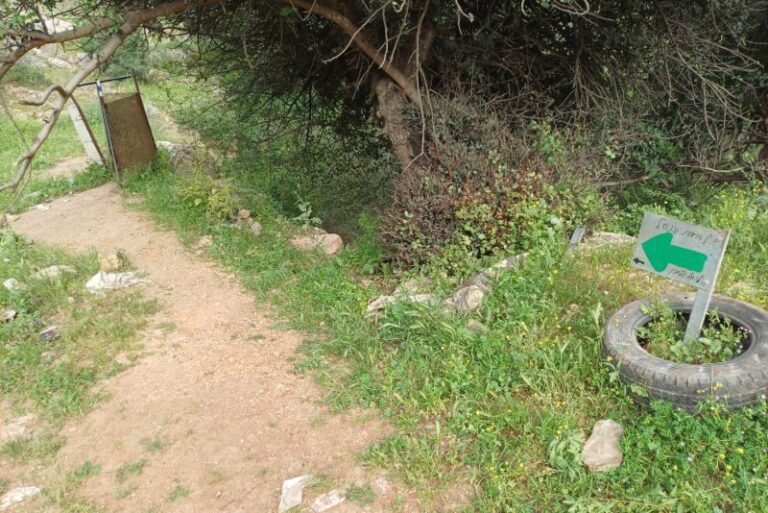
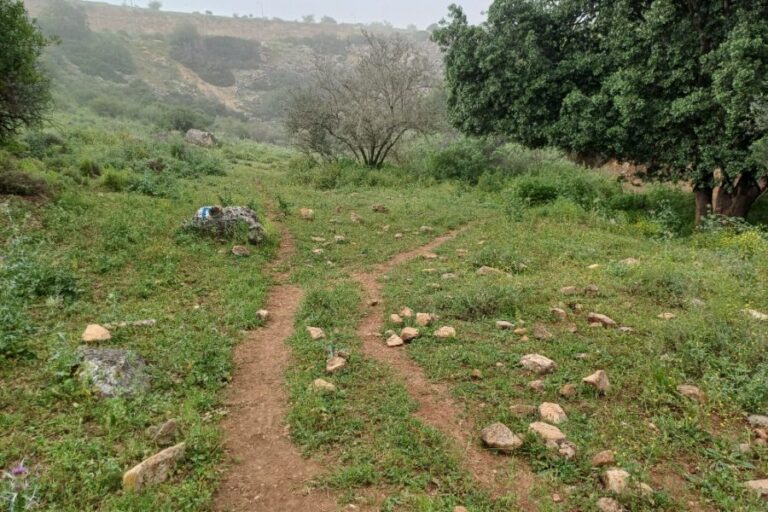
But for those who manage to overcome the rough start, a reward awaits: the spring point of the Reverse Water Carrier.
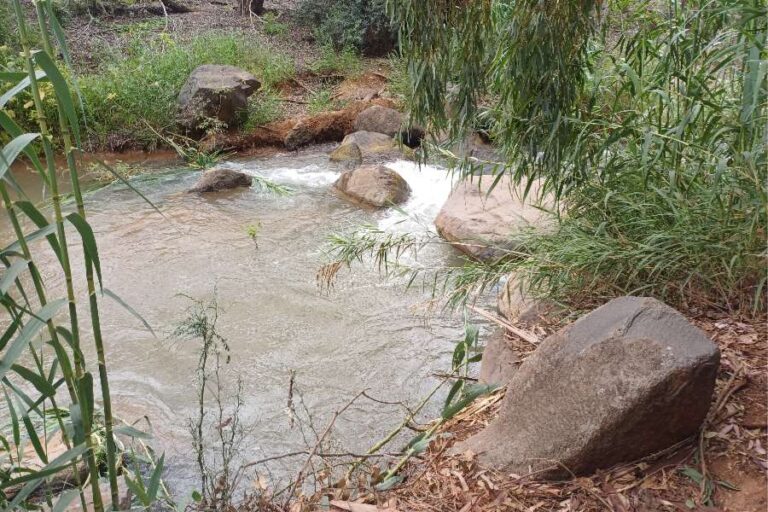
From a distance it sounds like nothing more than wind. But after leaving behind the low branches and mud, and passing a fenced wheat field, the sound grows stronger. When you step off the trail into the center of the channel, it suddenly happens: a powerful roar of water pouring out, and a clear stream, narrow but fast and turbulent, that returns to flowing forcefully through the channel of Nahal Tzalmon.
The water emerges from metal steps, on which a sticker is affixed reading: “Everything happens for the good,” in memory of Almog Sarusi, who was abducted to Gaza and killed while in captivity.
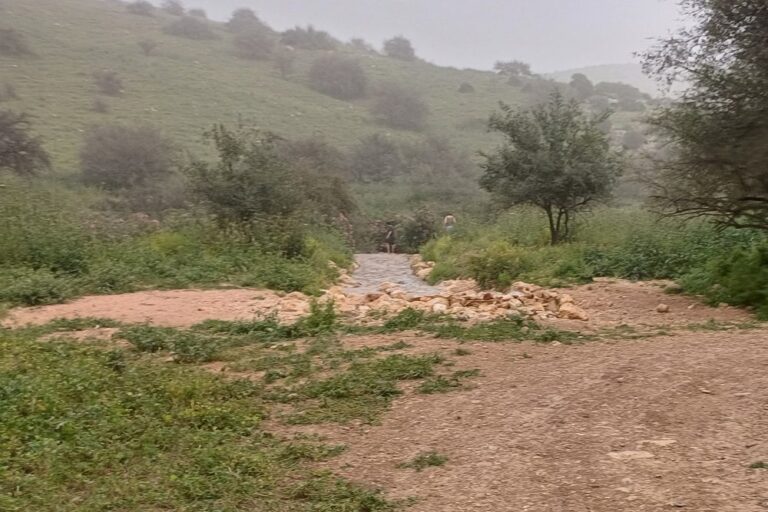
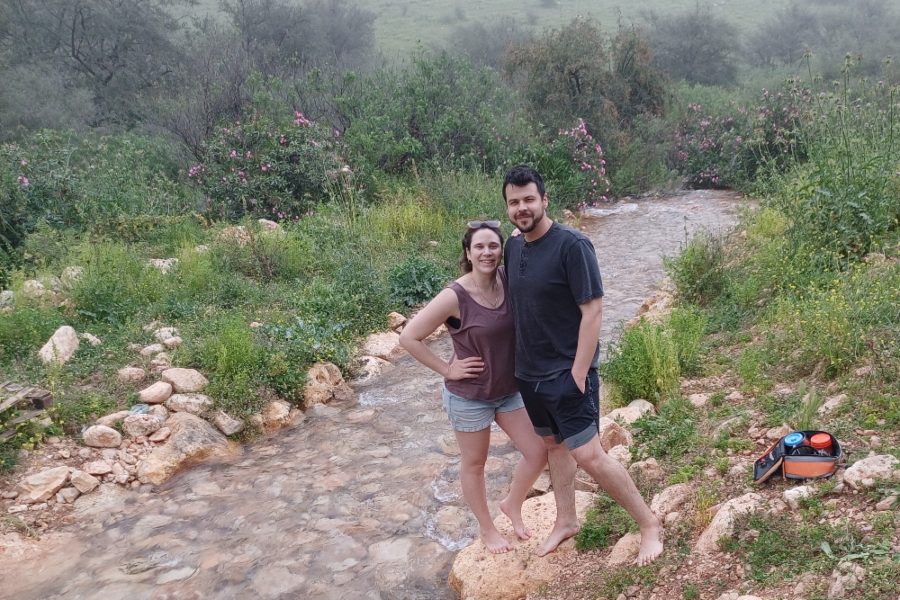
Around them there is hardly anyone. But among the pink and beautiful flowers growing nearby, Noga Kristal (38) and Dani Gins (34) are spending a quiet, almost reflective time together. “We came here because of her uncle,” says Gins. “He works in a water engineering company and told me they built something amazing here.” Kristal smiles broadly, clearly reluctant to leave: “It’s surprising there’s no one here. We’ve been here for more than two hours and haven’t seen a single soul,” she says. “It’s beautiful here, and the water is pleasant.” And indeed, unlike typical spring water, the stream here is cool, but not freezing.
The two, incidentally, did not arrive here from the Tzalmon Interchange, but via a shortcut that passes through the water reservoir near Kibbutz Hukok. According to Gins, “It brought us here in just a few minutes.”
Clear, transparent water, consistent with desalinated water, now flows through Nahal Tzalmon.
“Truthfully, no one yet knows what the implications of this are,” explains Raviv Levy. “Since this is the first time in the world we are doing something like this, we are waiting to see whether it harms the ecosystem, or actually benefits it. After all, this is desalinated water, which is slightly less saline than water coming from natural streams, so it might even reduce the salinity of the lake.”
Desalinated water is already widely used in Israel, both in agriculture and as drinking water. “Today, more than 60% of our drinking water comes from desalination. That means our water economy contains more desalinated water than pumped natural water,” says Raviv Levy.
“People abroad always tell me it’s a waste, these are the most expensive waters. I explain to them that it’s only a waste if you have an alternative. Look at neighboring countries, where there isn’t water every day of the week. We don’t have that problem.”
Israel is considered a global leader in water management and desalination. Today, six major desalination plants operate in the country, with a seventh currently in development. Israel also effectively functions as an exporter of water to its neighbors.
The peace agreement with Jordan, for example, includes a clause under which Israel commits to selling Jordan 50 million cubic meters of water per year, a figure that has increased over time to roughly 100 million cubic meters. “And this is expected to grow further in the coming years,” says Levy. “It is an inseparable part of the peace agreement, and of the concept of genuine cooperation.”
“There is something new here, that didn’t exist before”
The trail along Nahal Tzalmon continues downhill, this time running right beside the flowing stream. Although the channel is wide and full of fresh vegetation, there are sections where there is no direct access to the water.
Those looking for an easy family-friendly route can drive between the banana greenhouses of Kibbutz Ginosar and reach a simple entrance to the blue-marked trail. Here, near the Israel National Trail, more hikers can be found.
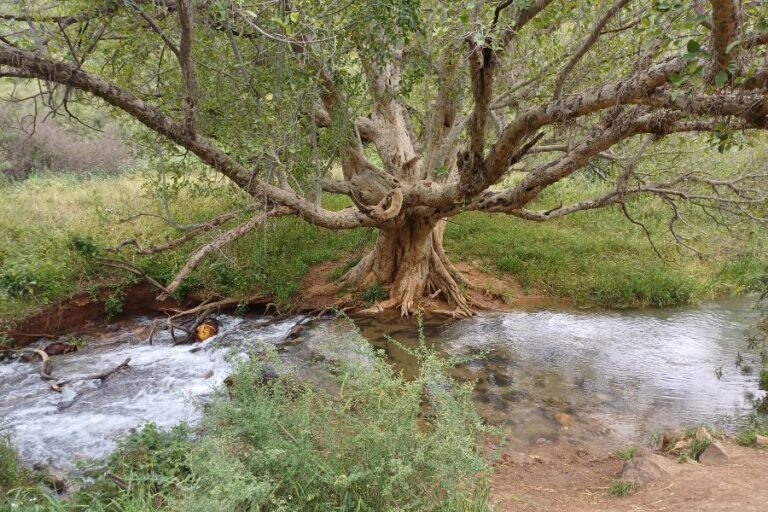
Along most of the route the stream is relatively deep, but it is also possible to walk alongside it. After a few minutes upstream, a stunning spot appears: a large tree whose roots slow the flow of the stream before it spills forward into a small waterfall.
On the nearby bank, a comfortable descent opens into a small clearing, where shade and roots create an inviting wading area, hard to imagine that just a year ago it was completely dry.
“It’s been on my list for a very long time,” says Tuvy Shavit (55), as he begins the trail with his partner Hadas Gain. “When I heard it opened up, I said—okay, I’m already in the north.”
Shavit and Gain, who arrived from the Sharon region, say they are used to much tougher hikes. “I’m more of a desert person,” Shavit adds. “I go off-trail, with aerial photos and terrain analysis. And here you have something new, something that didn’t exist before.”

“There’s a book by Meir Shalev, In His House in the Desert, in which the main character is a worker at Mekorot,” says Shavit. “He discovers all these places, and he also has his hidden ‘backyard’—a real place that exists in the Negev. Nobody really thinks about it, but all the people who were first in all these remote corners were always employees of the Electric Company and Mekorot.”
“I remember the presentation I prepared for everyone when we started the project,” says Ziv Cohen from Mekorot, “I’m very much an engineering-minded person, but I also draw and sculpt, and I put a lot of visual and creative elements into the presentation because it was important to me that everyone would be as excited about it as we were.”

Ziv Cohen, 51, from Ramat Yishai, was responsible for building the water carrier, and it is clear he is deeply moved by the project. “There was a lot of responsibility in it, and also a lot of big words—Zionism, water security, care for the Land of Israel. I knew I would do it.”
“I’m originally from Beersheva,” he says. “I’ve always been passionate about water, and I started working in water companies in the south. When I was offered a job on the National Water Carrier, I was excited. It’s a huge project, even from before the founding of the state, with so much importance and legacy. I decided to take my wife, and we moved north because I wanted to be fully involved in it. That’s how we ended up in Ramat Yishai. I didn’t know that later on, I would be asked to build the Reverse Water Carrier.”
“During the work I was constantly in the field. We worked with environmental organizations, with tough farmers and with fellahin, and to all of them you have to explain why this is an important project, how it protects the Kinneret, how it benefits the environment,” says Ziv Cohen.
“For me, reviving the stream is more than reviving ecology. In Upper Tzalmon there are 24 old flour mills. In today’s terms, it was a real industrial zone. I have a dream that some of them will be revived—that a school for water power will be built there, maybe even a turbine.”
And what did the project manager do when he first arrived at the flowing stream?
“I jumped straight in and swam. There’s no feeling like it.”
With strong flow conditions, the water level of the Sea of Galilee could rise by half a meter.
At this time of year, in spring, the water in Nahal Tzalmon reaches almost waist height in the narrower sections of the channel. But Raviv Levy explains that such a flow is not expected year-round, because the amount of desalinated water fed into the Reverse Water Carrier varies.
“The pipeline carries surplus desalinated water,” he says, “but it only operates when there are surplus reserves. In the summer, or during dry winters, it will carry less.”
Although the pipeline is capable of transporting up to 15,000 cubic meters per hour, until two months ago only about 1,000 cubic meters per hour were flowing through it, due to constraints in the desalination system. “At the beginning of winter, after repairs at the desalination plants were completed, it was operated at a capacity of 5,000 cubic meters,” says Levy, “but it won’t stay like that into the summer.”
“Flowing such quantities of water,” says Raviv Levy, “is expected to significantly affect the level of the Sea of Galilee. We are talking about a range from a few centimeters per year in low-flow conditions, to almost half a meter under strong flow.”
However, he emphasizes that even the use of desalinated water itself helps preserve the lake’s level. “Sometimes it is simply better to use it, rather than pump water from the Kinneret in the first place. The contribution of desalination to the Kinneret through reduced pumping is on the order of four meters per year.”
According to Levy, “The Kinneret functions like a kind of water battery. We inject water when we have surpluses, and extract it when there is a shortage. And the decision to store it there is based on responsibility for its climate balance.”
Staying at the forefront of water innovation
The National Water Carrier, whose construction was completed in 1964, is one of the early technological visions of Zionism, and like the Reverse Water Carrier, it was the first of its kind. It was built to transport water from the Sea of Galilee through the coastal plain to the northern Negev, in order to “make the desert bloom.”
According to testimonies from members of the British Peel Commission in the 1930s, which recommended partitioning Mandatory Palestine between Jews and Arabs, the plan left such a strong impression on them that it became a major factor in their recommendation to include the Negev within the Jewish state. The National Water Carrier was built, from its earliest days, by Mekorot, which was established by the Histadrut, the Jewish Agency, and the Jewish National Fund.
“Today, we feel we are at a world-leading level in the water sector, and that is truly correct,” says Levy. “This happened because we understood our challenges, and dealt with issues that other countries are only beginning to face today.”
At the same time, he warns against complacency. “It is important that we do not rest on our laurels. Although the Israel Water Authority and Mekorot are the only bodies in the country with plans extending to 2050 and 2075, we must not neglect technology. Many countries today are where we once were. If we do not continue investing in developing this field, like in high-tech, we will not be there when they come to buy.”
The lower section of Nahal Tzalmon: the final kilometers toward the Sea of Galilee
After the orchards, the Tzalmon flows through a wide channel filled with reeds, then under a bridge and into Kibbutz Ginosar. There, it forms the northern boundary of the kibbutz.
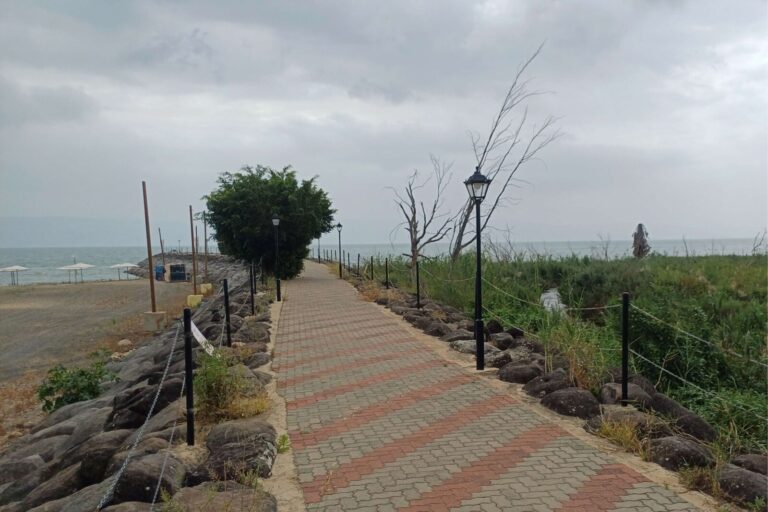
On one side lies nature, rees and abundant vegetation. On the other, an old walking path, partly cracked but lined with welcoming seating areas, accompanies the stream in the final stretch of its journey to the Kinneret. A pleasant-looking bridge crosses it, giving the kibbutz children access to the nearby grove.
Further along, roughly halfway to the Sea of Galilee, someone chose to build a futuristic-looking glass-covered tennis court, whose music and appearance feel out of place in the landscape.
But apart from that point, the path winds alongside Nahal Tzalmon all the way to a long breakwater. From there, walkers can look out over the final stage of the water’s long journey, from the Acre region all the way to the Kinneret, where it flows into the small inland sea.
“Maybe this alone won’t save the Kinneret,” says Raviv Levy, “but it shows how much we think about our water reservoirs, and how we take care of them.”