
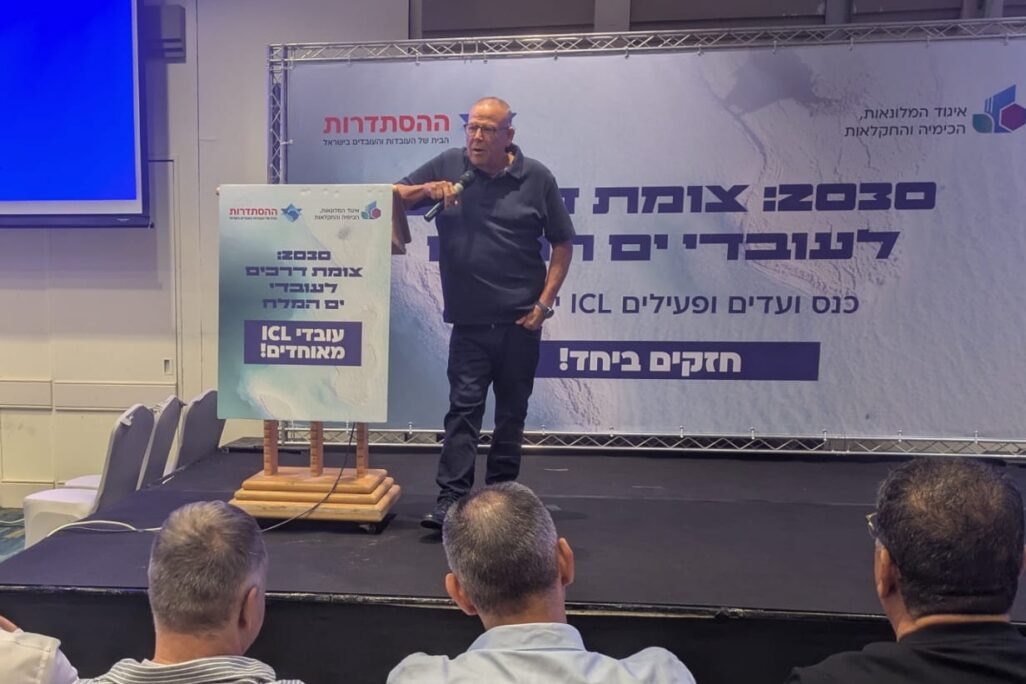
"We have enough problems in the north, we don't need to stir up employment problems in the south as well," Histadrut Chairman Arnon Bar-David said on Wednesday at a conference of the ICL Group (formerly Israel Chemicals) committees held at the Dead Sea. Bar-David added: "We will do whatever it takes so that these plants continue to provide a dignified livelihood for the people living in this region."
The conference was organized as part of the committees' preparations and the establishment of a headquarters to safeguard workers' rights in light of the advancement of the Dead Sea Concession Bill Memorandum.
"You work here day in and day out, hard labor in heavy heat, realizing the potential of this vital national resource—the Dead Sea," Bar-David said. "These plants provide an island of employment and stability for a great many families in Arad, Beer Sheva, and Dimona. We came here to tell you that the Histadrut will continue to back you and cover you in whatever is needed."
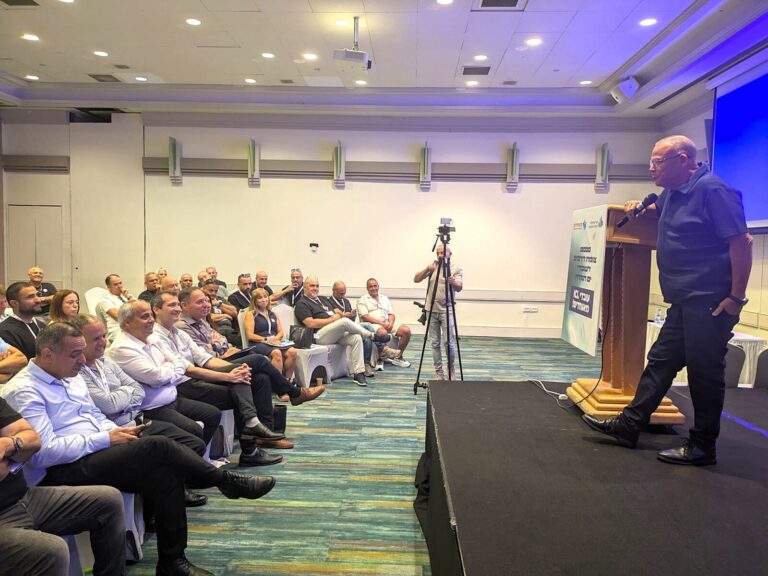
The conference was initiated by the Hotel, Chemistry, and Agriculture Workers Union in the Histadrut. The union's chairman, Rom Dvir, criticized the Treasury for pushing forward the legislation of the Dead Sea Concession Law before the clauses concerning the protection of workers' job security and working conditions have been completed. "The ICL Group employs about 30,000 workers, 42% of whom live in Dimona and 38% in Beer Sheva," Dvir said.
"We are not ashamed of the excellent collective agreements that the labor leaders here have secured over the years. These agreements reflect the hard work the employees perform and anchor the middle class in the Negev. These agreements bring a dignified livelihood to thousands of families who shop in the supermarkets of Dimona and Arad and drive the Negev's economy. Does the Treasury want only poor people in the south? Only hewers of wood and drawers of water?"
Dvir also raised concerns that concession terms that do not allow for profitability will harm workers' conditions and, as a result, the attractiveness of the work: "Who will agree to work here in 50 degrees celsius, with the long commutes, under degraded conditions? Then the state will do what it did in the hotel, industrial, construction, and agricultural sectors—claim that Israelis are unwilling to work hard and bring in foreign workers, or open a border crossing here for Jordanian laborers, instead of the Israeli middle class that currently earns its living from Israel's natural resources. We will not allow this to happen."
The Mayor of Dimona, Benny Biton, shared that his father was among the first ten employees to work at the Dead Sea Works in 1952. "For many years I have been saying that if there is no Israel Chemicals, there is no Negev. I haven't seen a demonstration of power like this in many years, and I am moved to see all the committee members joining hands in one room. I want to tell you that the local authority heads in the Negev will all stand behind you along with the Histadrut. We will not allow any harm to come to the workers who are our backbone, and if necessary, we will shut down the entire State of Israel."
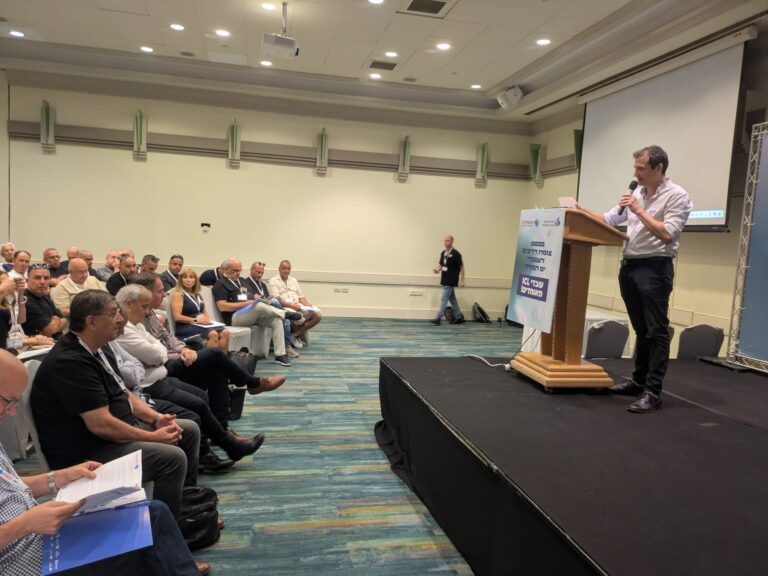
Acting Histadrut Chairman and Head of the Histadrut's Liaison Bureau to the Knesset, Roy Yaakov, emphasized that the partnership between the Histadrut and local government is an alliance that strengthens workers in Israel: "When the committees from ICL came to speak with me, I discovered how much they care and how important it is to them that this management and these owners, with whom labor relations are excellent, receive the concession. The committees here sit around the table and achieve results.
"I promise you: the bill memorandum written by the Treasury will be changed. There will be no such thing as a concession changing without a solution for the workers, and we will do everything possible so that the current owners are also the owners who continue. This process will have to pass through the Knesset, and in the Knesset, the Histadrut has power because it represents the workers in the State of Israel."
"Israeli Governments Mostly Know How to Liquidate Local Industries"
The Chairman of the Economics and Strategy Division at the Histadrut and CEO of the Trade Union Division, Adam Blumenberg, presented the Histadrut's position regarding the concession bill memorandum. He clarified that the Histadrut demands the regulation of workers' rights as a condition for advancing the law, while involving worker representatives in the process, including issues of continued employment and the preservation of rights and agreements; ensuring economic viability for the concessionaire so it does not come at the expense of employment volume and worker conditions; allocating the concession to a single entity and anchoring the concessionaire's responsibility toward downstream plants—the Bromine Compounds plant in Ramat Hovav and the Dead Sea Periclase plant; and maintaining R&D activity in Israel.
Furthermore, Blumenberg clarified that the Histadrut opposes restricting water pumping at Israeli plants while the Kingdom of Jordan significantly expands water pumping at its competing plants, without regional regulation of the matter. "Regrettably, Israeli governments throughout generations mostly know how to liquidate local industries without looking at the surrounding implications, the result of narrow-minded thinking in the Treasury," Blumenberg said. "There is no understanding that a narrow view of squeezing out another shekel of profit for the state treasury could bring devastation to the region. On behalf of the 850,000 Histadrut members standing behind you, I tell you, this will not happen. If necessary, we will set the country ablaze. This struggle is not yours alone."
"Sitting here is a forum that can win any war," said Negev Region Chairman Norbert Bukobza. "I tell you, if they try to harm you, the entire Negev will be closed. There will be solidarity here because this is the pearl of the Negev. There are widening circles that make a living from ICL plants, and we will not allow them or the workers to be harmed. The very fact of our gathering today shows that we are alert, determined, and above all, united. Arnon has made sure throughout his entire term to emphasize the importance of maneuvering between diplomacy and power. I sincerely hope a solution can be reached through dialogue and discourse. But if not, the state needs to remember that we also know how to wage battles."
Central Negev Deputy Region Chairman, Itzik Nefesh, added: "I see the heads and members of the committees here, who lead organized labor on a daily basis, and this is truly a hour of testing. Every condition and clause in the ICL agreements was achieved through blood, sweat, and tears, making your workplaces coveted, good, and worthy. We will not allow organized labor in the Negev to be undermined."
"An Industry That Provides Jobs and Quality Livelihood"
ICL Group President and CEO, Elad Aharonson, emphasized that "at the end of the day, you look at what we have been doing here for decades: an industry that provides jobs and quality livelihood. For it to be stable over the years, it needs to be profitable."
According to him, the group is a public entity, where for every shekel it earns, about 80 agorot go to the general public of small investors and pension savers: "When people talk about the next concession needing to remain with the people of Israel, this is the people of Israel. Sustainability is a balance between environmental, economic, and social factors. I hope the Treasury understands that the next concessionaire will need to make a profit—whether it is us or another concessionaire, and I hope it will be us.
"Alongside important environmental considerations, we need to create a situation where the next concessionaire can run a competitive business. The average wage of the Jordanian company is between an eighth and a tenth of the wage in Israel, and I am proud of the wages I pay my workers. We must ensure that the concession terms mandate the employment of Israeli workers. But this is the business environment in which we compete. The State of Israel needs to manage these relations vis-à-vis the Jordanians as well, because it cannot be that we are downsizing while they are growing."
A Dramatic Change in the Balance of Power Between the State and the Future Operator
The Dead Sea Concession Bill Memorandum is a government legislative initiative led by the Ministry of Finance alongside other ministries, aimed at regulating the future of industrial activity and national resources in the area in advance, ahead of the expected expiration of the ICL Group's current concession deed in March 2030.
The purpose of the move, which is currently undergoing legislative and approval processes, is to establish the legal framework and conditions for the new international tender that will be launched toward the end of the concession. The proposed version drives a dramatic shift in the balance of power between the state and the future operator: it anchors mechanisms to increase state royalties from mineral extraction (such as potash and bromine), and imposes unprecedented environmental obligations on the tender winner, including active responsibility for damage restoration, coastal protection, and regulated management of water levels and sinkholes.