
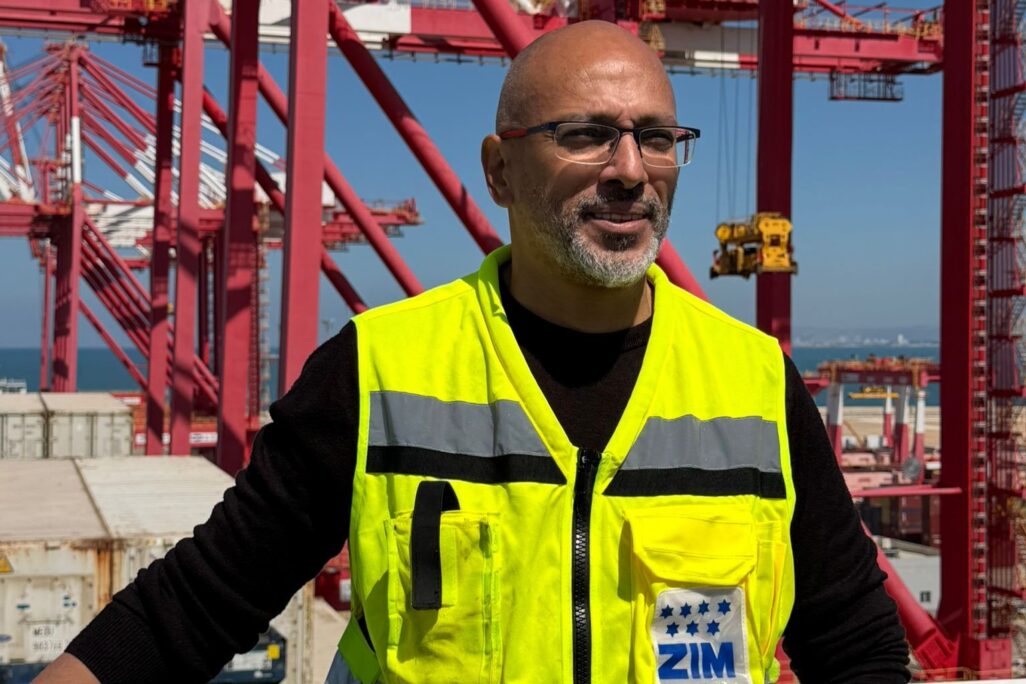
“The Qataris are taking over assets, just like in the rest of the Western world," explains the chairman of the 'ZIM' workers' union, Oren Caspi, regarding his opposition to the sale of the company. “The Qataris have a sovereign wealth fund, and that's how they take over universities in the United States and Europe, as well as soccer teams. In Israel, they are using it to acquire cyber companies and companies of security importance. And now they have also hired a former Chief of Staff and a former senior Navy official to promote the deal.”
Caspi, 54 and a father of two, has served as the chairman of the company's union for about 5 years. He found himself standing at a critical intersection, leading the struggle against what he defines as “the greatest danger to Israeli shipping”: the deal to sell ZIM to the German company ‘Hapag-Lloyd’, in which about 22% of the shares are held by investment funds from Qatar and Saudi Arabia. In an interview with Dava’ conducted on the day tensions between Iran and Israel escalated last week, Caspi described what an escalation would look like.
“We are already on standby in case the skies close,” says Caspi, who just returned from meetings on the matter. “ZIM is ready, and the moment we are called upon, we will carry out rescues, just like always.” During the two previous rounds with Iran, ZIM managed to bring critical state employees to Israel through rapid operations. These were primarily doctors and medical staff who were brought over from Cyprus during the very first days of the fighting. "If the government agrees to the deal and splits ZIM, it is not at all certain that it will be able to do such a thing.”
The deal to sell ZIM began taking shape earlier this year and has already been approved by the shareholders of both companies. The transfer of Israel's only major shipping company, along with its 140 ships, to Hapag-Lloyd is now awaiting the approval of the state, which holds a ‘golden share’ in the company.
“It is worrying that a former Chief of Staff is advising a company with Qatari interests”
What is enabling the promotion of this deal? Caspi offers a bleak explanation. “I am ringing all the warning bells, but the Members of Knesset are naturally busy with a great many things, and Hapag-Lloyd is using a lot of leverage to push themselves forward.” At this point, Caspi directs sharp criticism toward former senior IDF officials. “Hapag-Lloyd recently hired Gabi Ashkenazi to advise them, to show that this makes sense from a security perspective. The fact that a former Chief of Staff is advising a company with Qatari and Saudi interests in such a sensitive deal is, in my eyes, worrying. In my eyes, he is making a mistake here. Unfortunately, money buys everything these days; that is how the Qataris operate, we've already seen it in several instances, and unfortunately, here in Israel, too, allegedly, at high levels of government.
At the beginning of the month, it was reported in TheMarker that Hapag-Lloyd had hired the services of Gabi Ashkenazi to advise it ahead of the acquisition move. Furthermore, in June 2025, another investigative report by TheMarker was published, revealing that starting in 2017, the former Chief of Staff had worked with the Qatari government under the financial group Blue Skies World, which allegedly trained hundreds of Qatari soldiers in operating offensive and defensive cyber. Ashkenazi denied the allegations, stating that he had never personally engaged with the Qatari government. The group claimed that it operated strictly within the field of defensive cyber.

Caspi also reveals for the first time another senior figure involved in the deal. “Recently, we discovered that they also hired a former senior Navy official for this, a former ZIM employee, Brig. Gen. (Ret.) Rani Ben-Yehuda. Ben-Yehuda is also a highly accomplished individual, and their choice to assist a foreign company in selling Israel's capabilities, I'll say it without filters, is bleak and worrying in my eyes. I know the Minister of Transportation has already said she is against the deal, but the Minister of Defense needs to state his opinion, and these two senior officials are already there, promoting a company when we know exactly who is behind it.”
No response to the allegations against them was received from Ashkenazi and Ben-Yehuda.
“They are offering us 16 ships instead of 140”
As part of the deal details published by ‘Hapag-Lloyd’, it is explained that the company seeks to acquire 90% of all of ZIM's ships, contracts, assets, and shipping lines, and merge them into itself. The remainder, about 16 ships and two shipping lines, are expected to remain under a downsized and “renewed ZIM” company, which will be transferred to the 'FIMI' investment fund owned by Israeli businessman Ishay Davidi. The state has already used Davidi's assistance in the past for privatization moves.
Although the state sold its holdings in ZIM in 2004, it retained a “golden share,” which grants the state veto power over decisions regarding the sale of the company, and also imposes additional restrictions. Among other things, the golden share requires ZIM to always operate 11 ships across two routes that have been defined as having security importance. Under the emerging deal, the “renewed ZIM” will be the entity subjected to the conditions of the golden share.
In Knesset discussions on the matter, representatives from the FIMI fund and Hapag-Lloyd presented the deal as an opportunity for the state. “Instead of 13 old ships, we will get 16 new ones,” Davidi claimed during a hearing in the Economic Affairs Committee, but other participants in the discussion thought otherwise. The Director of the Shipping and Ports Authority, Zadok Regner, for instance, said that "there is nothing good for the State of Israel in this deal.” The Naval Officers Union also expressed concern: “90% of Israel's trade is by sea. What will happen on the day of reckoning?”
Caspi agrees that the deal threatens Israeli shipping, and according to him, the problem with such a move is structural. “Ishay Davidi is perfectly fine, and let's assume for a moment that Hapag-Lloyd didn't have Qatari involvement. A downsized ZIM simply cannot handle the challenges. The shipping industry is a field where scale provides a significant advantage; it is a single market operating worldwide. When one major route is cut off, or traffic on it drops, or it becomes unprofitable, you need a large company that can absorb the blow and wait for the situation to improve.”
Caspi says that Hapag-Lloyd is interested in acquiring ZIM because its shipping lines are profitable, but it will leave the unprofitable lines in the hands of the “renewed ZIM.” “In an analysis we conducted, we discovered that the smaller ZIM is more profitable than the giant Hapag-Lloyd,” he says. “But put that aside, during an emergency situation in a war here, the other two companies, MSC and Maersk, immediately stop their trips; they don't want to take risks.”
“Imagine having to rely only on them, and on 16 ships that can only sail to two destinations. So what if one of them is America, a large portion of our supplies and aid actually comes from Southeast Asia, where there won't be a shipping line. And let's say they allocate one ship to Thailand, who will receive it at the port? You are selling a company; its value isn't just the ships, it is mostly, above all, the connections, the people everywhere in the world. That is something that cannot be brought back.”
Loss of expertise
An even more severe matter in the eyes of Caspi, and many others, is the loss of expertise. "They say that a nation that controls the seas has never been defeated. Anyone who works in shipping knows that this is truly a matter of a nation, of tradition. Look around you, there is not a single country that has established a shipping company that succeeded in the last 80 years; they are all very old companies, including in Israel, where it was established at the initiative of Ben-Gurion. This requires a tradition passed down from sailor to sailor and from port worker to port worker.”
"Let's say that not all of ZIM's headquarters will move and not all of the staff will be fired, but the number of Israeli sailors and Israeli ships will drop by two-thirds, at best. Where will we get harbor pilots to bring ships into the port? Where will we get maritime logistics officers? Where will they grow? They will start importing people from Greece to operate the port.”
Caspi is not alone in this perspective. The Naval Officers Union expressed deep concern over the long-term damage to Israel's maritime capabilities. Others who are worried about the threat of mass layoffs, besides, of course, the workers whom Caspi represents, are the local authority leaders in the Haifa region, and particularly within the Haifa Municipality.
“They say that 600-700 jobs will be taken from here directly, and another 1,000-1,500 indirectly,” Caspi says, “almost all of them here, in the Bay area, and in the North in general.” Senior officials in the Haifa Municipality confirm his words.
"I also want to add that in Haifa and the North, one of the biggest challenges is employment opportunities,” Caspi says. “Losing 1,500 people who earn a good salary, who go to the supermarket, who send their kids to after-school activities, that is hard on any city, and certainly for cities in the North. It affects everyone: the checkout operator at the kiosk, the guy with the private tutoring business. Even the Mayor, Yona Yahav, has stepped up to fight this. Not to mention that when there is no longer an Israeli shipping company, and only the two large companies are left here, it will create a duopoly, and they will raise prices.”