
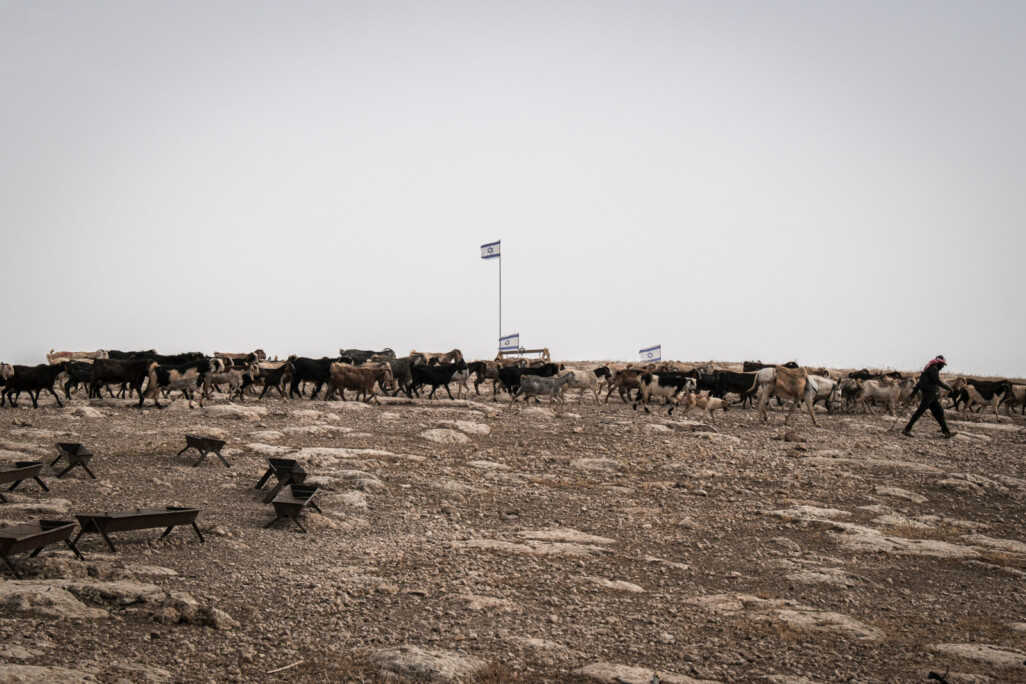
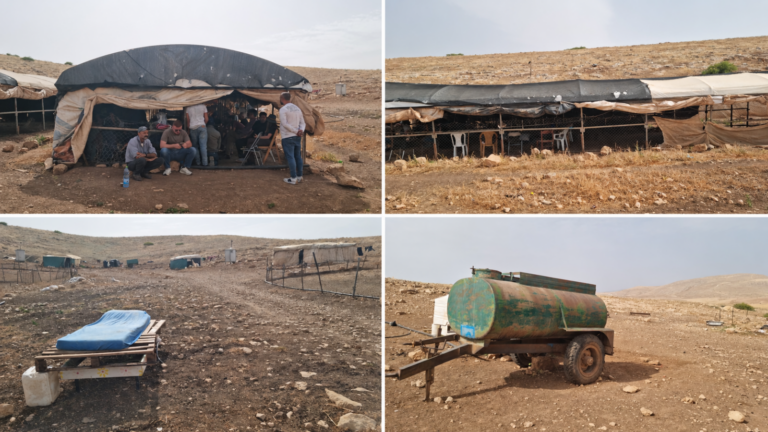
At the edge of a desert valley in the southeastern West Bank, about a bumpy half-hour drive from the nearby community, Moshav Beka'ot, lies a small encampment. It contains five sleeping tents, two grazing tents, and a large gathering tent. In the center of the encampment, under the open sky, are wooden plank beds and a mattress. On its outskirts sits a rusty tanker for drinking and bathing water, alongside a makeshift shower. This is nearly all the property of the Abu Kabash family, who resides in Wadi Humsa–a vast, sparsely populated desert expanse where they claim to have been grazing their flocks for at least twenty years.
About two kilometers away stand three caravans with an Israeli flag flying above them. This past March, to the sound of barking dogs, a gang coming from the direction of the caravans raided the encampment in Humsa.
The riots, which according to testimonies included sexual assault and beatings to the faces of children, brought numerous international media outlets to the small Wadi (valley). The family is convinced that if the night had ended “only” with the murder of one of the men, no one would have cared. Approximately 100 additional incidents in that month alone, in which at least six Palestinians were killed, show that there is a basis for their words.
The army and police monitor Wadi Humsa around the clock from several bases located in the area, and yet, according to the family members, it took them about an hour and a half to arrive. The Judea and Samaria District Police opened an investigation, and unlike other cases, there were arrests, but an indictment has yet to be filed. A massive herd of hundreds of sheep, which was grazing in one of the most photographed and documented areas in Israel, has yet to be located.
The introduction to the story of the Abu Kabash family, and to dozens of similar cases in the central West Bank, is led by Major General (Res.) Yaakov Orr. He invites journalists, social activists, and ordinary Israelis so they can see for themselves what is happening in the region. Orr, who previously served as the commander of the Gaza Division and as the defense establishment auditor in the State Comptroller’s Office, has recently been conducting these tours every week to break through the wall of alienation. To show that despite the tendency to attribute these incidents to fringe groups and religious extremism, Israeli sovereignty, both in its presence and its absence, also plays a central role.
Another dunam and another sheep
To witness this, we drive north for about fifteen minutes, from Humsa toward Dadia, a Bedouin encampment adjacent to Moshav Ro'i, where the Basharat family lives. There, closer to the road, every day is Independence Day: Israeli flags are arranged in rows and circles at symmetrical spaces alongside unpaved paths that separate the encampment from the Israeli caravans across from it. Unlike Humsa, which lies deeper within the desert expanse, here the Israeli outpost (illegal, for now) is intentionally situated right next to the Bedouins.
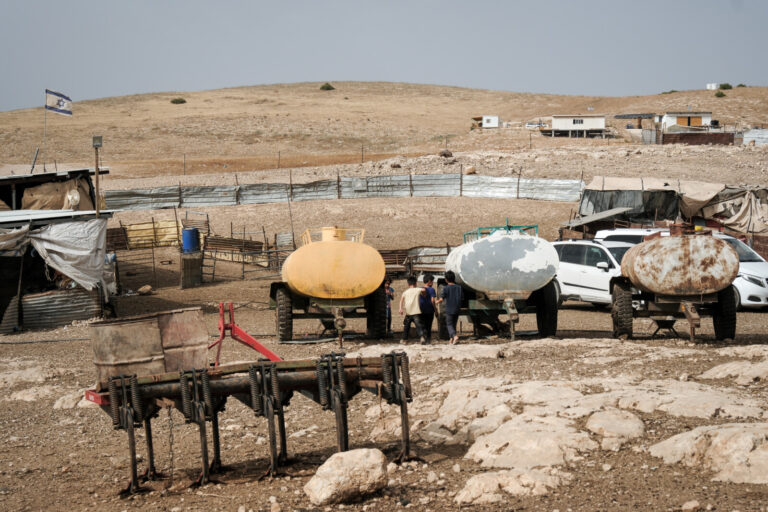
The person responsible for this massive flag enterprise is Eyal Spiegel, a 19-year-old resident of Ariel and a student at the Evyatar Yeshiva. In a video report on Kan, Spiegel claimed that “there is absolutely no difference between Tel Aviv and here,” and stated that the project's ultimate goal is to increase the sense of comfort for drivers on the West Bank roads, “so that they shall see and fear, so they understand who this land belongs to.”
However, in Dadiah, the flags do not only face the drivers on the road, they encircle the area where the Basharat family grazes their flock. The family members, who claim to have lived and grazed in the area for decades, say that if their sheep accidentally enter one of the areas marked by the flags, the caravan residents call the army, and a force arrives within minutes. According to them, these incidents frequently end in delays, arrest, or violence.
So, another dunam and another sheep, Palestinian herding communities are gradually being pushed out of the spaces where they lived and grazed toward the margins of Palestinian cities and villages in Areas A and B, where they are relatively protected from attacks by Israelis. According to UN data, approximately 30,000 Palestinians have been displaced from their homes in the West Bank in recent years.
The problem is not a shortage of land. On these vast disputed lands, entire cities could have been built, for Jews and Arabs, together or separately. In practice, direct and initiated violence against herding communities has become a significant tool in the service of the State of Israel in the struggle over Area C. This is despite the fact that the army defines it, at least in part, as terrorism and calls on its soldiers to act against it, and even right-wing figures and settlers have begun to condemn it more and more in recent months.
The Israeli flags that appear repeatedly across these zones of violence illustrate that before this injustice is religious or sectarian, it is national. Israeli citizens are harming defenseless people in territory under Israeli control, beneath the symbols of the State, in proximity to security forces, and sometimes even with their active participation. They do this not only because of their interpretation of the Torah and its commandments, but also because the state apparatus, through both its presence and its absence, provides the conditions that make it possible.
"There is the law, and there is what happens in practice"
It must be said: contrary to what might appear from afar, the number of perpetrators of this violence is not large. In most of the caravan farms shown on Major General Orr's tour, there are only two to four structures, where only a few people live, or dozens at most. The army estimates that the total number of rioters in the West Bank is one thousand people at most. If this estimate is correct, it only exacerbates the failure.
According to IDF and police data, approximately 1,550 incidents of nationalist crime were recorded during 2024–2025, about 200 of which were defined as severe. This is a type of crime with a relatively small number of perpetrators, yet its damage is immense and impacts Israeli society as a whole. With a reasonable, coordinated effort by the army, police, welfare, and other civil authorities, this situation could have been dealt with long ago.
Most Israelis, regardless of their position on the settlement enterprise or the future of the Israeli-Palestinian conflict, would not be willing to accept such a level of violence in their own communities. This is not only for moral reasons, but also for practical ones: unaddressed violence does not remain in one place.
According to the law applicable in the area, Israel is responsible for the security of all residents in Area C. Unfortunately, this responsibility is hardly ever realized, as Moatasem Odeh from the village of Qusra experienced firsthand. According to an investigation broadcast last week on Kan, Moatasem 's son, Amir Odeh, was shot and killed in March by an Israeli wearing a uniform and carrying an IDF weapon during a violent raid on the village. Moatasem himself was seriously injured in a knife attack. In his testimony he gave to the investigation, Moatasem said that he called the police several times even before the attack began, because he felt that something bad was about to happen, and they "said they were on the way, on the way, but nobody came.”
Ironically, the most concise explanation for the cause of the attacks on the Odeh, Basharat, and Abu Kabash families, and thousands of others, is actually provided by Rivka Lefair, a resident of the outpost Shomrei HaEmek (Guardians of the Valley) in the Shilo area. “There is the law, and there is what happens in practice,” Lafair said in the same investigation by Kan. By doing so, she attempted to legitimize the initiated violence, presenting it as a preemptive action that offers a security solution in the absence of a military presence. One can dispute this portrayal of things, but she is right about one thing: Israelis have already brought the flags, the roads, the weapons, and the uniforms to these spaces. Now, it is time for them to bring the law.